
















Delegation is more than just offloading tasks – it’s about giving your team ownership to make decisions and grow. Leaders who delegate effectively see 112% higher growth rates and 33% more profitability. Yet many avoid it due to fears of losing control or doubts about team capabilities.
Here’s the key: Delegating ownership, not just tasks, empowers your team to operate independently. This builds confidence, improves performance, and reduces bottlenecks. Start by identifying tasks that don’t require your unique expertise, match them to the right people, and set clear goals. Use frameworks like RACI to define roles and provide structured feedback without micromanaging. Over time, this approach creates a resilient, self-sufficient team.
Quick Takeaways:
- Delegate tasks that align with team members’ skills and growth potential.
- Define clear expectations and decision-making authority upfront.
- Support through regular check-ins but avoid micromanaging.
- Recognize achievements and reward accountability to reinforce autonomy.
Start small: Pick one task this week to delegate and set clear success criteria. Over time, this practice will transform your leadership approach by exploring top leadership development programs and empower your team to thrive.
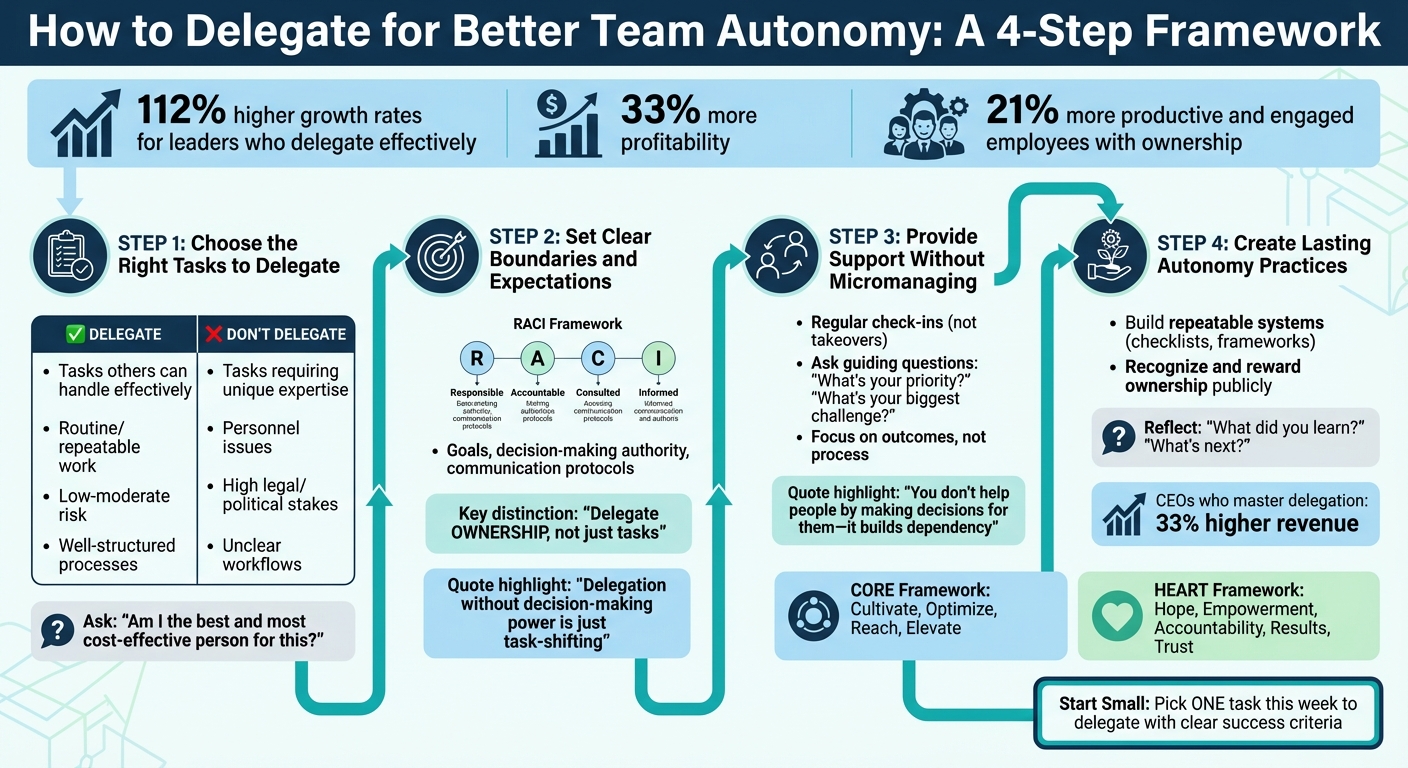
4-Step Framework for Effective Team Delegation
Step 1: Choose the Right Tasks to Delegate
What Makes a Task Suitable for Delegation
Ask yourself: "Am I the best and most cost-effective person to handle this task?" [2]. If a junior team member can complete the task effectively with the right guidance, it’s a strong candidate for delegation. This isn’t about shirking responsibilities—it’s about blending servant leadership and traditional management to focus your time and expertise where they’re most impactful.
Tasks that don’t require your unique skills, specialized knowledge, or decision-making authority are ideal for delegation [7]. Routine, repetitive work is an obvious choice, but even parts of larger, strategic projects – like drafting a section of a strategy document – can be delegated if someone else is prepared to take it on [2][5]. The goal is to align the task with the team member’s current abilities and growth potential. Delegation should stretch their capabilities without leaving them overwhelmed [1][5].
However, some tasks are better kept on your plate. Avoid delegating sensitive personnel matters, performance reviews, or decisions with significant political risk [4][5]. Passing off these responsibilities might feel like offloading unpleasant duties rather than providing a meaningful opportunity. Similarly, if the process surrounding a task is unpredictable or chaotic, fix the system first – no team member, no matter how skilled, can thrive in a poorly defined process [6].
| Delegation Criteria | Suitable for Delegation | Unsuitable for Delegation |
|---|---|---|
| Expertise | Tasks others can handle more effectively or affordably | Tasks requiring your unique skills or knowledge |
| Development | Opportunities for team learning and growth | Critical tasks with zero margin for error |
| Nature of Work | Routine, repeatable tasks | Personnel issues, performance reviews |
| Risk Level | Low to moderate risk | Tasks with high legal, regulatory, or political stakes |
| Process | Well-structured, predictable processes | Tasks with unclear or inconsistent workflows |
Once you’ve identified tasks for delegation, the next step is to align them with your team’s skills and readiness.
Assess Your Team’s Skills and Capacity
To delegate effectively, you need to match tasks to the right people. Start by evaluating your team members’ skills and capacity. Have open conversations to understand their strengths, interests, and growth aspirations [4]. These discussions will reveal not only their technical abilities but also their willingness to take on new challenges.
The sweet spot for delegation lies in balancing autonomy with skill [4]. Giving too much freedom too soon can overwhelm someone, while micromanaging experienced team members can stifle their performance. Review each person’s track record and assess whether the task’s process is reliable and predictable [6]. Even the most capable employee can falter if the system they’re working within is flawed.
Create a list of tasks and categorize them based on whether they require your expertise or can be delegated [7][2]. Then, assign tasks to team members based on their strengths and development goals. For newer employees, consider starting small – perhaps they draft a project outline while a senior team member handles the final delivery. Gradually, you can increase their level of responsibility and independence [1].
sbb-itb-5c9cdaf
Step 2: Set Clear Boundaries and Expectations
Define Goals and Decision-Making Authority
After assigning a task to the right person, the next step is to define success clearly. Ambiguity can lead to confusion and inefficiency, so it’s crucial to set specific outcomes, quality benchmarks, and deadlines upfront. As Kevin Sharer, a Harvard Business School Professor, emphasizes:
"You’ve got to have real clarity of objective… what does good look like and by what timeline, and the technique of measuring accomplishment." [5]
Start by explaining the purpose of the task to help guide independent decision-making. Then, identify what aspects are nonnegotiable and where they have the freedom to make their own choices [1]. This clarity helps prevent the uncertainty that can lead to "analysis paralysis."
However, be cautious about simply assigning tasks without granting decision-making authority. Organizational psychologist David Burkus explains:
"Delegation without decision-making power is just task-shifting. If you assign the work but hold onto every decision, then you’ve made yourself the bottleneck." [4]
To avoid this, define which decisions the team member can handle independently and which ones need your input. Establish clear communication protocols – decide what requires immediate updates, what can wait for regular check-ins, and what they can handle entirely on their own [1]. Research shows that leaders who delegate effectively experience 112% higher growth rates and 33% greater profitability compared to those who struggle with letting go of control [4].
By setting these boundaries, you create a foundation for using structured frameworks to reinforce expectations.
Use Frameworks to Clarify Expectations
Frameworks like RACI (Responsible, Accountable, Consulted, Informed) are excellent tools for eliminating ambiguity. The RACI framework assigns specific roles for decisions, ensuring everyone knows who is in charge of what [3]. Without such clarity, routine work can become bogged down in decision-making, wasting valuable leadership time and refining your leadership style [3].
Another effective approach is distinguishing between tasks and ownership. For example, assigning a task – "Complete this report by Friday" – can create dependency. On the other hand, assigning ownership – "You’re responsible for the monthly reporting process" – promotes autonomy and professional growth [4]. Lay out the desired outcome and let the individual decide how to achieve it.
Rather than hovering over every step, set up clear checkpoints [4][5]. Schedule specific progress reviews and outline what they should be prepared to present during those sessions. Leave enough time between the initial handoff and the final deadline for adjustments, but avoid the temptation to micromanage [2]. Striking this balance between guidance and independence fosters genuine team autonomy and development.
Step 3: Provide Support Without Micromanaging
Set Up Regular Check-Ins and Feedback
Once you’ve clearly delegated tasks, the next step is offering support without overstepping. Effective leaders know how to coach their team without taking over. Regular check-ins should feel like collaborative coaching sessions, not an excuse for you to jump back into the work. As Benjamin Laker, Professor of Leadership at Henley Business School, explains:
"Your role is to guide, not to reinsert yourself at the first sign of discomfort." [1]
During these sessions, create a space where team members can share their ideas and grow their confidence. Avoid the temptation to solve problems for them. Instead, steer the conversation toward goals and outcomes by asking pointed questions like, "What’s your priority?" This approach encourages critical thinking and self-reliance.
Elsbeth Johnson, Senior Lecturer at MIT Sloan School of Management, emphasizes this approach:
"You don’t help people by making the decision for them… that actually doesn’t build capability in them. It builds dependency on you." [2]
To make feedback sessions productive, standardize them with questions such as "What is your biggest challenge right now?" or "How do you plan to address it?" Focus on the end results rather than dictating the process. By defining success upfront and providing feedback on outcomes, you allow your team the freedom to determine their own methods.
This balance between support and autonomy builds confidence and fosters accountability.
Balance Guidance with Accountability
True leadership is about holding people accountable without micromanaging. Establish a timeline that includes room for multiple drafts and opportunities for learning. This approach helps prevent the urge to take back control as deadlines loom.
When mistakes happen, treat them as learning opportunities. After the task is completed, ask reflective questions like, "What support did you need but didn’t get?" or "What tasks would you like to take on next?" These discussions close the feedback loop and refine your delegation strategies moving forward.
Building trust is essential. Show your team that you’re committed to their growth. When they sense your investment in their development, they’ll be more open to feedback and more likely to take ownership of their work.
Accountability also works hand-in-hand with recognition. Celebrate successes publicly and give team members specific credit for their achievements. Highlighting their wins reinforces their sense of autonomy and motivates the entire team. As Kevin Sharer, Professor at Harvard Business School, puts it:
"You’ve got to have some way to monitor the progress along the way without me getting in your way." [5]
The goal is to create a system where your support empowers your team, helping them grow in both capability and confidence.
Step 4: Create Lasting Autonomy Practices
Build Repeatable Delegation Systems
Once tasks and boundaries are clearly defined, the next step is to make delegation a consistent part of your workflow. Delegation isn’t a one-off action – it’s a process that thrives on structure and repetition. Building reliable systems for delegation is key to fostering team trust and supporting long-term growth.
A good starting point is using routine checklists to provide context, set objectives, and outline what success looks like. This simple habit ensures no details slip through the cracks and helps eliminate bottlenecks caused by over-reliance on a single person.
Take time to evaluate which tasks can be handled by others. Focus on identifying responsibilities that don’t require your specialized expertise. Research shows that CEOs who master delegation drive 33% higher revenue by adhering to this practice consistently [2][5]. Moreover, linking delegation skills to leadership development creates a pipeline of capable team members, signaling that nurturing others’ growth is non-negotiable.
The CORE framework – Cultivate, Optimize, Reach, Elevate – offers a structured way to embed delegation into your leadership style. By building trust through open communication and processes, streamlining workflows, setting clear goals, and enhancing team capabilities, leaders can create a balance between emotional intelligence and operational efficiency. This approach helps ensure that delegation is not only effective but also scalable.
Recognize and Reward Ownership
As your delegation systems take hold, reinforcing accountability through recognition becomes crucial. When team members step up and deliver results, take the time to celebrate their achievements. Publicly acknowledging these wins – whether in team meetings, company-wide updates, or one-on-one conversations – encourages others to embrace ownership. As Patrick Mullane, Executive Director at HBS Online, explains:
"It’s counter-intuitive, but not claiming success for yourself will lead to more future wins" [5].
Recognition doesn’t stop at praise. Reward team members who excel with greater autonomy. Let them lead mini-projects, spearhead task forces, or dedicate time to self-directed initiatives. Studies show that employees who feel ownership over their work are 21% more productive and engaged [9]. Additionally, connect tangible rewards – such as bonuses, promotions, or career development opportunities – to consistent performance and accountability [8][10].
To close the loop, incorporate structured reflection after tasks are completed. Ask questions like, “What did you learn?” or “What would you like to take on next time?” [2][4]. These conversations not only build trust but also refine your delegation approach over time. By combining recognition with reflection, you can embed autonomy into the fabric of your team’s culture.
Avoid These Mistakes When Delegating to Your Team
Conclusion: Transform Your Leadership Through Delegation
Delegation is more than just a way to manage workload – it’s a strategy for growth that reshapes leaders and empowers teams. By moving beyond simply assigning tasks to truly granting ownership, you create an environment where capacity, confidence, and independence can flourish. And research backs this up.
To put delegation into action, focus on tasks that encourage growth. Clearly define boundaries to provide direction without stifling creativity. Offer consistent support through check-ins, but steer clear of micromanaging. Build systems that make delegation a repeatable process, and acknowledge those who rise to the challenge of greater responsibility.
As Benjamin Laker, Professor of Leadership at the University of Reading, explains:
"The most effective leaders today aren’t the ones who do it all. They’re the ones who build others who can" [1].
The HEART framework – Hope, Empowerment, Accountability, Results, Trust – serves as a practical guide for this transformation. By inspiring hope in your team’s potential, empowering them with real authority, holding them accountable with constructive support, prioritizing impactful results, and building trust through consistency, delegation evolves from a simple leadership tool into the cornerstone of a thriving, resilient team culture.
Start small. This week, take a moment to review your workload and choose one task to delegate. Set clear success criteria, establish checkpoints, and give your team the authority to take the lead. Over time, these deliberate acts of trust will build a team capable of excelling with minimal oversight – a true hallmark of exceptional leadership.
FAQs
How do I decide what to delegate first?
Start by pinpointing tasks that don’t demand your specific expertise. This frees you up to concentrate on high-impact priorities. Hand off time-consuming duties or those causing delays, and focus on responsibilities that not only advance your goals but also help your team grow and build confidence. Delegating effectively encourages independence, strengthens trust, and aligns with HEARTnomics™ principles by empowering your team, improving decision-making, and fueling organizational progress.
What decisions should I let my team make on their own?
Delegating decisions effectively means aligning them with your team’s expertise and responsibilities. Let them take ownership of tasks such as determining how to approach their work, solving problems within their domain, and making day-to-day operational choices. To ensure this works smoothly, set clear expectations, outline measurable success criteria, and define the boundaries for decision-making. This approach not only builds trust and autonomy but also helps your team grow in confidence and capability.
How do I check progress without micromanaging?
To keep track of progress without hovering over every detail, start by establishing clear expectations and defining success metrics from the beginning. Instead of constantly checking in, rely on structured updates like regular progress reports or scheduled check-ins. This approach helps maintain oversight without being overbearing.
Building trust is key – when your team feels trusted, they’re more likely to take ownership of their work. Offering opportunities for growth and development further reinforces accountability. By consistently reviewing outcomes against the agreed metrics, you can stay informed while giving your team the freedom to manage their responsibilities effectively.