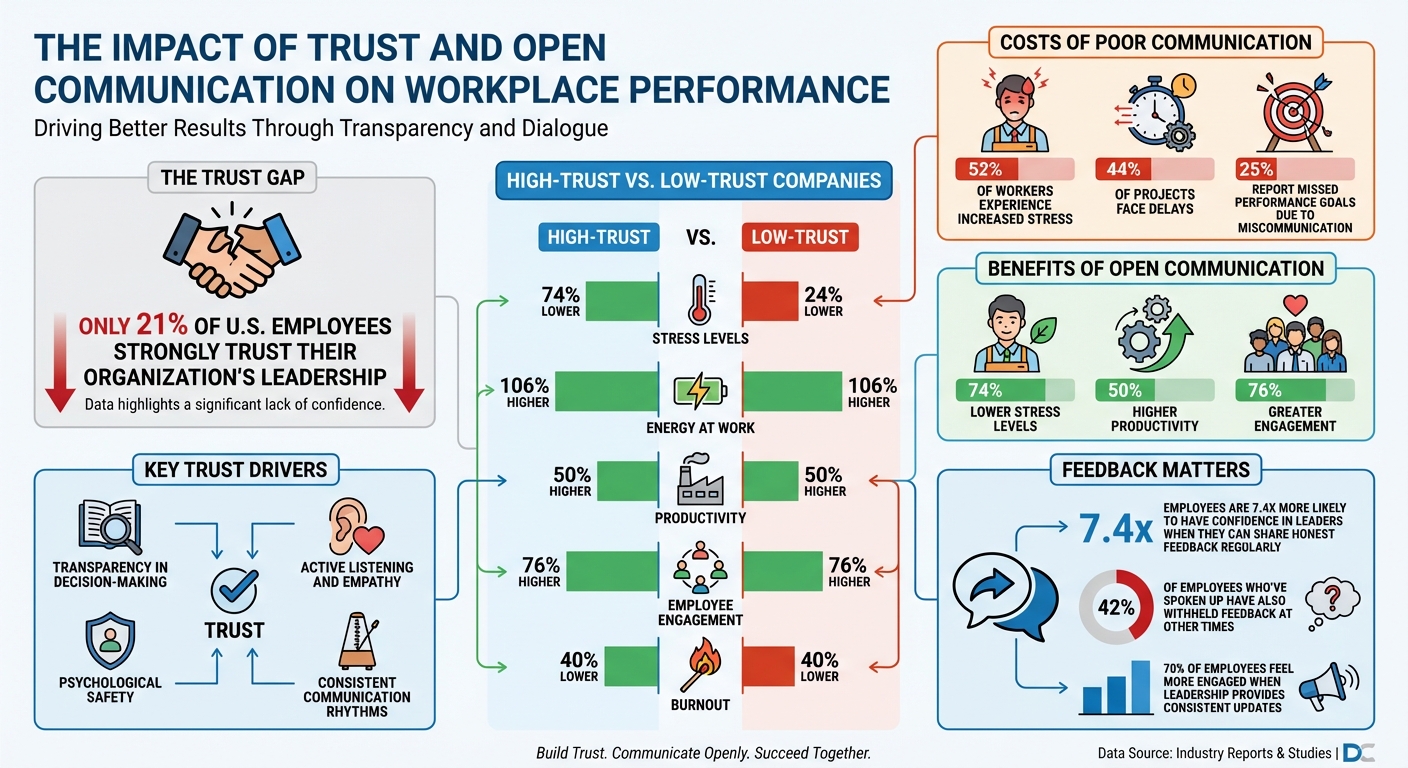
Trust is the backbone of leadership development programs and team collaboration. Yet, only 21% of U.S. employees strongly trust their organization’s leadership styles, highlighting a major disconnect. Poor communication leads to stress for 52% of workers and delays in 44% of projects. On the other hand, workplaces with open communication see 74% lower stress, 50% higher productivity, and 76% greater engagement.
To build trust through communication, focus on these key strategies:
- Be transparent: Share both successes and challenges, explaining the "why" behind decisions.
- Listen actively: Engage fully, ask open-ended questions, and create space for honest feedback.
- Foster safety: Encourage open dialogue without fear of judgment or retaliation.
- Use consistent communication rhythms: Regular updates, one-on-ones, and team meetings keep everyone informed and aligned.
These approaches, combined with actionable systems like anonymous surveys and clear feedback loops, can transform communication into a trust-building tool. Start with small changes today, like scheduling regular touchpoints or inviting candid feedback, to create a workplace where trust and open communication thrive.
The Impact of Trust and Open Communication on Workplace Performance
How to Build Trust Through Honest Communication | 5 Proven Strategies
sbb-itb-5c9cdaf
Why Trust and Open Communication Work Together
Trust and open communication go hand in hand, creating a dynamic where one strengthens the other. When leaders and teams share openly, employees feel valued, which deepens trust. This cycle – honest communication fostering respect, which then encourages more openness – becomes a powerful force for collaboration and connection [3][5]. It also naturally nurtures an atmosphere of psychological safety.
Trust plays a key role in establishing psychological safety – the sense that you can voice ideas, ask questions, or admit mistakes without fear of judgment or punishment [3][5]. Without this safety, employees tend to hold back, keeping information to themselves, guarding resources, or engaging in office politics. These behaviors not only slow down decision-making but also hinder teamwork [5]. A telling statistic: 42% of employees who’ve spoken up about workplace issues admit they’ve withheld feedback at other times, often out of fear of repercussions or feeling their input wouldn’t matter [3].
"Underlying our willingness to converse openly at work is a solid foundation of trust in the organization and the entire work environment." – Lauren Rice, Qualtrics [3]
The benefits of combining trust with open communication are undeniable. In high-trust companies, employees experience 74% less stress, 106% more energy, 50% higher productivity, 76% greater engagement, and 40% less burnout compared to those in low-trust environments [5].
| Benefit of High-Trust Communication | Impact Compared to Low-Trust Companies |
|---|---|
| Stress Levels | 74% Lower |
| Energy at Work | 106% Higher |
| Productivity | 50% Higher |
| Employee Engagement | 76% Higher |
| Burnout | 40% Lower |
It’s not just about how much information is shared – it’s also about its quality. Studies reveal that accuracy and relevance of information are the strongest factors in building trust with coworkers and supervisors. Meanwhile, adequacy and completeness of information are more critical for fostering trust in senior leadership [6]. In short, clear and thorough communication doesn’t just keep people informed – it cements trust, laying the foundation for an open and collaborative workplace.
How to Assess Your Team’s Trust and Communication
Understanding the current levels of trust within your team is crucial to fostering open and effective communication across your organization. Trust isn’t just about words – it’s reflected in actions, attitudes, and behaviors. By examining your team’s communication climate, you can uncover areas where trust thrives and where it needs attention.
Use Surveys to Measure Trust
Anonymous surveys are a powerful tool for gathering honest feedback. When employees can voice their thoughts without fear of being identified, they’re more likely to provide truthful insights. Interestingly, when employees feel safe sharing honest feedback, confidence in leadership increases by 7.4 times. Yet, only 21% of U.S. employees report having strong trust in their leadership [4].
Your surveys should focus on key trust drivers, such as whether leaders communicate a clear vision, inspire confidence in the organization’s future, and support employees during times of change. These topics are central to my leadership keynotes. Understanding your leadership communication style is the first step in addressing these challenges. For example, in 2022, only 22% of employees believed their leaders had a clear plan – down from 55% in 2020 [4]. Regular pulse surveys can help you spot these shifts quickly, rather than waiting for an annual review. Include questions that assess whether employees feel informed about business updates and decisions or if they often feel left in the dark [3]. To close the loop, acknowledge the survey results and take meaningful action based on the feedback.
Identify Behavioral Warning Signs
Trust issues often show up in behaviors before they become visible in survey data. For instance, if meetings are dominated by a few voices while others stay silent, it may indicate that employees don’t feel safe speaking up. Other warning signs include information hoarding, office politics, and an avoidance of difficult conversations [3][5].
Pay attention to feedback trends. A concerning 42% of employees who have raised work-related issues admit to withholding feedback at other times, often due to fear of consequences or believing their input won’t matter [3]. High turnover rates, especially in specific departments, can also point to trust problems. Even subtle cues like folded arms, lack of eye contact, or disengaged body language during discussions can signal discomfort or a lack of openness [3].
| Warning Sign | What It Looks Like | Impact |
|---|---|---|
| Silence | No questions or dissent in meetings | Stifled innovation; hidden risks |
| Defensiveness | Resisting feedback; shifting blame for mistakes | Lack of accountability; repeated errors |
| Disengagement | Minimal effort; low morale | Reduced productivity |
| Confusion | Frequent clarification requests; missed deadlines | 44% project failure rate [3] |
These individual behaviors often reflect broader trust issues within the organization.
Review Your Feedback Channels
Take a close look at your communication platforms – whether it’s Slack, email, video calls, or suggestion boxes. Are they being used effectively? A lack of negative feedback doesn’t necessarily mean everything is fine; it could indicate that employees are afraid to speak up. Check if remote employees feel as included as those in the office, and ensure that your channels encourage participation and responsiveness [3]. Ideas that go unacknowledged discourage employees from sharing in the future.
"Trust begins with having effective and supportive two-way conversations with followers, not with having all the answers." – Denise McLain, Senior Strategic Consultant, Gallup [4]
Evaluate whether your communication is clear and consistent. Inconsistent or sporadic messaging can leave employees blindsided, lowering engagement and trust [3]. The statistics are telling: 52% of employees say poor communication increases their stress levels, and 25% report that miscommunication has directly caused missed performance goals [3].
Communication Strategies That Build Trust
To strengthen trust within your team, it’s essential to focus on communication strategies that address any existing gaps. These practical approaches can help leaders foster open and honest relationships with their teams.
Be Transparent and Honest
Being transparent means sharing both the wins and the challenges. When decisions are made, explain the reasoning behind them. For example, let your team know why a deadline was set, why a particular person was chosen for a project, or why certain budget cuts had to happen. Providing this context ensures your team understands the "why" behind decisions, rather than feeling left in the dark [2][4].
Honesty also involves being vulnerable. If you make a mistake, own up to it. Share what went wrong, what you’ve learned, and how you plan to avoid similar issues in the future [3]. Former Starbucks CEO Howard Schultz summed it up perfectly:
"I think the currency of leadership is transparency. You’ve got to be truthful" [2].
Clear communication builds confidence and supports change. For instance, sharing Objectives and Key Results (OKRs) across the organization aligns everyone with the broader goals and fosters accountability [3]. When communicating decisions, provide updates that are easy to follow and demonstrate your strategic thinking. Even on tough topics like compensation or layoffs, transparency matters. Research shows that 60% of employees want companies to be upfront about actions taken to prevent layoffs, while 56% want clarity on why certain roles were cut [2].
Practice Active Listening and Empathy
Active listening means more than just hearing words – it’s about fully engaging in the conversation. Start by removing distractions: put away your phone, close your laptop, and choose a quiet space for meaningful discussions.
Try the "pause and repeat" technique: before replying, take a moment to gather your thoughts and summarize what the other person said to confirm your understanding. Ask open-ended questions like, "What challenges are you facing with this project?" or "How do you think we should address this?" [1]. Use non-verbal cues, such as nodding or maintaining eye contact, to show you’re actively engaged, and allow pauses so others can process and respond at their own pace.
Regular one-on-one meetings are another great way to build connections and show your commitment to understanding your team [2]. During these conversations, encourage team members to share their ideas before offering your own solutions. Additionally, knowing whether your natural listening style is more analytical or relational can help you tailor your approach to different situations. You can also identify your leadership style to better understand how you communicate with others.
Create Safe Spaces for Feedback
Creating psychological safety means fostering an environment where team members feel comfortable sharing ideas, questioning assumptions, and voicing concerns without fear of judgment or retaliation. This starts with welcoming differing opinions and showing that it’s okay to challenge the status quo [3].
Establish clear ground rules for discussions: use respectful language, avoid interruptions, and assume positive intent. These guidelines encourage open dialogue [1].
For those who may hesitate to speak up, anonymous options like suggestion boxes or surveys can help lower barriers [1][3]. Another approach is the "round-robin" method in meetings, which ensures everyone has a chance to contribute, preventing louder voices from overshadowing quieter ones [1][3].
Always acknowledge feedback, even if immediate action isn’t possible, and model openness by asking for candid feedback on your own performance. This shows that growth is a two-way street [3]. The impact is clear: employees are 7.4 times more likely to have confidence in leaders when they regularly have opportunities to share honest feedback [4].
How to Embed Open Communication into Your Organization
Building open, honest communication into daily operations is a cornerstone for fostering trust that lasts, a core focus of Heartnomics consulting services. The following strategies expand on earlier discussions about assessing trust and encouraging proactive communication.
Set Up Regular Communication Rhythms
Consistency is key to keeping dialogue flowing and addressing issues before they escalate. Schedule regular meetings, such as weekly one-on-ones, bi-weekly team discussions, and quarterly town halls. These meetings create predictable opportunities for everyone to share updates and concerns. During team meetings, use structured turn-taking to ensure quieter team members have a chance to speak, preventing louder voices from dominating the conversation [1][3].
Also, include regular business updates that cover financial performance, organizational changes, and new hires. Studies reveal that 70% of employees feel more engaged when leadership provides consistent updates on company strategy and decision-making [8][9].
Build Two-Way Feedback Systems
Open dialogue thrives when feedback flows in both directions. Create formal systems that encourage team members at all levels to share their thoughts. For example, RACI mapping (Responsible, Accountable, Consulted, and Informed) can clarify who needs to be involved or informed about specific projects, reducing the risk of miscommunication [3].
Some companies are already leading the way in transparency. In early 2024, Asana began sharing board meeting minutes with all employees, offering a clear view of strategic priorities and fostering trust in leadership decisions [7]. Similarly, Reaktor, a Finnish software consultancy, uses an online forum where employees can discuss and influence organizational policies and decisions [7].
The critical step is closing the feedback loop. When employees provide input, acknowledge it and communicate how their suggestions have been considered – even if not every idea is implemented.
Increase Transparency in Decision-Making
Transparency in decision-making means explaining not just what decisions were made, but also why and how. Providing this context helps employees see how their work fits into broader organizational goals.
Use tools like Objectives and Key Results (OKRs) to align tasks with measurable outcomes. Goal alignment software can ensure every task connects to a larger objective and has a clear owner [3].
You might also explore a "give to get" data model, where employees voluntarily share information in exchange for benefits like personalized coaching or career development opportunities [7]. For instance, MetLife uses AI tools to analyze call center interactions, not for punitive purposes but to provide real-time coaching that helps employees improve their emotional tone and effectiveness [7].
When rolling out unpopular policies, address concerns head-on. Communicate the reasons for the change immediately to prevent misinformation from spreading. As Deloitte puts it:
"Transparency – defined as an employer using straightforward and plain language to share information, motives, and decisions that matter to workers – is a key dimension of trust" [7].
Finally, strike a balance between openness and privacy. Focus on transparency that promotes accountability, avoiding practices that feel invasive or erode trust. This approach transforms everyday communication into a foundation for trust and clarity across the organization.
Using HEARTnomics™ Principles to Build Trust
HEARTnomics™ introduces a unique framework that blends emotional intelligence with operational strategies, offering a structured way to build trust through effective communication. Unlike one-size-fits-all leadership models, this system incorporates five essential principles – Hope, Empowerment, Accountability, Results, and Trust – into everyday practices. Together, these elements reshape how leaders connect with their teams and deliver measurable outcomes. Let’s break down how each principle can redefine your communication approach.
Apply HEARTnomics™ to Your Communication
The HEART framework strengthens trust by embedding specific communication strategies into each principle. Hope involves sharing a clear vision and simplifying complex transitions into manageable steps. This clarity reassures teams and fosters confidence during periods of change [4].
Empowerment happens when employees are given both the knowledge and authority to make decisions effectively. It’s about explaining not just the "how" but also the "why" behind decisions. Accountability thrives when roles and expectations are transparent. When employees clearly understand their responsibilities, they’re more likely to hold themselves accountable and remain open to constructive feedback [1][2].
Results become more tangible when objectives and key results (OKRs) are visible across the organization. This visibility connects individual contributions to broader organizational achievements [3]. Finally, Trust is the bedrock of this framework – built through consistent transparency, reliability, and authenticity in every interaction. Transparency remains the cornerstone of effective leadership [2].
Scale Communication Excellence Across Teams
HEARTnomics™ also introduces frameworks like BEAT (Believe, Engage, Act, Transform) and CORE (Cultivate, Optimize, Reach, Elevate) to scale trust-building communication practices. These systems ensure that communication quality doesn’t rely solely on individual leaders but becomes a repeatable process across all levels of the organization.
Empowering managers to act as communication ambassadors is key. Since trust often falters at the manager level, equipping them with structured tools – like RACI mapping – helps eliminate information gaps and ensures clarity [4][3]. Structured communication tools create consistency, making it easier for teams to stay aligned.
Establishing regular communication routines, such as weekly one-on-ones, bi-weekly team meetings, and quarterly town halls, provides predictable opportunities for open dialogue. These routines turn communication into a habitual practice rather than an occasional effort, aligning it with the organization’s broader trust-building objectives.
Connect Communication to Measurable Results
To ensure continuous improvement, organizations can track the impact of communication on trust-building efforts. Anonymous employee surveys, for instance, can reveal trust levels and pinpoint communication breakdowns. HEARTnomics™ principles tie these insights to actionable improvements, showing how hope, empowerment, accountability, results, and trust directly influence performance.
The benefits of improved communication are clear: companies with high trust levels report lower stress, increased energy, higher productivity, and reduced burnout compared to their low-trust counterparts [5]. On the flip side, poor communication leads to tangible costs, including heightened stress, failed projects, and missed goals [3]. By adopting the HEARTnomics™ frameworks, organizations can monitor these metrics and demonstrate how enhanced communication drives trust and delivers real business results.
Conclusion
Using the proven strategies and HEARTnomics™ frameworks, the key is to weave these methods into every interaction. Trust isn’t built overnight – it’s earned through deliberate, consistent communication that respects and engages employees. Although there’s still a noticeable trust gap [4], leaders have the power to close it by stepping beyond occasional town halls or polished corporate statements.
Trust flourishes when leaders own up to mistakes, communicate openly – good news or bad – and genuinely invite feedback. Transparency is the cornerstone of leadership. Being truthful in every interaction fosters credibility. When combined with structured communication routines and a clear sense of accountability, this approach can reshape an organization’s culture from within.
The HEARTnomics™ frameworks – HEART, BEAT, and CORE – provide a practical, repeatable system for embedding trust-building habits into leadership practices and organizational processes. By aligning emotional intelligence with operational discipline, these principles can turn communication into a strategic advantage.
Start with one small but impactful change today. Set up a consistent communication rhythm, actively listen during your next one-on-one, or publicly share your team’s Objectives and Key Results (OKRs) to enhance transparency. Each step creates momentum toward a workplace where open communication and trust become the foundation for lasting performance and growth. This ongoing dedication to honest conversations is what drives enduring trust and meaningful progress.
FAQs
What’s the best way for leaders to measure trust within their team?
Leaders can gauge trust within their teams by using anonymous pulse surveys. These surveys should focus on key questions, such as whether team members feel safe sharing ideas, trust leaders to keep their promises, and perceive communication as open and clear. This approach provides a quick snapshot of trust levels and, when conducted regularly, helps track changes over time.
Another valuable tool is 360-degree feedback, where peers and direct reports assess trust-related behaviors. This method offers a broader view of how trust is experienced across the team. Additionally, behavioral indicators – like turnover rates, participation in team projects, and willingness to share ideas during meetings – serve as useful ways to validate survey findings.
To take this a step further, HEARTnomics™ offers its Trust-Pulse Dashboard, which integrates survey results, feedback, and engagement metrics into a comprehensive Trust Index. This tool allows leaders to monitor progress, set actionable goals, and strengthen trust while maintaining team confidentiality. Pairing these data-driven insights with open conversations – such as town halls or team debriefs – ensures that trust-building efforts truly reflect the team’s experiences and lead to meaningful improvements.
What are the signs of poor communication in the workplace?
A workplace without open communication often reveals itself in some noticeable ways. For instance, employees might hold back from sharing their ideas or concerns, believing their feedback will either be ignored or dismissed. This can lead to a workplace atmosphere where team members feel undervalued and disconnected, ultimately breaking down trust within the team.
Another red flag is when employees feel that key information – whether about decisions, challenges, or performance – is being withheld. This lack of openness can make people hesitant to ask questions or offer input, fearing judgment or negative repercussions. Over time, this secrecy can weaken confidence in leadership and create obstacles to teamwork and progress.
If employees voice that they’re being left out of important discussions or decision-making processes, it’s a strong sign that open communication isn’t being prioritized. To address these challenges, organizations need to take deliberate steps to build trust, promote open dialogue, and maintain transparency at every level.
How can organizations maintain clear and consistent communication for remote and in-office teams?
Creating effective communication between remote and in-office teams starts with a unified strategy. A good first step? Use a single, easily accessible platform as your go-to hub for updates, meeting notes, and project documents. This way, everyone – no matter where they are – has access to the same information at the same time. To keep everyone on the same page, schedule regular meetings with clear agendas. Live-stream these meetings and record them, so team members can join live or review the content later.
To avoid confusion, establish consistent communication practices. Use standardized naming conventions, templates, and a clear, uniform tone across all channels. Quick feedback tools like polls or reaction features can also help ensure everyone is engaged and on the same wavelength.
The HEARTnomics™ HEART framework – centered on Hope, Empowerment, Accountability, Results, and Trust – takes this a step further. By promoting transparency, encouraging questions, and holding team members accountable, this framework reinforces trust and collaboration. When paired with dependable tools and a steady communication cadence, it ensures every team member feels informed, aligned, and valued – whether they’re working remotely or on-site.