Balancing empathy and performance is one of the biggest challenges leaders face today. Too much focus on results can lead to burnout and disengagement, while excessive empathy risks missed goals and stagnant growth. Research shows only 9% of organizations excel at balancing these priorities, but those that do see better profitability, resilience, and employee retention.
Key takeaways:
- Empathy builds trust and motivates employees, but without accountability, it can erode standards.
- Performance-driven leadership achieves short-term results but can cause high turnover and low engagement.
- Balanced leadership – combining empathy with clear expectations – leads to long-term success.
The solution? Leaders must pair compassionate support with firm accountability. Strategies like setting clear expectations, fostering psychological safety, and using data-driven feedback can help. The HEARTnomics™ framework (Hope, Empowerment, Accountability, Results, Trust) offers a practical way to achieve this balance, ensuring teams feel valued while meeting goals.
Empathy isn’t about being "soft." It’s about understanding your team’s needs and driving results together. Leaders who master this balance create environments where people thrive – and so do business outcomes.
How to Balance Empathy & Accountability as a Leader
To see how you currently measure up, you can Unlock Your HEART Leadership Code™ and identify your specific growth areas.
Empathy Without Performance: What Goes Wrong
When leaders lean too much on empathy without reinforcing accountability, they risk creating confusion that undermines team performance. Instead of fostering a more engaged and productive workplace, this imbalance often leads to eroded standards, missed deadlines, and stagnant growth. By blurring expectations, leaders inadvertently set the stage for operational setbacks.
Lower Standards and Missed Deadlines
Excessive empathy can lead to over-leniency. When managers prioritize employee emotions over achieving targets, they tend to avoid difficult conversations, which weakens accountability [4]. Interestingly, research reveals that leaders who display an excess of empathy – about 8% of all leaders – can harm productivity more than those who lack empathy altogether [1].
Assertive leadership is critical for maintaining urgency, setting clear expectations, and driving results. Without it, teams often falter when faced with disruptions or shifting priorities [1]. Leaders who focus solely on being supportive, without also demanding performance, create environments where tough decisions are avoided, and revenue targets are harder to meet [1].
Teams That Stop Growing
Unchecked empathy doesn’t just affect deadlines – it also stifles the innovation and growth teams need to thrive. Without clear performance metrics and goals, employees lose motivation to push boundaries or challenge the status quo [7]. Growth depends on a balance of "soft" factors like engagement and wellbeing with "hard" drivers like accountability and results tracking [5]. Without this balance, progress stalls.
Leaders themselves can suffer from empathy burnout when they become overly involved in their team members’ challenges. This type of burnout can derail strategic thinking and slow overall progress [7]. While compassion is often well-intentioned, if it leads to softened expectations, it may be interpreted as a lack of commitment to professional development [7]. As Scion Executive Search aptly puts it:
"Empathy in the executive seat isn’t about being agreeable or soft-spoken; it’s about being deeply attuned to the people who power the organization." [6]
The numbers speak for themselves: only 9% of companies manage to strike the right balance between focusing on performance and prioritizing people [1]. The rest either push too hard or care too much, and both extremes prevent teams from reaching their full potential.
Performance Without Empathy: What Goes Wrong
Let’s take a closer look at what happens when empathy is left out of the equation entirely. Leaders who focus solely on hitting targets may create an illusion of productivity, but it’s a short-lived success. The pandemic shifted this dynamic in a big way. Before 2020, some leaders managed to drive results without prioritizing empathy. But research tracking over 5,000 U.S.-based managers and executives shows that, since the onset of COVID-19, a lack of empathy has consistently hurt productivity[2]. At the same time, the link between empathetic leadership and employee engagement became stronger, jumping from a correlation of 0.30 in 2019 to 0.46 in 2020[1]. Ignoring empathy doesn’t just create an imbalance – it fuels disengagement and turnover.
High Turnover and Low Engagement
A culture that puts performance above people burns employees out quickly and erodes long-term results. Right now, employee engagement has dropped to just 32%, while 17% of workers are actively disengaged[9]. When employees feel like they’re just numbers on a spreadsheet, they either keep their heads down or head for the door[3]. Exhaustion and alienation set in when leaders fail to show empathy[1]. This creates a vicious cycle: burnout rises, engagement falls, and retaining top talent becomes nearly impossible – even during times of economic uncertainty[8].
Organizations that ignore these warning signs often struggle to bounce back during periods of disruption. They experience deeper performance declines compared to companies that strike a balance between focusing on results and supporting their people[1]. In 2022, 35% of leaders were rated by their teams as showing "too little" empathy[1]. This gap doesn’t just lead to higher turnover. It also undermines collaboration – the very foundation of innovation.
Diminished Collaboration and Innovation
The fallout from a performance-only mindset doesn’t stop at losing employees – it extends to losing the creativity and ideas those employees could have brought to the table. When workers feel unsafe taking risks or making mistakes, they stop sharing new ideas[10]. In fact, 30% of information workers say weak collaboration is a major barrier to maintaining innovation[11]. For innovation to thrive, teams need more than confidence in each other’s abilities (cognitive trust); they need to feel genuine care and support (affective trust)[10][13]. Without empathy, teams often become siloed, with departments competing against one another instead of working together[12].
A stark example of this was seen at the Paris Olympics in August 2024, when the U.S. Men’s Olympic 4×100 Meter Relay Team was disqualified. Despite having some of the fastest individual sprinters in the world, the team failed due to poor baton exchanges – a direct consequence of prioritizing individual performance over teamwork and coordination[10].
The connection between empathy and innovation is undeniable. Seventy-eight percent of workers say innovation boosts their engagement[11]. But when empathy is absent, engagement plummets, and innovation stalls. This creates a downward spiral that’s tough to break. While focusing on performance might help meet short-term goals, it comes at the expense of the collaboration and creativity needed for sustainable success. Without empathy, even the most high-performing teams risk falling apart in the long run.
Empathy vs. Performance: Side-by-Side Comparison
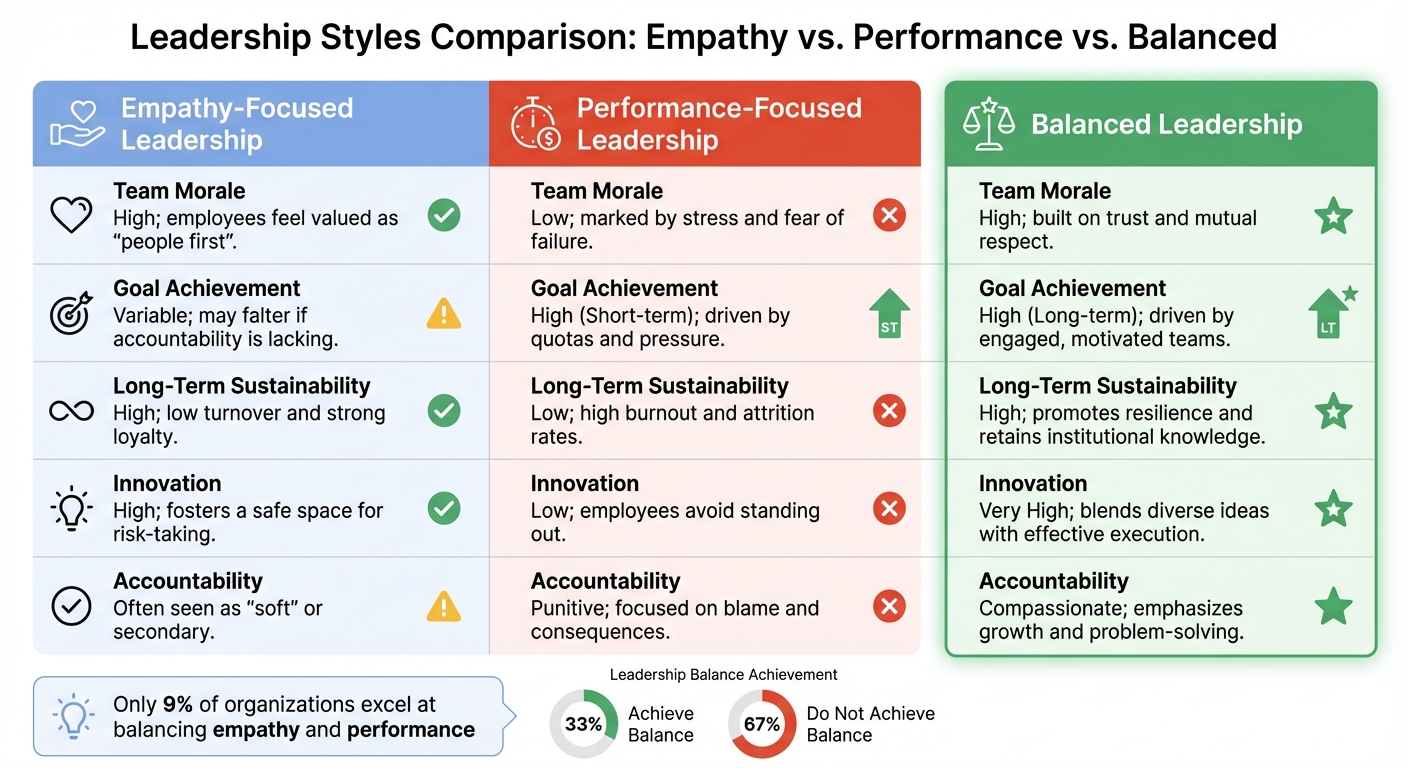
Empathy vs Performance Leadership Styles Comparison Chart
Striking the right balance between empathy and performance is essential for effective leadership. A well-rounded approach brings lasting success, but comparing these leadership styles reveals their unique impacts. Research highlights two primary leadership pathways: emotional (empathy-driven) and mental (performance-driven) [15]. Both play a crucial role in shaping how leadership is perceived, yet many leaders lean too heavily on one side, often to the detriment of team outcomes.
Empathy-driven leaders foster trust and create environments where employees feel safe admitting mistakes rather than hiding them [16]. This openness can fuel innovation. In fact, 85% of employees say empathetic leadership encourages innovation, and 81% believe it directly boosts company revenue [14]. On the other hand, performance-focused leaders often rely on authority and punitive measures, such as formal reprimands. While this approach might deliver short-term results, it can discourage honest feedback and create a tense work atmosphere [16]. These contrasting methods profoundly shape team dynamics and influence long-term success.
Balanced leadership – where empathy and performance coexist – remains rare but highly effective. Companies with such leaders consistently outperform competitors in profitability, adaptability, and resilience during challenging times [1]. Between 2019 and 2022, the percentage of leaders achieving this balance rose slightly from 28% to 33%, leaving two-thirds still struggling to find equilibrium [1]. The table below provides a clear comparison of these leadership styles.
Comparison Table: Empathy vs. Performance
| Metric | Empathy-Focused Leadership | Performance-Focused Leadership | Balanced Leadership |
|---|---|---|---|
| Team Morale | High; employees feel valued as "people first" | Low; marked by stress and fear of failure | High; built on trust and mutual respect |
| Goal Achievement | Variable; may falter if accountability is lacking | High (Short-term); driven by quotas and pressure | High (Long-term); driven by engaged, motivated teams |
| Long-Term Sustainability | High; low turnover and strong loyalty | Low; high burnout and attrition rates | High; promotes resilience and retains institutional knowledge |
| Innovation | High; fosters a safe space for risk-taking | Low; employees avoid standing out | Very High; blends diverse ideas with effective execution |
| Accountability | Often seen as "soft" or secondary | Punitive; focused on blame and consequences | Compassionate; emphasizes growth and problem-solving |
This comparison underscores the importance of blending empathy with performance to build stronger, more resilient teams and achieve lasting success.
sbb-itb-5c9cdaf
How to Balance Empathy and Performance
Balancing empathy with performance means finding a way to prioritize both without sacrificing one for the other. Leaders who excel at this "both/and" approach consistently achieve better outcomes compared to those who lean too heavily toward one side. Below are practical strategies to help leaders navigate this balance effectively.
At the heart of this concept is what researchers call "versatility" – the ability to combine assertive behaviors (like driving results and creating urgency) with supportive behaviors (like showing empathy and offering help) [1]. This isn’t just a feel-good trait; it’s a critical leadership skill that directly influences organizational success. As Dave Ulrich, a prominent HR expert, explains:
"The ability to manage paradoxes is the most important leadership competency today." [1]
Here’s how leaders can integrate empathy into performance-driven environments.
Set Clear Expectations with Compassionate Feedback
A great starting point is to pair clear expectations with compassionate feedback. Strong leaders maintain high standards while showing genuine care for their team members. This "tough love" approach ensures accountability without compromising support [1]. It’s about being firm on goals but flexible in providing the tools and encouragement employees need to achieve them.
When setting performance goals, explain the reasoning behind them and connect individual tasks to the organization’s larger purpose. This helps employees see the importance of their work within the bigger picture [1][3]. As Matt Breitfelder, Head of Human Capital at Apollo Global Management, puts it:
"On the most fundamental level, leadership is about empathy, and understanding what that particular person needs to unlock their full potential and performance." [1]
Empathy can also serve as a problem-solving tool. If someone is falling short of expectations, take the time to identify the root cause – whether it’s a lack of resources, unclear objectives, or personal challenges – and provide targeted solutions. This approach not only boosts performance but also supports emotional well-being.
Build Psychological Safety While Driving Results
Psychological safety doesn’t mean lowering standards. Instead, it’s about creating an environment where team members feel secure enough to take risks, share ideas, and collaborate openly. This sense of safety fosters innovation and better results [1]. In fact, the link between empathetic leadership and employee engagement strengthened significantly, rising from .30 in 2019 to .46 in 2020 [1].
Even under pressure, leaders must focus on people-centered activities to maintain trust and engagement [1]. For example, combining assertive behaviors like setting tight deadlines with supportive actions like offering flexibility and resources ensures both high performance and a positive team dynamic.
Use Data-Driven Accountability
Data can be a powerful tool for balancing empathy and performance. Tools like 360-degree feedback and engagement surveys can help leaders gauge whether they’re offering the right level of empathy – neither too much nor too little [1]. Interestingly, research shows that excessive empathy can sometimes hinder productivity more than a lack of it [2]. The key is finding the right balance for your team and the situation.
Monitoring both engagement and performance metrics helps leaders catch early signs of burnout while keeping goals on track [1]. Regular check-ins that address questions like "Are we meeting our objectives?" and "Do team members feel supported in reaching them?" encourage transparency and ensure that both performance and well-being are prioritized. This creates a work environment where results and relationships thrive together.
The HEARTnomics™ Approach to Balanced Leadership
HEARTnomics™ combines empathy with performance through two interconnected frameworks: HEART and CORE. Together, these tools pave the way for sustainable growth and meaningful cultural change.
At its core, this approach is built on what leadership experts refer to as versatility – the ability to balance opposing demands [1]. Instead of the traditional "either/or" mindset that forces leaders to choose between focusing on people or results, HEARTnomics™ promotes a "both/and" strategy. This equips leaders to prioritize both simultaneously, creating what researchers call "People and Performance Winners" – organizations that excel in profitability, consistency, and resilience [1]. This method underscores the importance of blending empathy with high performance.
Applying the HEART Framework
The HEART framework – an acronym for Hope, Empowerment, Accountability, Results, Trust – offers a structured way to balance supportive and assertive leadership behaviors [1].
Hope acts as the guiding vision, connecting individual roles to the larger organizational mission, especially during high-stress periods. Empowerment and Trust foster psychological safety and encourage employees to unlock their full potential, laying the groundwork for innovation and engagement.
On the performance side, Accountability and Results maintain high standards and ensure goals are met. These elements introduce urgency and competitiveness while reinforcing trust built through empowerment. The framework recognizes that leaders must balance tough decision-making with team involvement [1].
Interestingly, only 9% of leaders effectively balance a results-driven mindset with a focus on human capital [1]. The HEART framework provides a roadmap for making empathy and performance equally essential, setting the stage for the operational strategies outlined in the CORE framework.
Leveraging the CORE Framework
The CORE framework – Cultivate, Optimize, Reach, Elevate – translates the HEART principles into actionable strategies that connect emotional intelligence with measurable outcomes.
Cultivate emphasizes building trust by empowering individuals and strengthening team dynamics. Optimize focuses on operational excellence, using clear metrics and accountability to maintain strong results while nurturing empathy. Reach ensures alignment between team efforts and organizational goals, while Elevate integrates emotional awareness with disciplined execution to sustain long-term progress [1].
This framework reveals a key insight: leaders who balance empathy with a results-driven focus consistently outperform those who lean too heavily on one side [1]. CORE equips leaders with specific behaviors and communication strategies to maintain emotional connections while driving performance [1].
Conclusion
Leadership is about striking the right balance between empathy and performance – a feat that only 9% of companies manage to pull off. Those that do consistently excel in profitability, resilience, and employee retention [1]. Achieving this balance requires what experts refer to as versatility – the skill to navigate opposing demands without tipping too far in one direction.
The reality is stark: only 33% of leaders successfully maintain this equilibrium [1][2]. When leaders fail to balance these priorities, productivity and engagement often take a hit. Yet, this challenge also presents an opportunity for organizations to cultivate this crucial leadership capability.
"Empathy isn’t a soft skill – it’s a hard catalyst for business results." – Joe Folkman, CEO, Zenger Folkman [17]
To address these leadership gaps, HEARTnomics™ offers a structured framework. This method integrates Hope, Empowerment, Accountability, Results, and Trust with Cultivate, Optimize, Reach, and Elevate to help leaders build environments where psychological safety and high standards coexist. It’s not about simply being "nice" – it’s about driving effectiveness.
The best leaders embody what can be described as a "cool head and a warm heart" [1]. They align individual contributions with the organization’s mission, balance data-driven accountability with genuine compassion, and establish boundaries that are both clear and supportive. This balanced approach lays the groundwork for sustainable growth, meaningful cultural change, and enduring success, ensuring organizations can thrive even in uncertain times.
FAQs
How can leaders balance empathy with achieving high performance?
Leaders can strike a balance between empathy and performance by weaving compassion into how goals are defined, tracked, and rewarded. Studies show that empathetic leadership enhances job satisfaction, builds trust, and sparks innovation – factors that naturally drive better outcomes. Here’s how leaders can make this happen:
- Encourage a culture of shared empathy: Make caring and support a collective effort within the team, rather than placing the entire emotional load on the leader.
- Establish clear performance expectations: Link measurable outcomes to empathetic actions, ensuring accountability while preserving trust.
- Adopt sustainable empathy practices: Set boundaries, check in with yourself regularly, and use small, consistent habits to remain emotionally engaged without risking burnout.
HEARTnomics™ offers a practical framework to bring this balance to life. Its HEART model – Hope, Empowerment, Accountability, Results, Trust – blends emotional intelligence with clear, measurable objectives. Meanwhile, the BEAT and CORE systems help translate personal growth into organizational impact. By combining love-centered leadership with performance metrics, HEARTnomics™ equips leaders to build trust, achieve long-term success, and deliver results even in high-pressure environments.
What are the potential downsides of prioritizing empathy too much in leadership?
While empathy plays a key role in effective leadership, leaning too heavily on it can create unexpected hurdles. Leaders who overly prioritize compassion might find themselves emotionally drained, as they try to address every concern from their team. This can leave little room for essential tasks like strategic planning or even their own self-care. On top of that, if a leader lacks firsthand experience with certain challenges, their empathy risks feeling hollow, which could chip away at trust and credibility.
Another issue arises when empathy overshadows accountability. When leaders focus solely on understanding and supporting their team, they may unintentionally deprioritize results and deadlines. This can lead to a drop in productivity and missed goals. That’s where HEARTnomics™ comes in. By blending emotional intelligence with a structured approach to accountability, using frameworks like HEART (Hope, Empowerment, Accountability, Results, Trust), it helps leaders strike the perfect balance. This way, they can build meaningful connections while staying focused on measurable achievements and long-term success.
How does HEARTnomics™ help leaders balance empathy and performance?
HEARTnomics™ is all about helping leaders strike the perfect balance between empathy and performance. It blends emotional intelligence – what they call the "heart" – with operational excellence, or the "logic." Using the HEART framework, which stands for Hope, Empowerment, Accountability, Results, Trust, leaders can build stronger relationships, inspire innovation, and create a culture where teams feel both empowered and accountable for achieving measurable goals.
This approach brings together empathy-driven leadership and data-backed strategies, ensuring leaders can motivate their teams while staying focused on results. Proprietary tools like CORE and BEAT are designed to streamline processes, scale operations, and support sustainable growth. The result? High-performing teams that not only deliver under pressure but also feel valued and supported every step of the way.