Heart-centered leadership is about leading with empathy, trust, and emotional intelligence to help agile teams thrive. This approach focuses on treating team members as individuals, not just "resources", and aligning their strengths with meaningful goals. Research shows that emotionally engaged teams outperform others by 200%, while disengagement costs U.S. companies $500 billion annually.
Key Takeaways:
- Emotional Intelligence: Leaders who manage emotions and foster positivity build trust and psychological safety.
- Purpose-Driven Leadership: Connecting tasks to meaningful outcomes boosts engagement and performance.
- Continuous Growth: Encouraging learning and adapting to change ensures long-term success.
- Practical Tools: Frameworks like HEARTnomics™ (Hope, Empowerment, Accountability, Results, Trust) provide actionable strategies to balance care with results.
By prioritizing emotional support and trust, heart-centered leadership transforms agile teams into high-performing, engaged groups ready to navigate challenges effectively.
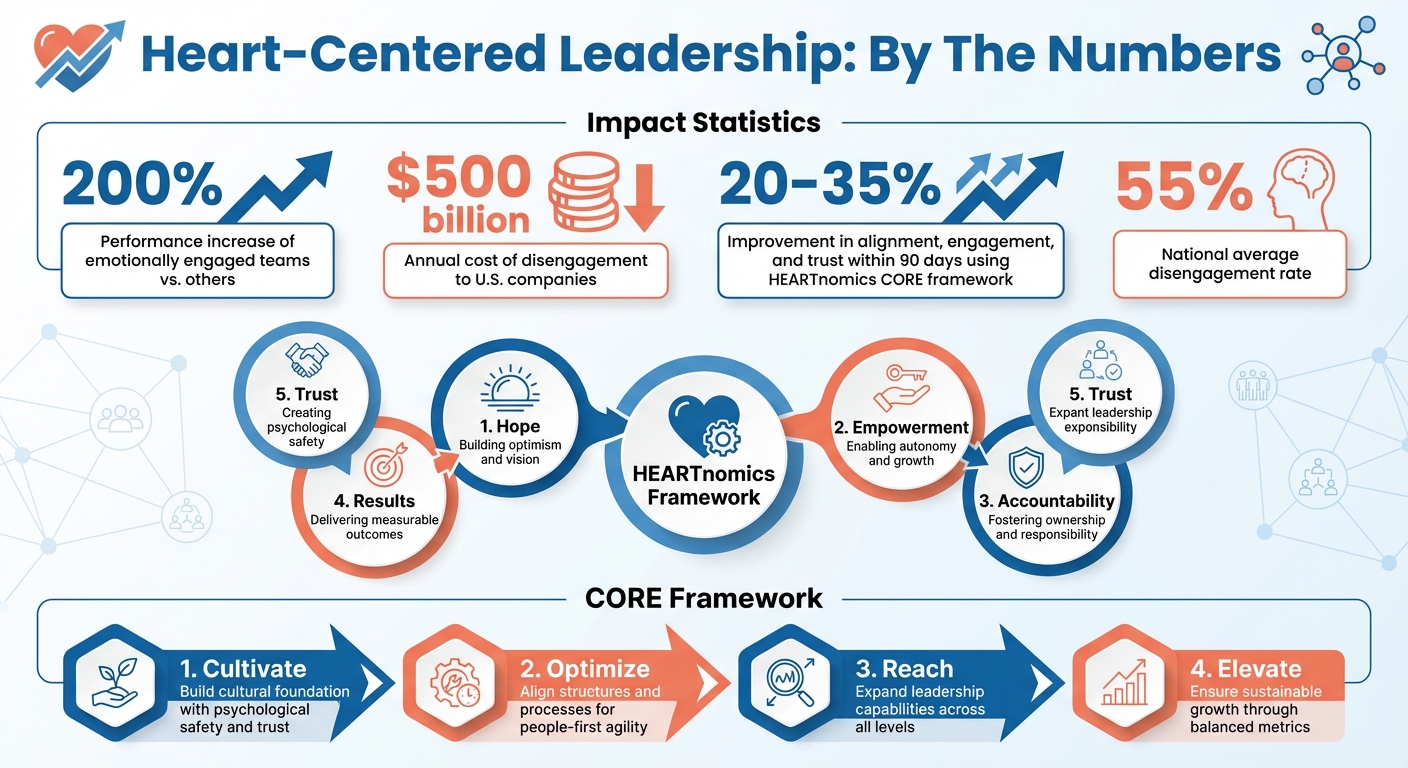
Heart-Centered Leadership Impact: Key Statistics and Framework Components
How Heart-Centered Leadership Changes the Way You Live, Love & Lead | Cheryl DeSantis | HR Leaders
Core Principles of Heart-Centered Agile Leadership
Heart-centered agile leadership revolves around three key principles: psychological safety, purpose-driven engagement, and continuous learning. Together, these principles create a foundation for teams to thrive and perform at their best. Let’s dive into how trust, purpose, and adaptability shape agile leadership.
Building Psychological Safety and Trust
Psychological safety is the cornerstone of high-performing teams. It creates an environment where individuals feel comfortable taking risks, sharing ideas, and even failing – without fear of blame or judgment. When team members trust that their mistakes are opportunities to grow, innovation naturally follows.
The way leaders handle setbacks plays a critical role in fostering this safety. Instead of asking, "Who’s responsible for this problem?" effective leaders focus on solutions by asking, "What can we learn from this?" This approach shifts the narrative from blame to progress, building trust and encouraging experimentation.
A compelling example comes from an August 2023 study published in California Management Review, which analyzed nursing teams during the COVID-19 pandemic and other crises. Researchers Max-Antoine Renault and Murat Tarakci found that teams with "affective leaders" – leaders who created positive emotional experiences – were better equipped to adapt to extreme challenges. In contrast, teams without this leadership struggled to keep up with change [2][3].
Once trust is established, leaders can focus on connecting their teams to a shared sense of purpose.
Leading with Purpose and People-Centered Values
Purpose-driven leadership is at the heart of agile environments. It’s not just about meeting goals – it’s about tying daily tasks to meaningful outcomes. When leaders help their teams see the bigger picture, they inspire deeper engagement and stronger performance.
"Compassionate leaders recognize that everybody has important strengths, is a critical part of the team, and works to ensure everyone has what they need for success." – Jim Schiel, Founder & CEO, Artisan Agility [1]
A practical way to lead with purpose is to move beyond the traditional Golden Rule. Instead of treating others as you’d like to be treated, treat them as they want to be treated. This shift shows genuine care and fosters a sense of belonging. Leaders who prioritize their team’s well-being over administrative tasks create a culture where people feel valued – a vital factor, especially when disengaged employees cost U.S. companies around $500 billion annually [1].
Encouraging Adaptability and Continuous Learning
In an agile world, change is constant. That’s why continuous learning isn’t optional – it’s essential. Heart-centered leaders embrace failure as a stepping stone for growth, ensuring that every sprint or iteration includes opportunities for both team and individual development.
This mindset aligns with the Agile Manifesto’s principle of prioritizing "individuals and interactions over processes and tools" [1]. Leaders who model adaptability – by welcoming feedback and adjusting strategies – encourage their teams to do the same. This creates a resilient culture capable of navigating uncertainty.
"As organizations mirror their leadership, adaptive organizations require adaptive leaders. Unless leaders undergo their own transformation, no organizational transformation will occur." – Agile Leadership Journey [6]
Research from the Center for Creative Leadership highlights the importance of self-regulation techniques for leaders. These practices boost psychological resources like optimism and self-awareness, which are crucial for guiding teams through rapid change [5]. Leaders who invest in leadership development programs set the tone for a team culture that values learning and adaptability.
Practical Strategies for Heart-Centered Leadership in Agile Teams
Heart-centered leadership isn’t just a concept – it’s a practice that requires consistent effort. Leaders must intentionally integrate this approach into their daily actions. Below are strategies to help leaders enhance agile rituals, navigate emotional challenges, and strike the right balance between autonomy and accountability.
Creating Rituals that Build Trust and Collaboration
Trust and collaboration aren’t built overnight – they’re nurtured through consistent practices. Agile rituals like standups, retrospectives, and planning sessions are more than just logistical meetings. They’re opportunities to strengthen team bonds and create a culture of accountability. Leaders who actively listen and encourage shared responsibility during these rituals foster a sense of belonging and purpose.
One common pitfall occurs during high-pressure periods when leaders cancel team rituals to "save time." For example, Rosa, a Head of Customer Service, canceled a town hall meeting to ease her team’s workload. However, the unintended message her team received was to "keep your heads down" instead of feeling supported [4].
Even during stressful times, maintaining rituals is essential. Use retrospectives to focus on learning rather than blame. Ask questions like, “What can we take away from this?” instead of “Who’s at fault?” This shift encourages problem-solving and growth. Incorporate learning goals into every sprint – this ensures progress is measured not just by task completion but by personal and team development [1]. And, apply the "Platinum Rule" during interactions: treat others as they wish to be treated, which creates a more inclusive and empathetic environment [1].
These rituals lay the groundwork for effectively managing emotions in uncertain times.
Managing Emotions During Uncertainty
In times of crisis, leaders set the emotional tone for their teams. Research highlights that leaders who cultivate psychological resilience and optimism serve as a steadying force during turbulent periods [5]. This doesn’t mean suppressing emotions – it’s about acknowledging stress while staying solution-focused.
Compassion, not just empathy, is key here. Empathy allows leaders to feel their team’s struggles, but compassion takes it further by pairing that understanding with actionable support [7]. This distinction is vital, especially as leaders increasingly take on roles that require addressing mental health and team anxiety in high-stress situations [7].
By managing their own emotions and modeling constructive behavior, leaders can guide their teams through uncertainty with confidence and care.
Empowering Teams Through Autonomy and Accountability
One of the biggest challenges in agile leadership is finding the right balance between giving teams autonomy and ensuring accountability. The answer lies in providing clear direction without micromanaging. Leaders should align team efforts with broader organizational goals while trusting their teams to determine how to achieve those goals.
When performance issues arise, focus on solutions instead of assigning blame. Redirect the team’s energy toward addressing challenges and learning from them [1]. This approach builds trust and reinforces the principles of the HEARTnomics CORE framework, which emphasizes both results and relationships.
Flexibility is another critical component. Leaders should identify team members’ strengths and, when necessary, adjust roles or team compositions to align with evolving goals [1]. This not only improves engagement and outcomes but also shows a genuine investment in each individual’s growth.
Finally, leaders should minimize administrative tasks that don’t directly support the team. By prioritizing their team’s well-being and development over paperwork, leaders deepen trust, enabling autonomy and accountability to thrive. When team members see their leader dedicating time to their success, it creates a ripple effect of motivation and commitment.
sbb-itb-5c9cdaf
Scaling Heart-Centered Leadership Across Agile Organizations
Heart-centered leadership has the potential to reshape entire organizations, not just individual teams. Achieving this transformation, however, takes more than good intentions. It requires rethinking structures, implementing balanced measurement systems, and creating frameworks that align processes and people on a larger scale.
Aligning Structures and Processes with People-First Agility
Many organizations claim to prioritize their people, but their structures often tell a different story. Traditional hierarchies tend to center on management, leaving the teams that actually drive results at the periphery. Scaling heart-centered leadership requires flipping this model – restructuring HR policies and organizational frameworks to acknowledge that value is created by teams, not just management [1].
Breaking down silos between departments is another critical step. Collaboration rooted in trust and meaningful relationships fosters a sense of community across the organization [9]. Cross-functional communication, especially during times of change or crisis, becomes essential [10]. Isolated teams can weaken resilience, while integrated collaboration enables organizations to adapt more effectively without sacrificing people-first principles. These changes are key to embedding heart-centered values throughout the organization and supporting agility at scale.
Structures should also encourage continuous learning at every level. Each sprint or iteration should include clear learning objectives for both individuals and teams [1]. This approach underscores the idea that growth is just as important as delivery, reinforcing the principles of sustainable agility. Aligning structures and processes with these values ensures that heart-centered leadership can thrive across the organization.
Measuring Success: Balancing Outcomes and Well-Being
The numbers don’t lie: companies with highly engaged employees perform 200% better than those where disengagement hovers at the national average of 55% [1]. These figures highlight a simple truth – employee well-being directly impacts business outcomes.
"Organizations mirror their leaders… Organizational policies and metrics help support and enforce the value system."
- Agile Leadership Journey [6]
To measure success effectively, organizations need to focus on four key areas: Growth Mindset (how adaptable leaders are), Catalyst Habits (engagement without micromanagement), Aligned Values (psychological safety and collaboration), and Value Delivery (incremental customer feedback) [6]. Tracking well-being indicators like engagement, turnover, and psychological safety alongside business metrics such as productivity and delivery speed ensures a balanced approach [1][6].
The mistake many organizations make is prioritizing numbers over people [4]. Leaders must emphasize that compassion and performance go hand in hand. When teams feel that leadership cares more about hitting targets than their well-being, trust erodes – and with it, the agility needed to succeed. Balancing measurable outcomes with a focus on individual well-being creates the foundation for scaling heart-centered leadership across the organization.
Using the HEARTnomics CORE Framework for Lasting Transformation
The HEARTnomics CORE framework – Cultivate, Optimize, Reach, Elevate – offers a clear roadmap for integrating heart-centered values with operational goals. Organizations using this approach have seen a 20–35% boost in alignment, engagement, and trust within just 90 days [8]. This framework bridges emotional intelligence with data-driven systems, blending personal growth with organizational scalability.
"At the core of our consulting services is the HEARTnomics framework, which integrates Hope, Empowerment, Accountability, Results, and Trust into every aspect of organizational development."
- HEARTnomics Consulting [8]
The framework’s four components guide organizations through every stage of transformation:
- Cultivate: Build a solid cultural foundation by fostering psychological safety, trust, and a shared sense of purpose.
- Optimize: Align structures and processes to support people-first agility on a larger scale.
- Reach: Expand leadership capabilities across all levels, recognizing that leadership isn’t limited to titles [9].
- Elevate: Ensure sustainable growth by measuring success through both outcomes and well-being.
Conclusion: The Impact of Heart-Centered Leadership
Heart-centered leadership isn’t just about being empathetic – it’s a game-changer for any organization aiming to thrive in today’s fast-paced, unpredictable world. Research highlights that disengaged teams cost companies significantly, while engaged teams consistently deliver better results [1]. This proves that in agile environments, leaders who combine emotional intelligence with strategic clarity are essential.
When leaders shift their mindset from managing "resources" to genuinely leading people, they unlock a team’s ability to respond effectively in uncertain times. Studies show that high-performing, agile teams succeed because their leaders create positive emotional experiences and help regulate team morale during crises. On the flip side, teams without this type of leadership often struggle to adapt [2][3]. This demonstrates how heart-centered leadership isn’t just a nice-to-have – it’s critical for building resilience under pressure.
To make this leadership style actionable, organizations need a structured approach that blends emotional intelligence with operational excellence. Enter HEARTnomics – a framework that integrates Hope, Empowerment, Accountability, Results, and Trust. By balancing personal connection with data-driven strategies, it bridges individual growth with organizational success. For example, companies using the CORE framework (Cultivate, Optimize, Reach, Elevate) have reported 20–35% improvements in alignment, engagement, and trust within just 90 days [8]. This combination of compassion and strategic focus fuels long-term growth.
"Hanna has a passion for leadership and meets every encounter with her heart. If you are looking to raise the standard of your team, Hanna has the strategy and the systems to move your team to a new level."
- D.A.L., Strategic Advisor, U.S. Department of Homeland Security [8]
The leaders of tomorrow will be those who successfully merge compassion with performance. Heart-centered leadership fosters environments where teams not only adapt and excel but also thrive in the face of uncertainty. By equipping teams with trust, clarity, and resilience, these leaders embody the agile principles at the core of this guide.
FAQs
How does heart-centered leadership enhance team performance in agile environments?
Heart-centered leadership blends emotional intelligence – qualities like empathy, compassion, and a sincere commitment to well-being – with the structured methods that agile teams depend on. By creating a supportive atmosphere where people feel respected and appreciated, leaders can foster psychological safety. This, in turn, encourages teamwork, creative thinking, and adaptability, even in the face of rapid change.
This style of leadership enhances performance by improving job satisfaction, building trust and accountability, and lowering employee turnover. When individuals feel secure and empowered, they’re more likely to share ideas, adjust to challenges quickly, and keep momentum during high-pressure situations. HEARTnomics™ applies these principles through its unique frameworks, enabling leaders to combine emotional intelligence with operational efficiency. The result? Long-term growth, stronger trust, and exceptional performance in fast-paced environments.
How can leaders effectively apply the HEARTnomics™ framework to build agility and resilience in their teams?
To bring the HEARTnomics™ framework to life, leaders should begin by nurturing emotional intelligence in themselves and their teams. Start with a self-assessment or gather feedback to pinpoint strengths and areas that need improvement. Incorporate daily habits like self-reflection or mindfulness to cultivate a positive mindset and sharpen leadership skills. In team environments, focus on building trust – kick off meetings with expressions of gratitude or hopeful statements, encourage open dialogue, and celebrate individual and group contributions. These consistent, intentional efforts lay the groundwork for stronger team connections and resilience.
From there, put the HEARTnomics™ pillars – Hope, Empowerment, Accountability, Results, and Trust – into action with concrete strategies. For Hope, collaborate with your team to develop a shared vision for your goals and ensure it’s visible and accessible to everyone. For Empowerment, shift decision-making power to those closest to the work and prioritize coaching over issuing directives. Strengthen Accountability by defining clear, results-oriented criteria and using retrospectives as opportunities to learn and grow. To drive Results, align team objectives with broader organizational goals and use visual tools to track progress. Finally, foster Trust by holding regular feedback sessions where leaders lead by example – showing vulnerability and actively listening to team concerns. By weaving these principles into everyday workflows, leaders can cultivate a supportive, high-performing culture while achieving tangible results.
Why is psychological safety important for agile teams, and how can leaders create it?
Psychological safety means team members feel comfortable speaking up, sharing ideas, or admitting mistakes without fear of judgment or backlash. For agile teams, this isn’t just a nice-to-have – it’s a must. Why? Because it promotes experimentation, quick problem-solving, and flexibility, all of which are crucial for driving innovation and maintaining high performance.
Leaders play a big role in creating this kind of environment. By showing vulnerability, listening actively, and responding with empathy, they set the tone. The HEARTnomics™ framework offers a practical approach through its HEART pillars: Hope, Empowerment, Accountability, Results, Trust. For instance, leaders can establish clear expectations (Accountability), celebrate team milestones and effort (Hope), and build trust by maintaining open communication and making decisions transparently. Tools like regular team check-ins, anonymous feedback channels, and acknowledging lessons learned from mistakes can further nurture a safe and collaborative culture.
When psychological safety is prioritized, teams build stronger trust, take smart risks, and handle pressure with resilience. Steps like fostering a no-blame culture, welcoming diverse viewpoints, and offering emotional intelligence training can make a big difference. These strategies align perfectly with HEARTnomics™’ mission to support sustainable growth and empower agile teams to excel.