Burnout among leaders is a growing issue, with over half of individuals in leadership roles reporting its impact. It’s more than just feeling tired – it’s a prolonged state of stress that drains energy, clouds judgment, and weakens leadership effectiveness. Common causes include overwhelming workloads, emotional strain, and decision fatigue. Symptoms often go unnoticed, masked by continued performance, but they erode decision-making and team morale over time.
Key strategies to combat burnout include:
- Micro-Recovery Breaks: Short, intentional pauses to recharge and improve focus.
- Clear Work-Life Boundaries: Managing communication and prioritizing tasks to reduce stress.
- Delegation: Sharing responsibilities to lighten the load and empower teams.
For long-term recovery, frameworks like HEART (Hope, Empowerment, Accountability, Results, Trust), BEAT (Believe, Engage, Act, Transform), and CORE (Cultivate, Optimize, Reach, Elevate) provide structured approaches to rebuilding leadership resilience and addressing systemic issues.
Burnout isn’t solved by working harder – it’s about working smarter, creating balance, and supporting both personal and team well-being.
Burnout, Decision Fatigue, and How Leaders Reclaim Control Under Pressure
What Causes Burnout in Leaders
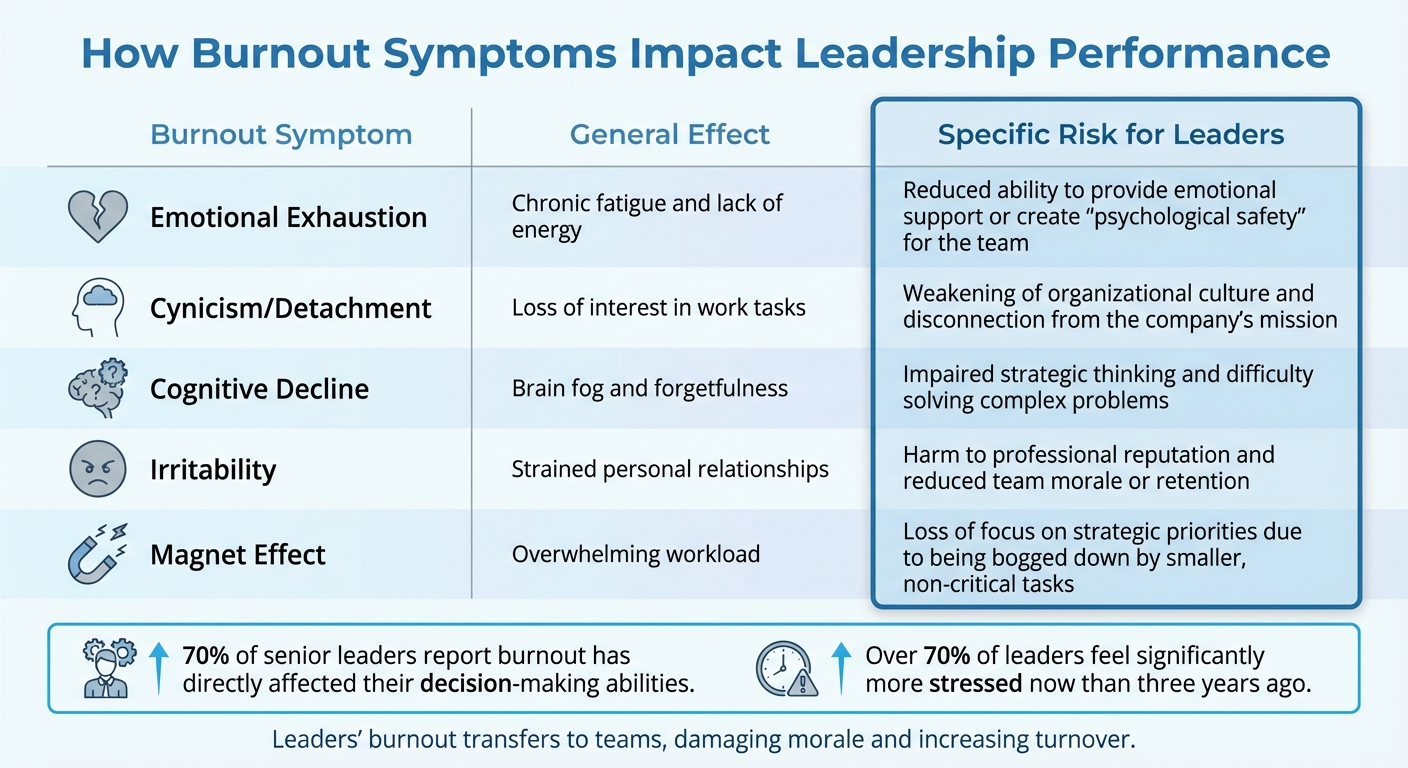
How Burnout Symptoms Impact Leadership Performance
Main Triggers of Leadership Burnout
Leadership burnout stems from a combination of pressures that often build unnoticed. One key factor is the "Magnet Effect." Reliable leaders frequently become the go-to person for every unclaimed task, leading to an overwhelming workload. While being seen as dependable can feel rewarding, it often comes at a cost. As Shanna Hocking, an executive consultant, explains:
"Being indispensable can feel good, but it can also stunt your growth. Strategic leaders create space for vision, not just execution" [1].
Another significant factor is emotional labor – the ongoing responsibility of absorbing team stress, delivering difficult news, and maintaining composure under pressure. This emotional toll can chip away at a leader’s ability to make sound decisions [4]. On top of this, constant high-stakes decision-making leads to decision fatigue, and the isolation at the top only amplifies the strain [2]. Many leaders feel they must project strength at all times, leaving little room to admit exhaustion or seek support [2][5]. This isolation not only hides vulnerability but also weakens long-term vision.
Perhaps the most concerning issue is what Dr. Michelle Rozen calls "high-functioning burnout." Leaders in this state continue to meet goals and solve problems, but inside, they feel disconnected and empty. Over time, this can lead to an identity crisis, as their sense of self becomes tied exclusively to their role as the organization’s pillar of strength [5]. These challenges create a perfect storm, resulting in symptoms that directly undermine leadership performance.
Symptoms and Their Impact on Leadership
The pressures of leadership burnout don’t just affect performance – they reshape how burnout appears in leaders. Unlike others, whose burnout may show as declining productivity, leaders often keep delivering results, masking their exhaustion. This "hidden burnout" can make the problem harder to detect and address [5].
The table below illustrates how common burnout symptoms translate into risks that specifically impact leadership:
| Burnout Symptom | General Effect | Specific Risk for Leaders |
|---|---|---|
| Emotional Exhaustion | Chronic fatigue and lack of energy | Reduced ability to provide emotional support or create "psychological safety" for the team [4][2] |
| Cynicism/Detachment | Loss of interest in work tasks | Weakening of organizational culture and disconnection from the company’s mission [3][5] |
| Cognitive Decline | Brain fog and forgetfulness | Impaired strategic thinking and difficulty solving complex problems [3] |
| Irritability | Strained personal relationships | Harm to professional reputation and reduced team morale or retention [5] |
| "Magnet Effect" | Overwhelming workload | Loss of focus on strategic priorities due to being bogged down by smaller, non-critical tasks [1] |
The statistics paint a concerning picture: 70% of senior leaders report that burnout has directly affected their decision-making abilities [3], and over 70% feel significantly more stressed now than they did three years ago [5]. Burnout erodes a leader’s ability to think critically, innovate, and respond thoughtfully rather than react impulsively [3][5]. Worse, the stress doesn’t stay contained. As the "organizational thermostat", a leader’s burnout often transfers to their team, damaging morale and increasing turnover [5]. Recognizing these symptoms is the first step toward implementing strategies that can restore balance and effectiveness.
Resilience Strategies for Burned-Out Leaders
Overcoming burnout isn’t just about working harder or pushing through; it’s about making strategic changes to both your mindset and environment. Below are practical, research-backed strategies designed to help leaders regain energy, sharpen focus, and sustain resilience.
Strategy 1: Take Micro-Recovery Breaks
Mental fatigue is one of the most common symptoms of burnout. To combat this, taking short, intentional breaks – known as micro-recovery breaks – can help your brain reset and recharge. Our brains naturally work in 90-minute cycles of focus followed by fatigue. Ignoring these rhythms can lead to "quiet exhaustion", where energy drains and decision-making suffers. In fact, 70% of senior leaders say burnout has negatively affected their ability to make decisions [3].
Frequent task-switching adds to this mental strain, increasing fatigue by up to 20%. However, simple practices like mindful breathing for just 2–3 minutes between meetings can lower cortisol levels and improve attention [7]. Leaders who carve out 90 minutes of uninterrupted thinking time each week report a 23% boost in focus and a 17% reduction in emotional exhaustion [7].
Leadership coach Mike Lee sums it up well:
"True resilience isn’t about enduring more – it’s about recovering better" [3].
Here are a few ways to incorporate micro-recovery into your routine:
- Physiological Sigh: Take a deep belly breath, add a quick second inhale into your chest, hold for three seconds, and then fully exhale. This technique helps reduce stress.
- 5-5-5 Reset: Take five deep breaths, identify five things you can see, hear, or feel, and commit to one recovery action for five minutes.
- Meeting Buffers: Build 10-minute breaks between meetings to avoid back-to-back scheduling. This is crucial since 44% of executives spend over 60% of their workweek in meetings and emails [7].
- Screen-Free Cooldowns: Step away from devices for five minutes before diving into emails to let your nervous system reset.
- Transition Rituals: Signal the end of a work period with small actions like tidying your workspace or going for a short walk.
Strategy 2: Set Clear Work-Life Boundaries
Burnout thrives in environments where reactivity and blurred boundaries dominate. Many leaders feel they need to be "always on", but this mindset actually hinders strategic thinking. The numbers are telling: in 2024, 56% of leaders reported feeling burned out, up from 52% in 2023. Among senior women leaders, this figure rose from 34% in 2022 to 45% in 2024 [2][7].
Peter Economy from Inc. offers a valuable perspective:
"Sustainable pace and performance aren’t competitors; they’re partners" [2].
To create healthier boundaries, consider these strategies:
- Define Communication Channels: Use email for non-urgent matters and reserve instant messaging for urgent issues only.
- Time Your Emails: Use scheduling tools to ensure emails are sent during business hours, promoting healthier work habits.
- Block Your Time: Designate "No Meeting" days to focus on high-priority work without interruptions.
- Shorten Meetings: Reduce meeting durations to allow for recovery time between sessions.
- Audit Your Calendar: Regularly review your schedule to eliminate low-value commitments.
- Set Decision Boundaries: Identify which decisions truly require your input and delegate the rest to reduce cognitive overload.
Strategy 3: Delegate to Empower Your Team
Many leaders fall into the trap of trying to do it all, a phenomenon known as the "Magnet Effect." Strategic delegation not only eases your workload but also empowers your team and boosts organizational effectiveness. Over 60% of executives report feeling overworked, with nearly half experiencing burnout symptoms [8]. Interestingly, employees with more autonomy are 43% less likely to face burnout [7].
Management expert Jim Collins captures the essence of this approach:
"A great strategy is as much about what you don’t do as what you do" [7].
Here’s how to delegate effectively:
- Task Audits: Categorize tasks into three groups – delegate, reduce, or protect [7].
- Play to Strengths: Assign tasks that align with your team members’ strengths, fostering both growth and better outcomes [8].
- Streamline Decisions: Separate decisions that require your input from those your team can handle independently. This reduces your mental load and speeds up processes [2].
- Set Clear Expectations: Provide clear instructions to avoid confusion and prevent micromanagement.
- Make Trade-Offs Visible: When new tasks arise, evaluate how they fit into current priorities and suggest alternative ownership if needed [1].
| Delegation Strategy | Leader Impact | Team Impact |
|---|---|---|
| Strategic Alignment | Frees time for vision and strategy | Enhances understanding of goals |
| Skill-Based Assignment | Reduces time on routine details | Encourages growth and competence |
| Shared Ownership | Reduces the "Magnet Effect" | Builds trust and collaboration |
| Decision Boundaries | Lessens cognitive overload | Promotes autonomy and confidence |
sbb-itb-5c9cdaf
Using HEARTnomics Frameworks for Long-Term Resilience
Addressing burnout isn’t just about quick fixes – it requires a comprehensive approach that combines emotional insight with effective systems. The HEARTnomics method introduces the HEART, BEAT, and CORE frameworks, each tailored to rebuild resilience and prevent future burnout. These frameworks work on both personal and organizational levels, creating a foundation for sustainable recovery.
HEART Framework for Emotional Recovery
Short-term solutions may help manage daily stress, but the HEART framework (Hope, Empowerment, Accountability, Results, Trust) focuses on deeper emotional recovery. It starts with Hope, which encourages reframing challenges. Instead of asking, "Why is this happening to me?" shift to "What can I learn from this?" This change in perspective helps rewire your response to stress, fostering resilience.
Empowerment is about stepping away from the "indispensable leader" mindset. By clearly defining responsibilities and delegating effectively, leaders can avoid overburdening themselves. The final elements – Accountability, Results, and Trust – build a structure that supports long-term recovery, ensuring leadership habits are sustainable and burnout doesn’t return.
BEAT Framework for Building Personal Rhythm
Finding a steady rhythm in your personal and professional life is key to avoiding burnout. The BEAT framework (Believe, Engage, Act, Transform) guides leaders from merely surviving to thriving. Believe reinforces the core values that shape decision-making. Engage directs energy and focus toward what truly matters, helping to avoid overcommitment. Act ensures daily actions align with leadership priorities, bridging the gap between intention and execution. Finally, Transform solidifies these habits, ensuring long-term alignment with personal values.
A practical tool within this framework is the Personal Development Pathway (PDP), which helps leaders set clear priorities and establish rhythms to maintain progress. Regular "pulse checks" provide a way to monitor growth and address any missteps before burnout reemerges.
CORE Framework for Preventing Organizational Burnout
Burnout isn’t just a personal issue – it often stems from organizational dysfunction. While the HEART and BEAT frameworks focus on individuals, the CORE framework (Cultivate, Optimize, Reach, Elevate) addresses systemic challenges. It views burnout as a predictable result of poorly designed systems and offers a roadmap for change.
As Hanna Bauer, CEO of HEARTnomics, puts it:
"Resilience isn’t a personality trait; it’s a systemic outcome built through intentional habits and a supportive environment" [9].
The CORE framework tackles "organizational arrhythmia", a problem caused by unrelenting hustle culture. By fostering psychological safety, optimizing workflows, and setting sustainable performance goals, organizations can create environments where leaders and teams thrive. Shifting from an individualistic "me-oriented" mindset to a collaborative "WE-oriented" culture has been shown to boost profitability by 23% and productivity by 21% [9]. This approach blends emotional intelligence with operational efficiency, making HEARTnomics a well-rounded strategy for transforming leadership dynamics.
Tracking Recovery and Maintaining Resilience
Measuring Your Recovery Progress
Recovering from burnout isn’t something you leave to chance – it’s about tracking clear, measurable signs that show you’re on the mend. One effective approach is energy auditing. This involves keeping a log of your daily activities to pinpoint what drains your energy (like endless meetings) versus what recharges you (perhaps focused, creative work like strategic planning) [6]. With this information, you can tweak your schedule to safeguard your mental and physical energy.
Another helpful tool is the 0–10 Alignment Rule. For every task or meeting, rate how well it aligns with your core leadership values on a scale of 0 to 10. Aim to increase the percentage of activities that score a 7 or higher – this signals you’re spending more time on what truly matters [5]. If you’re looking for something more science-backed, tracking your Heart Rate Variability (HRV) can give you insight into your stress tolerance and resilience levels [3]. Regular reviews of your calendar and commitments can also help you cut out low-value tasks and lighten your cognitive load [2].
Don’t overlook physical health indicators either. Keep an eye on hydration, sleep quality, and even iron levels, as these directly affect your mental clarity and productivity [10]. As Prudence Hatchett, a Leadership Resilience Strategist, puts it:
"You can do more with a rested brain than a tired one" [10].
Lastly, assess your progress against quarterly and annual goals. If you’re hitting your targets without falling into the same old pitfalls, it’s a strong sign that you’re on the right track [10]. These measurable checkpoints give you the tools to weave recovery practices into your everyday leadership habits.
Making Resilience Part of Your Leadership Practice
Once you’ve got a handle on your recovery, the next step is to turn those insights into daily habits that promote resilience. Recovery shouldn’t be an occasional treat – it needs to be part of your routine. Start your day with morning priming: get some sunlight within 30 minutes of waking to sync your circadian rhythm, and consider cold exposure (like a quick cold shower) to boost focus and mental clarity through norepinephrine release [3]. During the workday, schedule ultradian rhythm breaks every 90 minutes to recharge your focus and stave off mental fatigue [3].
When stress levels spike, try a simple breathing or sensory reset technique to quickly break the stress cycle. In the evening, commit to a digital detox at least an hour before bedtime to improve the quality of your sleep [3]. Leaders who prioritize these resilience practices report 30–40% fewer burnout symptoms and stress-related absences compared to those who don’t [11].
Equally important is leading by example. When you demonstrate self-care and enforce boundaries, you send a powerful message to your team. It normalizes these behaviors, creating an environment of psychological safety where team members feel comfortable speaking up about their struggles [6][12]. This kind of culture doesn’t just help individuals – it strengthens the entire organization’s ability to weather challenges and avoid burnout.
FAQs
How can I tell if I have high-functioning burnout?
High-functioning burnout can sneak up on you, showing up as constant stress and exhaustion, even while you’re keeping up with your responsibilities. It often looks like waking up with a sense of dread, feeling detached from your work, irritability, mental fog, and a hollow sense of achievement. Over time, the joy you once found in accomplishments fades, leaving exhaustion to take its place.
Catching these signs early is crucial. It allows leaders to take steps toward recovery and prevention. Strategies like practicing self-awareness, improving self-regulation, and adopting more sustainable habits can make a big difference in managing burnout before it deepens.
What micro-recovery break works best in a packed calendar?
Sometimes, the best way to recharge during a busy day is by taking a short, purposeful break. A quick 5-minute mindfulness or breathing exercise can do wonders for your energy and focus. These brief pauses allow you to reset without throwing off your entire schedule, helping you stay refreshed and on track.
How can I delegate without losing control or quality?
To delegate well while keeping control and ensuring quality, start by outlining the specific goals, expectations, and available resources. Match tasks to team members’ strengths to build both trust and accountability. Schedule regular check-ins to track progress, but avoid hovering or micromanaging. Equip your team with the right tools, templates, or guidelines to help them succeed. Think of delegation as an opportunity to empower your team while working toward long-term, effective results.