Vision-driven leadership connects everyday tasks to a larger purpose, helping teams focus on meaningful, long-term goals. By crafting a clear vision, involving team members in its creation, and aligning objectives with that vision, leaders can improve performance, engagement, and motivation through leadership development programs. Research shows organizations with well-communicated visions are twice as likely to achieve higher profit margins. Here’s how to make it work:
- Define a Clear Vision: Keep it concise (1-2 sentences), bold, and based on core values. A strong vision spans 5-30 years and serves as a decision-making compass.
- Align Goals: Translate the vision into actionable, measurable goals using frameworks like SMART or OKRs. Ensure goals are specific, relevant, and time-bound.
- Team Involvement: Engage team members in vision creation through surveys, workshops, and open dialogue. This builds ownership and clarity.
- Track Progress: Use clear metrics tied directly to the vision. Combine data with regular check-ins to ensure alignment.
- Celebrate Wins: Recognize achievements to sustain motivation and reinforce the connection to the vision.
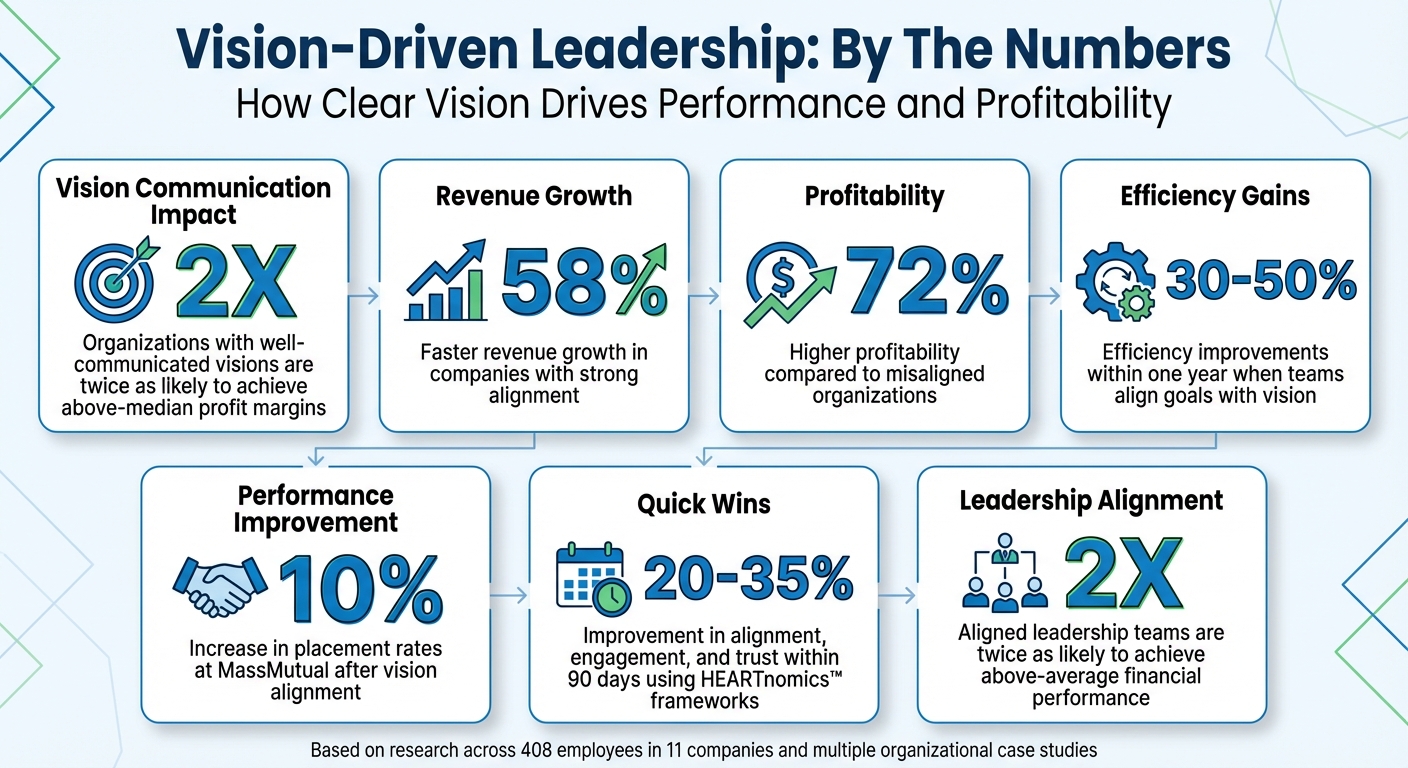
Vision-Driven Leadership Impact: Key Statistics and Performance Metrics
Vision Alignment and Goal-Setting for 2025
How to Define a Clear Vision
Crafting a forward-looking vision that ties long-term goals to current strategies is essential for guiding your team. A strong vision often spans 5 to 30 years into the future, offering a sense of direction and purpose for everyday tasks [5]. It connects the work done today to a bigger picture, helping individuals see how their efforts contribute to something meaningful.
The best visions are bold yet grounded, reflecting core values and staying concise – ideally just one or two sentences [5]. A well-thought-out vision serves as a decision-making compass. When challenges or competing priorities arise, team members can assess their choices by asking, “Does this align with our vision?” This clarity transforms routine tasks into part of a larger mission – like seeing themselves not just as "laying stones" but as "building a cathedral" [6]. A clearly articulated vision ensures that team objectives align seamlessly across the organization.
"Effort and courage are not enough without purpose and direction." – John F. Kennedy [7]
What Makes a Vision Effective
An effective vision blends emotional resonance with strategic intent. It connects to what psychologists call the Ideal Self, aligning individual aspirations and core values with the organization’s broader goals [1]. This emotional connection fosters a sense of growth and achievement, motivating team members to strive for excellence.
A clear vision also encourages employees to see the bigger picture, avoiding the trap of being consumed by day-to-day tasks [2]. For instance, research involving 408 employees across 11 companies revealed that clear communication of a vision improves performance by enhancing goal clarity [2].
Truly impactful visions resonate on multiple levels: the individual, the team, the customer, the organization, and society [9]. Studies show that aligning with these five sources of meaning motivates employees and boosts company performance. In fact, organizations with well-communicated visions are twice as likely to achieve above-median profit margins [9]. When a vision reflects shared values, it fosters a sense of unity and drives both engagement and productivity [6].
Including Your Team in Vision Creation
The process of building a vision is just as important as the vision itself. Engaging your team in its creation enhances ownership and ensures clarity. Rather than being developed solely by senior leadership, effective visions emerge from collaboration, incorporating diverse perspectives across the organization. This can be achieved through interviews, surveys, and group workshops [3]. Organizations can also utilize specialized training programs to facilitate these collaborative sessions.
Once feedback is gathered, responses can be grouped into themes like innovation, revenue growth, profitability, or workplace culture [3]. This approach helps identify common priorities and reconcile differing viewpoints. To ground the vision in reality, review baseline metrics and relevant data, ensuring the final statement reflects the organization’s current position [3]. By involving the team, you create alignment and encourage leadership that is rooted in shared goals.
Take, for example, Massachusetts Mutual Financial Group. During a period of strong industry performance, the company involved employees at all levels in crafting a vision centered on being "stewards of financial strength." This collaborative effort led to a 10% increase in placement rates [9].
Another example comes from a European financial-services firm. Faced with a major pricing challenge in 2008, the company shifted its vision from "quality regardless of cost" to one emphasizing customer service and cost-efficiency. By engaging every department in identifying improvement opportunities, they achieved efficiency gains of 30% to 50% within a year [9].
"Visioning takes you out beyond your present reality." – Erica Olsen, COO, M3 Planning [8]
Connecting Team Goals to Your Vision
Once you’ve established a clear vision, the next step is turning that vision into actionable team goals. Think of the vision as your organization’s ultimate destination, while the goals are the specific directions that help you get there. A well-defined vision inspires, but it’s the goals that translate that inspiration into measurable progress [1].
The real challenge lies in ensuring every goal ties directly to your vision while being clear enough for team members to understand their role. Research suggests that effectively communicating a vision helps people see how their daily work connects to the bigger picture. It improves goal clarity and encourages a mindset focused on high-level objectives [2]. This alignment empowers team members to evaluate their tasks in light of the broader vision.
Goals should also center on growth and opportunity – what’s often called a promotion focus – rather than simply avoiding failure. When goals are framed as opportunities for advancement, they inspire long-term commitment and meaningful change. On the other hand, goals based on obligations or "shoulds" might generate short-term compliance but are less likely to lead to lasting impact [1].
So, how do you structure these goals to make them as effective as possible? Let’s break it down.
Setting SMART Goals
The SMART framework – Specific, Measurable, Achievable, Relevant, and Time-bound – is one of several strategies for empowering teams by turning big-picture visions into actionable steps. It’s a way to break down a long-term vision into smaller, more manageable milestones.
- Specific goals eliminate ambiguity. For example, instead of saying "improve customer service", a specific goal would be "reduce average customer response time from 24 hours to 4 hours."
- Measurable goals let you track progress objectively, ensuring you know when you’ve succeeded.
- Achievable goals challenge your team without setting them up for failure.
- Relevant goals directly support your vision, preventing misaligned efforts.
- Time-bound goals create urgency and accountability with clear deadlines.
Some organizations take this a step further by using the OKR (Objectives and Key Results) framework. Objectives define the "what" – a qualitative aim tied to the vision – while Key Results are the measurable milestones that define success [10]. For instance, if your vision emphasizes innovation, an objective could be "Position our team as leaders in sustainable practices." Key results might include "Publish 12 industry research reports" and "Increase conference speaking engagements by 40% year-over-year."
Once your goals are clear, focus on the initiatives that align most closely with your vision.
Choosing Which Goals Matter Most
Not all goals are created equal. To make the biggest impact, prioritize those that drive your vision forward. This often means distinguishing between goals that reflect your "Ideal Self" – your core identity and values – and those tied to external pressures or expectations from others [1].
One way to identify the most meaningful goals is by conducting a Success Survey with your team. Ask members to define what success looks like to them through interviews or surveys. Then, group their responses into themes like innovation, workplace culture, customer experience, or revenue growth [3]. Reviewing these priorities as a group fosters an inclusive strategy and ensures everyone understands why certain goals are chosen.
Before finalizing priorities, it’s essential to level-set with baseline metrics. Share current performance data so everyone starts on the same page [3]. Tools like real-time polling during meetings can help anonymously capture team preferences and build consensus on which goals matter most [3]. This approach ensures all voices are heard – not just the loudest ones – and gives everyone a sense of ownership.
Real-world examples highlight the power of aligning goals with a shared vision. At MassMutual, the CFO guided the organization toward a vision of being "stewards of financial strength." Employees set individual goals that aligned with this vision, focusing on solving customer problems. The result? A 10% increase in insurance application placement rates [9]. Similarly, a European retail bank shifted its focus from bureaucracy to becoming a "federation of entrepreneurs", aligning goals with five key sources of meaning. Within a year, the bank achieved a 10% improvement in efficiency, surpassing expectations [9].
When prioritizing goals, it’s worth noting that people are motivated by different factors. Roughly 20% of individuals are primarily driven by one of five sources of meaning: personal fulfillment, their team, customer satisfaction, organizational success, or societal impact [9]. By addressing these diverse motivations, you can ensure your goals resonate across the board. Organizations that successfully align their vision with these motivations are twice as likely to achieve above-average profit margins [9].
Sharing Your Vision and Getting Team Buy-In
Once you’ve outlined your vision and aligned it with team goals, the next step is to inspire your team to fully commit. This requires clear and engaging communication that ensures every team member not only understands the vision but also sees how it connects to their personal aspirations.
One effective approach is creating a Positive Emotional Attractor state – essentially a mindset filled with hope, joy, and openness. This kind of emotional state encourages creativity and connection, making it easier for team members to embrace the vision. When a vision focuses on growth and opportunity, it inspires long-term commitment. On the other hand, visions based on obligation or fear tend to result in only short-term compliance [1].
Creating a Message That Connects
Your message should go beyond simply informing – it should resonate on an emotional level. Frame your vision as a chance for growth and opportunity, emphasizing the potential for gain rather than just avoiding loss. This "promotion-focused" approach can inspire deeper commitment [1].
Metaphors are a great way to make your vision instantly clear and relatable. Consultant Tanvi Gautam explains their power perfectly:
"A metaphor is a lightning flash – it illuminates the landscape in an instant, helping to calm the brain, coordinate energy, and clarify direction" [4].
By using vivid imagery, you can help your team see their work as part of something bigger and more meaningful, rather than just a list of tasks. Connecting the overarching vision to their personal aspirations – what researchers call "possible future selves" – can create an even stronger sense of commitment [1][2].
Once you’ve crafted a compelling message, open up the conversation to engage your team.
Building Engagement Through Conversation
True buy-in happens through dialogue, not monologue. Start by conducting individual interviews or surveys to understand each team member’s vision of success [3]. When you share the common themes that emerge – whether it’s innovation, work culture, or customer satisfaction – you’ll highlight shared priorities and uncover any differences [3]. Anonymous polling during team meetings is another great way to ensure that every voice is heard, which helps build trust [3]. This back-and-forth dialogue reinforces the connection between how vision drives high-performance teams and individual goals, keeping the process aligned.
Chris Hadfield, a former Commander of the International Space Station, captures the essence of leadership beautifully:
"Ultimately, leadership is not about glorious crowning acts. It’s about keeping your team focused on a goal and motivated to do their best to achieve it… It is about laying the groundwork for others’ success, and then standing back and letting them shine" [10].
Take time to allow for informal conversations to build trust before diving into concerns. If someone raises an issue with the vision, acknowledge their feelings first. Validating their concerns shows you’re listening, rather than just trying to sell an idea. This approach fosters collaboration and a stronger sense of shared purpose. For organizations seeking tailored guidance, Heartnomics Consulting provides expert support in aligning leadership vision with team execution.
sbb-itb-5c9cdaf
Using HEARTnomics™ Frameworks for Goal Alignment
Once you’ve established team buy-in, the next step is to align your vision with performance using structured HEARTnomics™ frameworks. These frameworks – HEART, BEAT, and CORE – offer a systematic way for leaders to connect team goals with the broader organizational vision, all while driving strong performance. The goal? To create lasting transformation through a focus on Love and Excellence. Learn more about these methodologies on the HEARTnomics™ website.
Studies reveal that organizations with aligned leadership teams are twice as likely to achieve above-average financial performance, whereas misaligned teams often face higher turnover and instability [12]. The HEARTnomics™ approach tackles this issue by blending people, purpose, and performance into a unified system that delivers measurable outcomes – typically showing a 20-35% improvement in alignment, engagement, and trust within just 90 days.
HEART Framework: Building Trust and Accountability
The HEART framework – Hope, Empowerment, Accountability, Results, Trust – focuses on combining emotional motivation with operational discipline to align goals effectively.
- Hope serves as the emotional driver, inspiring teams to move from their current state to a desired future. Neuroscience refers to this as activating the Positive Emotional Attractor (PEA), a state that supports creativity, social engagement, and openness to new ideas by calming the nervous system [1].
- Empowerment thrives on open, two-way communication. Establish feedback loops and open-door policies where team members feel safe sharing challenges and proposing solutions without fear of repercussions [12].
- Accountability is achieved when leaders take full ownership of their roles in the broader vision. Clear role definitions and shared Key Performance Indicators (KPIs) help track progress and ensure alignment [12].
- Results come naturally when strategies are executed against well-defined, mission-driven goals.
- Trust is the foundation holding everything together. Build it through transparency, empathy, and consistently aligning your actions with your words [12]. Leading by example is one of the quickest ways to establish credibility.
By weaving these elements together, the HEART framework fosters a culture of trust and accountability, which is essential for achieving and maintaining alignment.
BEAT Framework: Transforming Your Team
The BEAT framework – Believe, Engage, Act, Transform – helps leaders guide their teams from understanding a vision to acting on it.
- Believe begins with anchoring your vision in the "Ideal Self", which reflects team members’ core values and aspirations, rather than the "Ought Self", which is shaped by external pressures. Focusing on the Ideal Self fosters a "promotion focus", driving growth and optimism [1].
- Engage activates the PEA state, encouraging creativity and openness. Ask team members to visualize success and identify themes such as innovation, teamwork, or progress [3].
- Act translates the vision into actionable priorities and measurable goals. High goal clarity reduces uncertainty and helps team members align their daily efforts with the broader vision [2].
- Transform shifts the way team members perceive their work. Move them from focusing on small, immediate tasks ("low-level construals") to seeing the big picture and long-term purpose ("high-level construals"). Frame goals around "gain/no-gain" scenarios to encourage risk-taking and forward momentum [1].
This framework effectively bridges the gap between vision and execution, empowering teams to take meaningful action.
CORE Framework: Maintaining Performance Under Pressure
The CORE framework – Cultivate, Optimize, Reach, Elevate – is designed to help teams stay aligned and perform well, even during tough times.
- Cultivate resilience by keeping the PEA state active. This state promotes hope, social bonding, and emotional health, which are crucial for maintaining morale under stress [1].
- Optimize performance by reframing how team members see their work. Research involving 408 employees across 11 companies found that clear vision communication enhances goal clarity and helps teams focus on the bigger picture rather than getting bogged down in details [2].
- Reach for success by setting clear, vision-aligned goals. These goals provide stability and direction, even when short-term plans face disruption [2].
- Elevate performance by balancing the PEA with the Negative Emotional Attractor (NEA). While the NEA is necessary to push teams into action, the PEA must be nurtured to prevent burnout and sustain progress [1].
Before introducing new goals during challenging times, ensure the team understands baseline metrics to track success collectively [3]. In volatile environments, providing both autonomy and a clear vision allows flexibility while keeping everyone moving toward the organization’s ultimate objectives [2].
Measuring Progress and Recognizing Wins
Once goals are aligned, the next step is keeping track of progress. Measuring progress is what connects your vision to real-world performance. Clear metrics act as a guide, helping teams stay focused and maintain momentum.
Tracking Alignment with Metrics
Start by identifying a handful of key metrics that tie directly to your organization’s vision. Avoid drowning in data – focus on what truly drives results. Metrics generally fall into four categories: Activity, Output, Impact, and Readiness [17]. For example, if customer satisfaction is central to your vision, you might track lead follow-up time, consistency in lifecycle stages, and revenue attribution. These metrics ensure all departments are working in harmony [13].
A centralized CRM can serve as your "single source of truth." Use real-time dashboards to monitor task progress and cycle times [13][14][15][16]. Aim for a team utilization rate of 70–80% to strike the right balance between productivity and capacity [15].
Metrics alone don’t tell the whole story. Pair quantitative data with qualitative insights by scheduling regular one-on-one meetings. These conversations help uncover the reasons behind the numbers [14]. Instead of relying on annual reviews, adopt weekly or monthly check-ins. This approach allows you to identify obstacles early and make adjustments mid-cycle [18]. As Forrester highlights:
"Alignment and accountability come from identifying the correct metrics that provide leaders with the insight they need" [17].
Establishing these metrics lays the groundwork for celebrating meaningful milestones.
Celebrating Success to Strengthen Commitment
Recognizing achievements isn’t just a feel-good exercise – it’s a powerful way to sustain alignment and drive continued progress. Celebrating wins activates the Positive Emotional Attractor (PEA), a state linked to feelings of hope, joy, and optimism. This keeps teams motivated and focused on the long-term vision [1]. On the flip side, failing to acknowledge milestones can leave teams feeling undervalued and erode trust in leadership [11].
When celebrating, make it clear how the achievement ties back to your organization’s vision [18]. This connection reinforces the importance of everyday efforts in achieving broader goals. For example, companies that prioritize recognition often see measurable improvements in customer service and operational efficiency [9].
Tailor your celebrations to match the scale of the achievement. For major milestones, consider team outings or dinners. For smaller wins or virtual teams, tools like Microsoft Teams badges or virtual escape rooms can keep the momentum going [10]. Share these successes with senior leadership and the wider company to highlight their significance within the broader organizational context [10]. As astronaut Chris Hadfield wisely observes:
"Ultimately, leadership is not about glorious crowning acts. It’s about keeping your team focused on a goal and motivated to do their best to achieve it… It is about laying the groundwork for others’ success, and then standing back and letting them shine" [10].
Next Steps
Vision-driven leadership isn’t a one-and-done effort – it’s a continuous journey of maintaining clarity, fostering alignment, and taking purposeful action. You now have the tools to craft a clear vision, link team objectives to that vision, communicate effectively, and track progress. The next step? Turning these concepts into action.
Start by integrating the HEARTnomics™ frameworks into your leadership style. Use the HEART framework to establish trust and accountability within your team. Apply the BEAT framework to improve team dynamics, and rely on the CORE framework to maintain performance during tough times [19]. These tools bridge the gap between vision and everyday operations, blending emotional intelligence with practical execution. This approach is central to emotional intelligence in leadership, which empowers you to build trust and foster collaboration.
Take a close look at your organization to uncover and address leadership alignment challenges [12]. Regular check-ins – whether weekly or monthly – can help you evaluate progress and recalibrate goals as circumstances evolve [20][21]. The payoff is worth it: companies with strong alignment grow revenue 58% faster and achieve 72% higher profitability compared to those without alignment [22].
Don’t wait to act. Start small and build momentum. Host a goal-setting workshop with your team or celebrate a small but meaningful win that reinforces your vision [12][23]. As Warren Bennis wisely said:
"Leadership is the capacity to translate vision into reality" [12].
That transformation happens through deliberate and consistent effort. Lead by showing the way – model the behaviors you want to see, champion the vision, and encourage open conversations. When you align your team’s purpose, people, and performance, you create a resilient foundation for growth, no matter what challenges come your way.
FAQs
How can I involve my team in creating a shared vision for success?
To build a shared vision with your team, start by seeking their input. Ask each member to share their thoughts on what success looks like over the next 12–18 months. Encourage them to describe specific outcomes, the impact on customers, and even their personal goals. The more detailed and vivid the language, the more relatable and tangible the vision will feel.
Once you’ve gathered their ideas, look for common threads and emotional drivers – things like excitement, pride, or shared ambition. Use these insights to craft a concise and inspiring vision statement that embodies the team’s collective goals and values. Keep it clear and tied to measurable outcomes to ensure everyone stays aligned and focused.
To bring this vision to life, anchor it in actionable steps using the HEARTnomics™ framework. This might include sharing an optimistic outlook for the future, empowering individuals to take ownership of their roles, setting clear milestones to track progress, and celebrating wins to build trust and morale. This method not only makes the vision achievable but also strengthens collaboration and fosters long-term growth.
What are the benefits of aligning team goals with a clear vision?
Aligning team goals with a clear vision gives everyone a sense of direction and purpose. When a vision is communicated effectively, it helps employees understand how their efforts contribute to the larger mission. This understanding makes it easier to focus on what truly matters, prioritizing tasks that have a meaningful impact. It also boosts engagement and motivation, as people feel they’re part of something bigger rather than just checking off tasks.
A strong, shared vision builds trust and encourages collaboration. It creates an environment where team members support each other, stay accountable, and tackle challenges together. When paired with leadership systems like HEARTnomics™, vision alignment blends emotional intelligence with operational precision. The result? Teams achieve consistent growth, perform well under pressure, and adapt effectively to change. By translating vision into clear, measurable goals, leaders can inspire their teams and drive long-term success throughout the organization.
How can I track progress toward vision-driven team goals?
Tracking progress toward vision-focused goals starts with breaking that vision into specific, measurable objectives tied to clear outcomes. Tools like OKRs (Objectives and Key Results) or KPI scorecards can help align these objectives with your team’s overall mission. Keeping metrics updated – weekly for operational targets and monthly for engagement metrics – ensures accountability and makes it easier to spot issues early on.
A mix of quantitative data (like revenue growth or project milestones) and qualitative feedback (such as team pulse surveys) provides a well-rounded view of progress. Surveys are especially useful for gauging how connected team members feel to the vision, tapping into emotional factors like hope, trust, and a sense of empowerment.
To keep the momentum going, set up a quarterly review cycle. Use these reviews to evaluate progress, celebrate wins, and recalibrate goals where necessary. Studies suggest that organizations aligning their purpose with measurable outcomes tend to perform better and sustain growth over time. By blending data-driven strategies with emotional awareness, leaders can turn their vision into meaningful, actionable results.