Vision is the backbone of any high-performing team. Without it, even skilled individuals can lose direction and focus. A clear and stable vision:
- Aligns team efforts by providing a shared goal.
- Acts as a decision-making guide, especially in uncertain environments.
- Boosts productivity, engagement, and profitability.
For example, IBM‘s PC team succeeded in the 1980s with a focused vision, while Apple’s Lisa project failed due to unclear goals. A strong vision connects daily tasks to a larger purpose, fostering alignment and reducing wasted effort.
To create an effective vision, involve your team and use frameworks like HEART (one of the best leadership development programs) (Hope, Empowerment, Accountability, Results, Trust) to ensure clarity and inspiration. Communicating the vision through stories and integrating it into daily operations keeps teams aligned and motivated. Regularly tracking progress and adjusting the vision when necessary ensures long-term success.
The key takeaway? A well-defined vision isn’t just words – it’s a practical tool that transforms individual efforts into collective achievements.
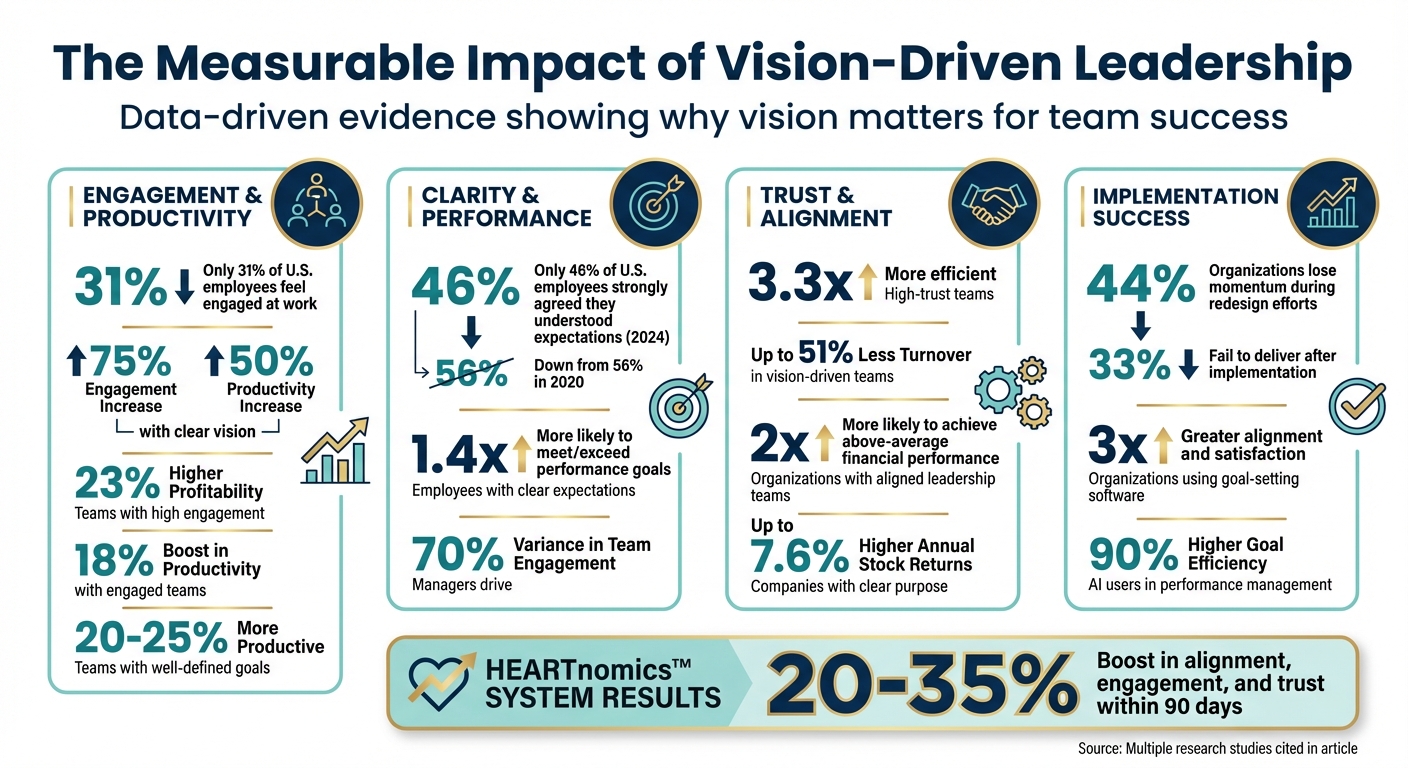
Impact of Vision-Driven Leadership on Team Performance Statistics
How to Create a Vision That Motivates Your Team
What Makes a Vision Meaningful
A meaningful vision serves as a roadmap, clarifying goals, stirring emotions, and guiding decisions. Think of it as a snapshot of where you want to be in 3 to 10 years – specific enough to direct resources effectively, yet ambitious enough to inspire action [7][9]. Without this clarity, teams often lose direction, leading to confusion and miscommunication [5].
When done right, a vision connects your organization’s mission to individual purpose, driving both engagement and productivity. Consider this: only 31% of U.S. employees feel engaged at work, but teams with high engagement levels see 23% higher profitability and an 18% boost in productivity [6]. When people see how their daily tasks contribute to a larger goal, they’re more likely to give their best effort.
To create a vision that resonates, involve your team. Ask key contributors to draft their own 5- to 10-year visions. Share these perspectives, then blend the best ideas into a unified direction. Once you’ve gathered input, use the HEART framework to shape these insights into a vision that’s both inspiring and actionable.
Building Your Vision Using the HEART Framework
The HEARTnomics™ HEART framework – Hope, Empowerment, Accountability, Results, Trust – is designed to merge emotional resonance with operational focus. It helps translate aspirations into a clear, team-driven strategy.
- Hope fuels motivation. Dr. Judith Rich describes hope as:
"Hope is a match in a dark tunnel, a moment of light, just enough to reveal the path ahead and ultimately the way out" [12].
Your vision should provide a glimpse of a brighter future, offering enough inspiration to make today’s challenges feel worthwhile [12][13].
- Empowerment equips your team with the confidence and authority to make decisions. This sense of ownership fosters innovation and increases job satisfaction [10][11].
- Accountability ensures consistency without stifling creativity. Empowerment without accountability can lead to disorganization, while accountability without empowerment can stifle progress [11].
- Results keep your vision grounded in measurable achievements. Define clear goals and metrics to track progress and maintain alignment [9].
- Trust underpins everything. As Tim Huff, President & CEO of TLG, puts it:
"Trust is a bedrock of successful leadership. Exceptional leaders understand the delicate balance between empowering their teams and maintaining the right level of accountability" [11].
When crafting your vision statement, aim for simplicity and inspiration. A short paragraph or a few concise sentences can be enough [9]. Tie daily objectives and tasks back to this vision to keep your team aligned. After all, managers drive 70% of the variance in team engagement [6][8]. By anchoring your vision in the HEART framework, you can turn individual efforts into collective success.
sbb-itb-5c9cdaf
Vision, Values and Leadership: How to Create a Team with Purpose
How to Communicate Your Vision Effectively
Crafting a vision is one thing; making it resonate with your team is another. The real challenge lies in ensuring every team member understands the vision, feels connected to it, and knows how to incorporate it into their daily tasks. Without clear communication, even the most ambitious vision can lose its impact.
When communicated effectively, a vision transforms daily work into something more meaningful. A study of 408 employees from 11 companies found that clear communication of a vision helps employees shift their focus from minor details to the bigger picture. This not only boosts motivation but also clarifies how individual tasks contribute to the organization’s success [14]. Your goal is to paint a picture so vivid that your team can almost see it in their minds. One tool to achieve this is storytelling.
Using Stories to Make Vision Relatable
Abstract goals can feel distant, but stories make them tangible and memorable. Take Walt Disney, for example. When he described his vision for his theme parks, he said he wanted "to keep the same smile on people’s faces when they leave the park as when they enter" [1]. This simple yet vivid image gave every employee a clear standard to strive for.
Research involving 128 participants shows that visions communicated with vivid language evoke stronger emotional responses than vague, abstract statements. These emotions often translate into greater commitment to goals and influence daily actions [15]. For instance, Tesla doesn’t just sell cars; it works toward "accelerating the world’s transition to sustainable energy" [1]. Similarly, in April 1976, Steve Jobs articulated Apple’s vision as putting "a computer in the hands of everyday people", creating a clear and motivating image of the future [15]. Even the IBM PC team in the early 1980s rallied behind a simple, focused vision: "to out-Apple Apple." This clarity helped maintain alignment, with 80% of their original plans staying intact from concept to launch [3].
On the flip side, vague or generic visions can lead to confusion and stalled progress. When crafting your vision, avoid broad terms like "inspiring" or "compelling." Instead, focus on specific, observable outcomes. Ask questions like, "What does success look like? What will the team experience once this vision is realized?" This approach helps your team not only understand the vision but also see their role in making it a reality [15][14]. Once your vision is clear and relatable, the next step is integrating it into daily operations. Organizations seeking to bridge this gap often benefit from specialized consulting services to align their strategy with execution.
Keeping Vision Present in Daily Operations
A vision that’s only displayed on a poster is unlikely to drive change. To have real impact, it needs to be part of your team’s daily workflow – woven into meetings, performance reviews, coaching sessions, and decision-making processes. Peter Jensen puts it well: "Imagery is the language of performance. Until people can see what needs to be done and themselves performing the steps to doing it, they can’t perform" [17].
Use your vision as a guiding framework for setting individual and team goals, ensuring alignment with long-term objectives [14]. Regular coaching sessions are a great way to check that everyone understands the vision and can connect their unique strengths to the organization’s goals [17].
Consistency is critical. A vision that constantly shifts can lead to confusion and skepticism. Research shows that a steady, well-communicated vision helps reduce these issues and fosters sustained commitment from the team [3]. To operationalize your vision, prioritize your core values – limit them to six so employees know what matters most when faced with tough decisions [1].
And don’t just talk about the vision – live it. As Jim Collins says, "When you have superb alignment, a visitor could drop into your organization from another planet and infer the vision without having to read it on paper" [17]. Your actions, both at work and beyond, should reflect the vision. This consistency builds trust and authenticity, encouraging your team to fully embrace the vision [16]. Leaders who embody their vision create the foundation for high-performing, enduring cultures [1].
Alvin Toffler’s advice sums it up perfectly: "You’ve got to think about big things while you’re doing small things so that all the small things go in the right direction" [14]. By integrating your vision into every decision and conversation, you turn it into a powerful guide for performance and growth.
Connecting Team Goals and Roles to Your Vision
Once your vision is clearly defined and communicated, the next step is turning it into actionable goals and responsibilities. If the vision remains disconnected from daily tasks, it risks becoming just an abstract idea. To truly inspire, your team needs to see how their everyday work contributes to the bigger picture. This requires deliberate alignment, ensuring that every level of the organization is working toward the same overarching purpose. By doing so, you lay the groundwork for setting actionable goals and defining clear roles.
The HEARTnomics™ CORE framework provides a practical approach to this. It consists of four key components:
- Cultivate: Foster shared ownership by involving the team in setting goals.
- Optimize: Clearly define roles and utilize each team member’s strengths.
- Reach: Connect individual efforts to measurable outcomes through aligned goals.
- Elevate: Shift from micromanaging to mentoring, empowering team members with autonomy and growth opportunities [19][21].
Research supports the importance of clarity in driving productivity. Teams with well-defined goals are 20–25% more productive. Yet, in 2024, only 46% of U.S. employees strongly agreed they understood what was expected of them, a drop from 56% in 2020 [21][22]. Employees with clear expectations are 1.4 times more likely to meet or exceed performance goals [22]. Connecting every goal and role to your vision is not just helpful – it’s critical.
Setting SMART Goals That Support Your Vision
Your vision provides the "why", while goals address the "how" and "what." The most effective goals are SMART – Specific, Measurable, Achievable, Relevant, and Time-bound. For example, a SMART goal could be: "Increase customer satisfaction scores from 78% to 85% by the end of Q3 2026 through faster response times and personalized follow-ups" [23][26].
These goals should cascade from the organization’s vision, ensuring alignment at every level. HubSpot’s 2025 research illustrates this well. For its Sales teams, having "Mission Clarity" – a clear understanding of the company’s purpose and how individual contributions support it – was the strongest predictor of higher sales performance. For Engineering teams, "Role Clarity" – a clear understanding of specific tasks – led to a greater number of pull requests [22].
"While leaders assume that larger canvases foster greater creativity, research reveals the opposite: constraints actually amplify innovation. By narrowing focus and creating clarity, we paradoxically unlock more profound creative solutions."
- Helen Russell, CPO, HubSpot [22]
Breaking down big objectives into smaller milestones not only makes progress easier to track but also creates opportunities to celebrate achievements along the way. Involving your team in the goal-setting process builds commitment and a sense of ownership. Regularly reviewing progress – whether weekly or quarterly – helps identify obstacles, adjust plans, and maintain momentum [23][24][26]. Companies with a clear sense of purpose and direction have even reported annual stock returns up to 7.6% higher [22].
Once measurable goals are in place, the next priority is defining individual roles to support those objectives.
Defining Clear Roles and Responsibilities
Clarity around roles is essential for accountability. It answers the question: "What am I responsible for, and how does my work contribute to our vision?" This step reinforces the alignment created by SMART goals.
One effective way to ensure role clarity is by developing role cards – standardized documents that outline expectations for each position. Ideally, these should be accessible on a shared platform, like an intranet, to ensure transparency and avoid overlapping responsibilities. Research shows that organizations with strong role clarity are over twice as likely to hold employees accountable and nearly five times more likely to be considered healthy and effective [27].
"Accountability isn’t about oversight – it’s about enabling success."
- McKinsey & Company [27]
Beyond job descriptions, managers play a crucial role in helping employees prioritize their tasks to align with broader objectives. This is where the Optimize component of the CORE framework becomes vital. High-performing teams excel when team members understand their specific roles, especially in technical or operational settings where role clarity is a stronger predictor of success than general mission alignment [20][22].
Tools like the CliftonStrengths Team Grid can help identify and align individual talents with team goals. Understanding each person’s strengths allows leaders to assign tasks that not only support the vision but also leverage unique skills. Given that managers account for 70% of the variance in team engagement [28], ensuring clarity in roles and responsibilities is a key driver of performance.
Tailor your approach to the needs of different roles. For customer-facing positions, emphasize mission clarity to boost engagement. For more technical or operational roles, focus on role clarity to enhance execution [22]. This tailored strategy ensures that each team member gets the clarity they need to succeed.
Here’s a quick summary of how the CORE framework translates into leadership actions and their impact on the team:
| CORE Component | Leadership Action | Impact on Team |
|---|---|---|
| Cultivate | Involve the team in goal-setting and define the "why" | Builds cohesion and engagement [19] |
| Optimize | Clearly define roles and align skills | Reduces redundancy and boosts technical output [20][22] |
| Reach | Set SMART goals tied to the vision | Increases productivity by 20–25% [21] |
| Elevate | Delegate ownership and provide coaching | Encourages innovation, accountability, and growth [19][21] |
When goals and roles are directly tied to your vision, your team transforms into a unified group working toward shared objectives [19]. This alignment is the foundation of high performance.
Making Vision Part of Your Culture and Daily Work
A vision tucked away in documents or PowerPoint slides won’t move the needle on performance. To truly make an impact, a vision needs to be part of every decision, action, and leadership effort. This means weaving it into the fabric of your organization – embedding it into systems and bringing it to life through consistent, intentional actions.
Studies reveal that 44% of organizations lose momentum during redesign efforts, and 33% fail to deliver after implementation [27]. The key difference? Whether the vision is actively integrated into day-to-day operations or left as a lofty, untouched ideal. When a vision is embedded in performance management, decision-making processes, and leadership behavior, it becomes a guiding force that influences every choice. These systems enable leaders to live out and reinforce the vision daily, making it tangible and actionable.
Building Systems That Support Your Vision
Once the vision is clear, the next step is creating systems that make it part of everyday work. This involves aligning four key elements: accountability (clear roles), coordination and control (relevant metrics), capabilities (developing talent), and motivation (values that resonate) [27].
To ensure the vision drives action, integrate it into goal-setting, feedback, and recognition processes. For instance, if your vision emphasizes quality, employees should feel empowered – not penalized – for pausing production to address defects. Key performance indicators (KPIs) should measure more than just speed or quantity; they should reflect alignment with core values [27]. Organizations that use goal-setting software report three times greater alignment and satisfaction, and 90% of AI users in performance management report higher goal efficiency [29].
Clear role definitions are equally important. When employees understand their specific contributions to the vision, accountability improves. Research shows that organizations with strong role clarity are over twice as likely to hold employees accountable and nearly five times more likely to maintain organizational health [27].
"Instead of just hanging that vision on the wall, they should go around regularly reminding people of that vision to help them connect the dots daily."
Break your vision into a hierarchy of goals that cascade from the big picture down to actionable tasks. For example, if your vision is to "revolutionize customer service", start with quarterly goals like "reduce response time to under 2 hours", and drill down to daily goals such as "respond to all customer emails within 30 minutes."
To help teams make decisions aligned with the vision, define a maximum of six core values and rank them in order of importance. This ranking can clarify priorities when values seem to conflict. For instance, if "innovation" and "quality" are both core values, your team will know which takes precedence when a new feature might introduce bugs.
Finally, update your recognition programs to reward not just hitting metrics but also embodying company values in the process [27][29].
Modeling the Vision Through Your Actions
While systems provide the structure for turning vision into action, leadership behavior is what brings it to life. Leaders can unlock their leadership code to better embody these values. Leaders must live the vision through their everyday actions to inspire trust and commitment [1]. Employees pay more attention to what leaders do than what they say. By consistently modeling core values, leaders set the tone and encourage their teams to follow suit.
This begins with aligned thinking. Great leaders help their teams see beyond the daily grind, connecting tasks to the "big picture" and showing how their work contributes to something larger [14][18]. When employees understand how their efforts align with the vision, they feel more motivated and committed.
Consistency is also crucial. A stable vision builds trust and prevents the confusion and cynicism that arise when leadership seems to waver [3]. Leaders who embody the vision consistently – day in and day out – ensure alignment across the organization.
Adopting a servant leadership approach can further strengthen this connection. Regularly engage with teams to show how individual successes contribute to the collective vision. Create opportunities for open dialogue, such as all-hands meetings, where you can listen, reflect, and reinforce shared values [25].
"As leaders, it’s so important to set the tone and create an open space. Listen deeply, reflect thoughtfully and reiterate values regularly at all-hands meetings."
When leaders align their actions with the vision – making decisions that reflect core values, maintaining consistency, and connecting daily work to the broader mission – they build the credibility and trust needed to sustain high performance. Together, strong systems and leadership behavior transform a vision from abstract words into a dynamic cultural force that drives results every day.
Tracking and Maintaining Vision-Driven Performance
Once you’ve established a clear vision and aligned it with daily operations, the next step is to consistently track performance. Without measurable metrics, even the most inspiring vision can lose its impact. It’s crucial to monitor both how well your team aligns with the vision cognitively and how engaged they feel emotionally.
Metrics That Show Vision Is Working
One of the first things to measure is goal clarity – how well employees understand their objectives, deadlines, and how their performance will be evaluated. Research involving 408 employees across 11 companies revealed that visionary leadership significantly improved individual goal achievement by enhancing this clarity [14]. Regular employee surveys can help you gauge whether they see a direct connection between their work and the overarching vision.
Another key indicator is whether employees are focusing on the bigger picture instead of getting bogged down in minor details. Teams that consistently keep a high-level perspective tend to stay aligned with the vision’s intent. On the other hand, when focus shifts to low-level tasks, the purpose behind the work can get lost [14][18]. Surveys can be used to ask team members if they concentrate on the "general meaning or overall effect" of their work rather than simply completing tasks [14].
Vision stability and clarity are two of the strongest predictors of team success. Case studies confirm that a clear and consistent vision drives better outcomes [3].
For example, organizations using the HEARTnomics™ System have reported a 20–35% boost in alignment, engagement, and trust within just 90 days. Metrics like employee engagement scores, anonymous surveys measuring trust levels, and progress toward goals can provide tangible evidence of whether your vision is translating into real performance improvements.
As you track these metrics, stay open to refining your vision when external factors demand it.
Updating Your Vision as Conditions Change
Even a well-crafted vision isn’t immune to change. The world operates under conditions of volatility, uncertainty, complexity, and ambiguity (VUCA), requiring leaders to strike a balance between adaptability and consistency [14][18]. While stability is often a solid predictor of success, major market shifts or new innovations may call for adjustments [3].
When it’s time to update your vision, ensure that it translates into clear, actionable goals right away. An updated vision won’t hold value if your team can’t connect it to specific actions [14][18]. Use concrete, image-based language to help your team visualize the change. For example, instead of abstract ideas, phrases like "make moviegoers laugh" can make the vision more relatable and easier to internalize [30].
Take the Hewlett Packard HP85 as an example. Initially launched with an unclear vision, the product struggled until Division Manager Bob Watson refocused the vision on targeting the equipment controller market. By aligning the vision with HP’s core strengths, the product found success in its new niche [3].
"You’ve got to think about big things while you’re doing small things so that all the small things go in the right direction."
- Alvin Toffler [18]
However, avoid frequent or drastic changes that can create confusion and erode trust. As Gary S. Lynn from the Stevens Institute of Technology explains:
"A vision which changes dramatically over time negatively affects planning and ongoing implementation… leading to deterioration in follower commitment."
- Gary S. Lynn [3]
When revising your vision, communicate the changes clearly, involve your team in the process, and lead by example. Without collective buy-in, your team risks losing the alignment necessary to move forward effectively.
Conclusion
A well-defined vision is the cornerstone of trust, alignment, and long-term success for high-performing teams. When leaders effectively communicate a vision and tie it to daily responsibilities, the results are striking: productivity can increase by 50%, engagement by 75% [31], and high-trust teams are 3.3 times more efficient [4]. Teams driven by a clear vision also see 23% higher profitability and experience up to 51% less turnover [6]. Furthermore, organizations with aligned leadership teams are twice as likely to achieve above-average financial performance [32].
But having a vision isn’t enough – it’s about turning that vision into action. Involve your team in shaping the vision, show them how their roles contribute to the bigger picture, and lead by example. As Warren Bennis once said:
"Leadership is the capacity to translate vision into reality" [32].
Without this translation, even the most inspiring vision risks falling flat.
Clarity is a prerequisite for progress [2]. Without clear direction, teams lose momentum, leading to missed deadlines and breakdowns in communication [5]. By setting clear goals, tracking relevant metrics, and adjusting the vision as circumstances evolve, you ensure that everyone is aligned and knows exactly where they’re headed.
Vision-driven leadership doesn’t just guide – it transforms. It integrates a shared purpose into daily work, supported by consistent communication, actionable feedback, and leaders who embody the values they promote. This alignment fosters a culture where decisive leadership thrives.
The question is: will you settle for managing tasks, or will you lead with vision? By committing to clarity, alignment, and excellence, you can unlock your team’s full potential and create an organization that excels even under pressure.
FAQs
How can I involve my team in creating a clear and inspiring vision?
Involving your team in shaping a vision begins with open collaboration and a clear sense of purpose. Start by exploring what truly motivates your team beyond the day-to-day grind. What’s the bigger picture driving your work? Create a space where everyone feels comfortable sharing ideas about a larger mission or goal that resonates with them.
From there, work together to paint a clear and inspiring picture of success. Ask your team to imagine what they want the future to look like in the next 3–5 years. Use specific and vivid language to make this vision feel tangible and exciting. As part of this process, identify 3–5 core values that reflect what your team stands for. Make it a collective effort so everyone feels their voice is heard and valued.
Once the vision is in place, empower your team to bring it to life in ways that feel authentic to them. Encourage autonomy and creativity in how they interpret and act on the vision. Keep the momentum going by revisiting and refining the vision regularly, ensuring it stays relevant and continues to inspire. By aligning on purpose, shared values, and giving ownership, you’ll build trust, boost engagement, and drive stronger performance.
What does the HEART framework focus on?
The HEART framework revolves around five essential pillars that guide leaders and teams toward peak performance: Hope, Empowerment, Accountability, Results, and Trust. Together, these components create a foundation that motivates teams, builds resilience, and encourages a culture focused on transparency and high standards.
By blending emotional intelligence with effective operational strategies, the HEART framework helps leaders connect people with processes, paving the way for meaningful growth on both personal and organizational levels.
How does storytelling help leaders communicate their vision effectively?
Storytelling takes a vision from being just an abstract concept and turns it into something relatable and memorable. By introducing characters, challenges, and victories, leaders can create vivid mental images that stick with their teams. This approach transforms a vision into something personal and actionable, rather than distant or impersonal.
When leaders apply storytelling techniques – like centering on real people, emphasizing what’s at stake, and incorporating emotional and visual details – they connect with both the heart and mind. This method builds trust, aligns the team, and ensures the vision resonates on a deeper level.
HEARTnomics™ integrates storytelling into its unique frameworks to help leaders inspire with clarity and purpose. By blending emotionally engaging narratives with data-backed strategies, HEARTnomics™ enables teams to achieve lasting growth, strengthen trust, and deliver their best performance, no matter the challenges they face.