Clear communication of vision is the backbone of effective leadership. Without it, even the best ideas can fail to inspire action or alignment. This guide breaks down how leaders can craft and share a vision that builds trust, motivates teams, and drives results.
Key Takeaways:
- Why Vision Matters: A strong vision improves team performance and fosters a shared sense of purpose. Companies with aligned cultures see up to 85% profit growth over five years.
- Crafting a Vision Statement: Focus on purpose, values, and future goals. Avoid vague or generic language, and make it relatable to your team’s daily work.
- Storytelling and Repetition: Use narratives to make your vision memorable. Reiterate it frequently across different platforms to ensure it sticks.
- Common Pitfalls: Don’t confuse vision with goals, avoid over-complicating the process, and ensure the vision reflects your organization’s unique identity.
- Team Engagement: Involve employees in shaping the vision to increase buy-in. Build trust through transparency, empathy, and consistent actions.
- Measuring Success: Use KPIs like alignment rates, financial returns, and emotional engagement metrics to track the impact of your vision.
Leaders who consistently communicate their vision, listen to their teams, and align actions with words can transform aspirations into measurable success. Let’s dive into the strategies that make it possible. For organizations seeking tailored support, our leadership consulting services can help implement these frameworks effectively.
How to communicate vision so your team buys-in | Part 1 of 3
How to Craft a Clear Vision Statement
A vision resonates most when it reflects an organization’s "ideal self" – a future that aligns with its core values rather than external pressures or expectations. Why does this matter? Chasing someone else’s vision often leads to frustration and disengagement. On the other hand, a vision rooted in an organization’s authentic aspirations can spark hope and lasting commitment. A strong vision activates the Positive Emotional Attractor (PEA), a state of mind that fosters hope, joy, and openness to new ideas. This mindset helps teams focus on the bigger picture and find deeper meaning in their work [1]. Beyond inspiration, a well-crafted vision anchors an organization’s strategic direction and sets the stage for defining clear, actionable components.
The best visions strike a balance between bold ambition and practical guidance. Take FedEx, for example. Their vision – "To achieve excellent financial returns through absolutely reliable, fast, punctual, and competitive transportation of high-priority goods and documents" – is both clear and adaptable, providing direction across various markets [4].
Core Elements of an Effective Vision
A compelling vision rests on three key components: purpose, values, and future-focused goals.
- Purpose: Explains why the organization exists beyond making a profit.
- Values: Defines how decisions are made and how the team operates.
- Future-Focused Goals: Paints a picture of success 5–10 years down the line while distinguishing vision from short-term objectives.
While a vision describes an aspirational future (like "promoting health"), goals set specific targets (such as "meeting a budget"). Goals alone rarely generate the excitement needed to drive transformation [1].
An effective vision should capture your organization’s core identity and be fueled by hope [1]. Avoid vague, generic statements that could apply to any company [5]. Instead, highlight your organization’s unique strengths and culture. A great example is Adobe Systems. In 2013, CEO Shantanu Narayen led a shift from selling software licenses to offering cloud-based subscriptions. Despite an initial 8% revenue drop, Adobe stayed true to its long-term vision. By 2022, recurring revenues hit $14 billion, with 80% coming from subscriptions [2].
Think of your vision as a compass that provides overall direction – not a detailed map dictating every step [9].
| Component | Purpose | Implementation |
|---|---|---|
| Vivid Imagery | Evokes connection | Use descriptive language to help employees "see" themselves in the future [5] |
| Future-Orientation | Inspires long-term thinking | Focus on 5–10 year aspirations, not immediate tactical goals [6][7] |
| Uniqueness | Establishes identity | Highlight strengths unique to your organization [6] |
| Actionable | Guides decisions | Ensure the vision informs daily choices, from hiring to product development [6] |
Your vision should encourage a "promotion focus" – centered on growth and advancement – rather than a "prevention focus" driven by safety and responsibility [1]. While a prevention focus may prompt short-term action, it rarely sustains long-term change.
Using Storytelling to Communicate Vision
Stories make vision statements stick. They create emotional connections that facts alone can’t achieve. As Ashley C. Jordan, Ph.D., Professor of Psychology at the University of Arizona, puts it:
A powerful vision statement isn’t just a statement – it’s a narrative [5].
The best stories shift the focus from what the company wants to achieve to how the future will look for customers and employees. Instead of saying, "We want to be the leading provider", try framing it as: "Imagine a world where families have access to…" This customer-focused approach is powerful – companies that prioritize customer value are 60% more profitable than those that don’t [9].
Repetition also plays a crucial role. The "Rule of 7" suggests that a message needs to be heard at least seven times to truly embed itself in an organization’s culture [5]. This concept, known as mere-exposure, shows that consistent repetition builds familiarity and alignment.
When crafting your narrative, condense it into memorable phrases that capture your purpose [3]. As the Community Tool Box aptly states:
Nothing happens until it happens in someone’s mind first [3].
With a clear narrative in place, avoid common mistakes that can undermine your vision.
Mistakes to Avoid When Writing Vision Statements
One frequent mistake is confusing vision with goals or mission. Goals like "Be a $10 million company" are not visions – they measure progress, while a vision describes a future state [8]. Similarly, mission statements focus on current operations ("what we do now"), whereas visions center on aspirations ("where we’re headed") [9].
Another pitfall is over-involvement in drafting. Including too many voices can result in generic, uninspired statements. As Allison Dunn, CEO of Deliberate Directions, warns:
Visions that describe everything describe nothing [8].
Other common errors include:
- Company-Centricity: Focusing solely on what the organization wants rather than the value it creates for customers and employees [9].
- Over-Detailing: Treating the vision as a detailed map instead of a flexible guide, which can stifle innovation [9].
- Generic Language: Using uninspiring terms like "honesty" or "integrity" that communicate basic expectations rather than ambition [11].
- Marketing Jargon: Framing the vision as an external tagline instead of an internal guide [11].
To challenge conventional thinking, apply the 20-Possibility Rule: brainstorm at least 20 different paths forward to uncover hidden assumptions [8]. Then, create 3–5 decision filters – yes/no questions to test whether new opportunities align with your long-term direction [8].
Finally, distinguish between "core values" (what you are) and "aspirational values" (what you aim to become) to maintain credibility [11]. As leadership expert Dan Reiland advises:
The plan must never overshadow the vision, and the vision must respect the plan [10].
For maximum impact, distill your vision into five to seven words to make it memorable and less prone to misinterpretation [11]. Schedule annual reviews to ensure your vision stays relevant, but don’t change it just because execution gets tough [8][11]. By avoiding these missteps, your vision can remain a guiding force for years to come.
How to Deliver Your Vision Effectively
Turning a vision into reality takes more than just a grand announcement – it requires consistent communication and engagement. Great leaders understand that sharing a vision isn’t a one-time event; it’s an ongoing dialogue tailored to different audiences and reinforced through regular touchpoints. Research highlights that visionary leadership works by helping people connect their daily tasks to larger goals, improving clarity and creating a sense of purpose [4]. This shift happens when leaders adjust their approach to meet their audience’s needs.
Adapting Your Message for Different Audiences
To make your vision resonate, you need to customize it for different groups. Stakeholders come with unique perspectives, so it’s essential to address their immediate concerns before introducing broader goals [3]. Think of it like fixing potholes before building highways – if your team is struggling with operational challenges, jumping straight into long-term plans can feel disconnected. Start by acknowledging their current realities, which builds trust through open communication, and then show how those day-to-day issues tie into the bigger picture.
Effective communication isn’t just about talking; it’s about listening too. Gathering feedback not only refines your vision but also helps people see how their personal goals align with the organization’s future [4]. A study involving 408 employees across 11 companies revealed that visionary leadership improves goal achievement by reshaping how people view their work. This transformation happens through conversations, not one-way speeches [4].
"You’ve got to think about big things while you’re doing small things so that all the small things go in the right direction." [4]
Using Multiple Channels to Reinforce Vision
Repetition may feel redundant, but it’s a cornerstone of effective vision communication. A vision sticks when it becomes woven into the fabric of daily operations, not when it’s treated as a one-off message. Research shows that leaders who actively communicate their vision, rather than just stating it, achieve far better results [4].
Start with formal presentations to establish the foundation, but don’t stop there. Many leaders use leadership keynotes to launch these initiatives with high impact. Informal conversations, town halls, and one-on-one meetings are where much of the real connection happens. Digital tools – like internal newsletters, collaboration platforms, and video updates – extend your reach and make the vision accessible anytime.
It’s also important to balance consistency with adaptability. Avoid making your vision feel vague or unattainable by including clear, actionable details. For instance, a company-wide email might focus on overarching themes, while a department meeting can dive into specific goals. A consistent message across all channels reinforces credibility and sets the stage for meaningful action.
Maintaining Consistency and Authenticity
Actions speak louder than words, and nothing undermines a vision faster than a leader whose behavior doesn’t align with their message. Authenticity means ensuring that decisions, resource allocations, and everyday actions reflect the vision you’ve shared. Teams notice when there’s a gap between what’s promised and what’s prioritized, so maintaining alignment is key.
Being honest about challenges is equally important. Acknowledge current shortcomings or obstacles openly – it builds trust and shows that your vision is more than just lofty rhetoric [3]. This transparency demonstrates a genuine commitment to change and helps the vision feel achievable.
When your actions consistently match your words, you create a sense of alignment that helps people shift their focus from the small details to the larger purpose. This not only boosts motivation but also transforms how people experience their work, making the vision feel real and attainable [4].
sbb-itb-5c9cdaf
Building Team Alignment and Engagement
A vision gains momentum when team members are actively involved in shaping it. When teams contribute to developing the vision rather than simply being told what it is, their commitment shifts from mere compliance to genuine enthusiasm. This collaborative approach not only boosts engagement but also reinforces the vision’s impact.
Creating Ownership Through Collaboration
True alignment happens when team members have a hand in crafting the vision. Take Salesforce, for example. CEO Marc Benioff uses a system called V2MOM (Vision, Values, Methods, Obstacles, and Measures) to ensure company-wide alignment. Each employee creates their own V2MOM, aligning their individual goals with the company’s overarching vision. This approach helps everyone connect their work to a larger purpose [2].
One critical element here is to listen more than you talk. Leaders who take the time to understand their team’s priorities can weave those perspectives into the vision, making it more inclusive and meaningful. For instance, in the late 1990s, Dr. Mieko Nishimizu at the World Bank launched a "village immersion program." Over 200 staff members lived with impoverished communities for two weeks, shifting the organization’s approach from a top-down model to one rooted in real human experiences [2].
It’s also important to address immediate challenges before introducing broader goals. By solving pressing operational issues, leaders build the trust and credibility needed to guide their teams toward long-term objectives [3]. Once shared ownership is established, the focus can move to fostering trust and psychological safety within the team.
Building Psychological Safety and Trust
Without trust, alignment falls apart. Recent studies show a worrying decline in trust between employees and their immediate managers [12]. In fact, about 33% of employees don’t trust their employers [15]. This erosion of trust can severely undermine engagement and make even the best-laid visions ineffective.
Building psychological safety starts with transparency. During uncertain times, leaders should resist the urge to withhold information. Instead, share what you know, acknowledge what you don’t, and outline the next steps. This openness reassures teams and keeps them committed to long-term goals [12].
Empathy and active listening are also critical. Leaders should focus on understanding their team members’ concerns and validating their feelings before jumping to solutions. Regular two-way communication is key – 85% of employees say consistent updates from management motivate them, yet 71% feel their leaders don’t communicate enough about goals and plans [15]. Even small gestures, like a quick check-in asking, “How can I support you?” can make a big difference [14].
"No one cares how much you know, until they know how much you care." – Dean Crisp [16]
Trust also relies on consistency. The "Five Cs of Trust" – Care, Communication, Character, Consistency, and Competence – serve as a guide for creating high-trust environments. Emotional consistency, in particular, encourages emotional safety so team members share ideas without fear of unpredictable reactions, deepening their belief in the vision [13].
The HEART Framework for Alignment
To ensure team unity and measurable progress, structured approaches like the HEART Framework can be invaluable. HEART stands for Hope, Empowerment, Accountability, Results, and Trust, and it’s designed to translate a vision into actionable steps while keeping the team aligned. Unlike vague goal-setting methods, HEART uses a Goals-Signals-Metrics process to turn big-picture ideas into measurable outcomes that guide daily decisions [17] [20].
Starting with clear goals is essential. This step helps align team members who may initially have different interpretations of a project’s direction. By agreeing on goals before diving into metrics, teams avoid wasting time tracking irrelevant data [18] [19]. For example, Gary Scholten, an executive at Principal Financial Group, spearheaded a digital-first transformation by focusing on six targeted experiments. By the time he retired in 2020, these efforts had delivered an internal rate of return exceeding 20%, with two-thirds of the benefits coming from top-line growth [2].
"Members of your team may each have their own ideas about the goals of the project, but by using this process it aligns everyone to build where you’re headed." – HEARTframework.com [18]
HEART also promotes cross-functional collaboration. By involving product managers, designers, and engineers in selecting metrics, the framework ensures technical feasibility aligns with business goals. This collaborative approach eliminates guesswork and provides leaders with data-backed insights to justify resource allocation [17] [19]. Additionally, HEART helps teams identify trade-offs, such as balancing user satisfaction with adoption rates, enabling more informed decisions.
To implement HEART effectively, focus on no more than three goals at a time to avoid spreading resources too thin [17] [19]. Apply the framework at the feature level rather than across entire product families to ensure metrics remain sensitive to design changes [17] [19]. Companies with strong internal communication have seen 47% higher returns to stakeholders, and organizations with effective change communication are 3.5 times more likely to outperform their competitors [15].
Measuring and Maintaining Vision Impact
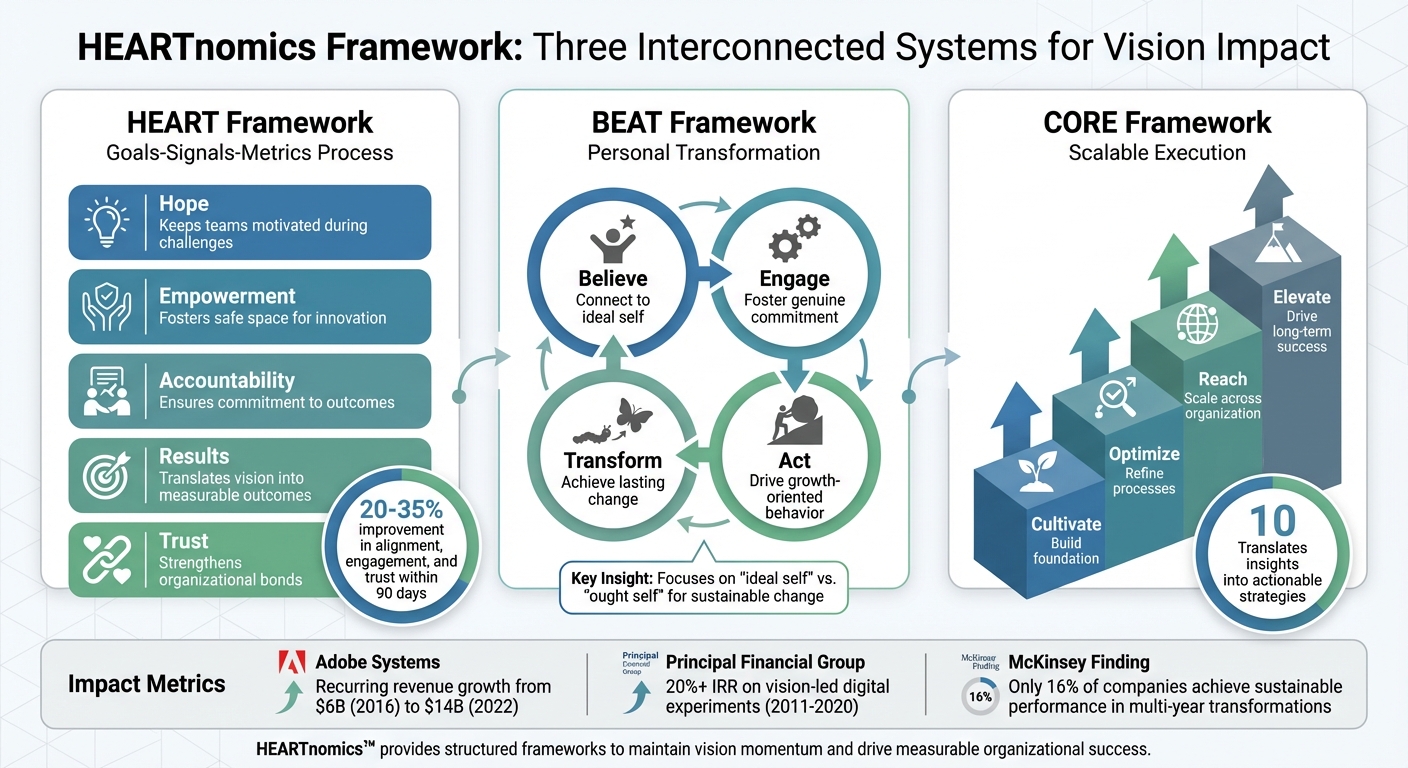
Vision Communication Framework: HEART, BEAT, and CORE Systems for Leadership Alignment
A vision without a way to measure its progress is like setting sail without a compass – it lacks direction and impact. Leaders need reliable ways to assess whether their vision is resonating and delivering the desired results. The real challenge lies in selecting metrics that not only track actions but also reveal how people are engaging on both emotional and intellectual levels.
Setting Key Performance Indicators (KPIs)
To gauge the success of a vision, effective KPIs should capture alignment, engagement, and even physiological responses. Tools like the V2MOM framework can help ensure alignment, with completion rates serving as a key indicator of enterprise-wide commitment [2]. Financial metrics, such as Internal Rate of Return (IRR), are also essential for evaluating the success of vision-driven initiatives. For example, Principal Financial Group saw an IRR of over 20% from six digital experiments aligned with their vision between 2011 and 2020 [2]. Similarly, Adobe Systems experienced a surge in recurring revenues, growing from $6 billion in 2016 to $14 billion by 2022, following a vision-led transformation [2].
Physiological metrics, like heart rate variability (HRV) and cortisol levels, can provide insights into how emotionally connected people feel to a vision. When a vision resonates, it activates the Positive Emotional Attractor (PEA) state, which is associated with higher HRV and lower cortisol levels. On the other hand, visions that feel forced or compliance-driven can trigger the Negative Emotional Attractor (NEA), which tends to stifle creativity and social connections [1].
| KPI Category | Specific Metrics | Impact Area |
|---|---|---|
| Alignment | V2MOM completion/cascading rates | Enterprise-wide commitment [2] |
| Financial | Internal Rate of Return (IRR) on vision-led projects | Strategic execution [2] |
| Physiological | Heart Rate Variability (HRV), Cortisol levels | Openness to change (PEA state) [1] |
| Neurological | DMN activation vs. TPN suppression | Creativity and social cognition [1] |
Using Feedback Loops for Improvement
Once KPIs are in place, the next step is to refine them through continuous feedback. Listening actively to your team is crucial – it helps uncover whether your vision is resonating or if there are barriers like mistrust, cynicism, or a sense of hopelessness [3]. Open conversations can clarify your vision and address concerns effectively [3].
"The more you talk to people and listen to them, the clearer your vision will become." – Community Tool Box [3]
Experimentation also plays a key role in refining a vision. For instance, Principal Financial Group’s digital strategy committee ran dozens of experiments across business units, ultimately focusing on six areas that showed the most promise based on real-world data [2]. By using experimental data, leaders can fine-tune their vision while staying focused on long-term goals rather than getting distracted by short-term fluctuations [3].
While quantitative metrics provide valuable snapshots, it’s the ongoing dialogue that keeps a vision dynamic and adaptable.
Maintaining Momentum with HEARTnomics Frameworks
Sustaining the impact of a vision requires structured frameworks. The HEARTnomics™ approach offers three interconnected systems – HEART (Hope, Empowerment, Accountability, Results, Trust), BEAT (Believe, Engage, Act, Transform), and CORE (Cultivate, Optimize, Reach, Elevate) – designed to maintain alignment, resilience, and performance under pressure.
The HEART system uses a Goals-Signals-Metrics process to ensure that every vision translates into measurable outcomes. This approach aligns with practices like starting planning cycles with "dreaming" sessions, where leaders explore long-term possibilities before setting annual budgets [2].
BEAT focuses on the personal transformation needed for people to embrace a vision. Research shows that visions rooted in the "ideal self" tend to inspire growth and accomplishment, while those based on the "ought self" often focus on safety and responsibility – an approach that is less effective for driving lasting change [1]. By connecting individual aspirations to the broader organizational vision, BEAT fosters genuine commitment rather than mere compliance.
Finally, CORE ensures that vision-driven initiatives scale effectively across an organization. This framework translates emotional and intellectual insights into actionable strategies, helping teams execute the vision in a meaningful way [2].
Organizations that implement HEARTnomics frameworks report a 20–35% improvement in alignment, engagement, and trust within just 90 days. These tools are especially critical given findings from a 2018 McKinsey study, which revealed that only 16% of companies undertaking multi-year digital transformations saw sustainable performance improvements [2]. By combining measurable metrics with structured frameworks, leaders can maintain momentum and drive long-term success.
Conclusion: Leading with Vision and Excellence
Communicating a vision is not a one-time task – it’s an ongoing effort that requires persistence and clarity. Adobe’s transformation is a powerful example of how staying committed to a vision, even through challenges, can lead to extraordinary results [2]. As Ron Ashkenas and Peter D. Moore aptly put it:
Turning a vision into a new reality doesn’t happen overnight. But if you have persistence and stay true to your vision, it may be the most important contribution you’ll ever make as a leader [2].
The key to turning vision into results lies in structured frameworks. This is where systems like HEARTnomics™ play a pivotal role – not as an extra layer, but as the very foundation for aligning emotional intelligence with operational goals.
The HEART framework – Hope, Empowerment, Accountability, Results, Trust – transforms inspiration into action. Hope keeps teams motivated during tough times, empowerment fosters a safe space for innovation, and trust strengthens the bonds that help organizations weather pressure [21]. Organizations that adopt such frameworks often see measurable improvements – 20–35% increases in alignment, engagement, and trust within just 90 days. These are the tangible outcomes that bridge the gap between aspiration and execution.
Structured planning is essential for translating vision into everyday actions. Start with "dreaming" sessions to explore long-term possibilities before diving into budget planning [2]. Focused experimentation is another valuable tool; for instance, Principal Financial Group’s digital strategy committee refined their approach over time and achieved an internal rate of return exceeding 20% across 11 years [2]. By integrating systems like these, organizations can merge operational precision with personal dedication to create sustainable success.
Ultimately, leading with vision is about building trust that reinforces leadership. This aligns with earlier strategies for fostering psychological safety and meaningful team engagement. When clear communication is coupled with frameworks like HEART, BEAT, and CORE, leaders create more than just alignment – they cultivate a culture where people believe in the mission, engage with purpose, and turn challenges into opportunities for growth.
FAQs
How does storytelling make it easier for leaders to communicate their vision?
Storytelling takes a vision from being just a statement to becoming an emotionally engaging narrative that truly connects with people. When leaders share their vision as a story, they create a bond that inspires action and gives a deeper sense of purpose – something that raw data or logical arguments alone can’t achieve.
A strong vision story includes a few essential ingredients: a clear and forward-looking plot, a meaningful connection to personal values, flexibility to resonate with different audiences, and an air of inevitability that makes the goal feel within reach. This storytelling approach simplifies complex ideas, makes the vision relevant to individual roles, and sparks emotional investment. When people can see themselves in the story, they’re far more likely to embrace the message and take action.
In a world that moves at lightning speed, storytelling has the power to grab attention, build trust, and bring teams together around a common goal. Tools like HEARTnomics™ weave storytelling with emotional intelligence and operational strategies, helping leaders drive meaningful change and long-term growth.
What mistakes should leaders avoid when creating a vision statement?
When creating a vision statement, it’s easy to stumble into a few common pitfalls that can weaken its message and purpose. One frequent misstep is centering the statement on the organization’s goals rather than addressing the customer’s needs. This approach can make the vision feel self-centered instead of motivating or relevant. Another issue is relying on generic or vague language, which can leave the statement feeling flat and forgettable.
Some vision statements also suffer from being overly complicated, crammed with jargon or long-winded phrases that are tough to grasp or remember. Treating the vision as a static slogan rather than a flexible guide for decision-making is another mistake that can sap its usefulness. Finally, blending the vision with a sales pitch or confusing it with mission-level specifics often muddles its purpose and clarity.
To steer clear of these issues, focus on crafting a vision that is customer-oriented, clear, and actionable. A strong vision should inspire your team, offer clear direction, and act as a strategic tool to align efforts and support long-term goals.
Why is involving employees in shaping the vision important for achieving buy-in?
When employees have a hand in shaping their organization’s vision, it stops being just a directive handed down from above. Instead, it becomes a shared mission everyone feels part of. This kind of collaboration creates a sense of psychological ownership, where employees clearly see how their roles connect to the bigger picture. The result? A workforce that feels more engaged, motivated, and ready to support the vision, even when obstacles arise.
HEARTnomics™ weaves employee participation into its HEART (Hope, Empowerment, Accountability, Results, Trust) and BEAT (Believe, Engage, Act, Transform) frameworks. These models encourage leaders to involve teams early on, gather their input, and align individual efforts with broader strategic goals. By doing so, organizations can build trust, enhance workplace culture, and ensure the vision is not only practical but also resilient – fueling performance and long-term growth.