Root Cause Analysis (RCA) is a structured approach for identifying the true cause of problems, rather than just addressing symptoms. It’s essential for reducing recurring issues, improving processes, and saving costs. RCA works hand-in-hand with Continuous Improvement (CI) methods like Lean and Six Sigma by focusing on long-term solutions.
Key takeaways:
- RCA identifies underlying issues to prevent recurring problems.
- CI emphasizes small, consistent improvements using data-driven decisions.
- RCA reduces costs from poor quality, which can account for 10-15% of operational expenses.
- Effective RCA methods include the 5 Whys, Fishbone Diagrams, and Pareto Analysis.
- RCA supports a shift from reactive problem-solving to proactive prevention.
Goals and Benefits of Root Cause Analysis in Continuous Improvement
Core Objectives of RCA
Root Cause Analysis (RCA) has three main objectives that set it apart from quick-fix problem-solving. First, it focuses on identifying the underlying causes of issues rather than just addressing the symptoms. For instance, instead of simply repairing a broken machine, RCA digs deeper to find out why it broke in the first place [1][6]. Second, it aims to prevent recurring problems by tackling the factors that allow issues to resurface, breaking the cycle of repeated failures [1][8]. Third, RCA provides a structured method to implement corrective actions, targeting specific process or system failures [1][3].
One of RCA’s most impactful shifts is moving organizations from reactive to proactive problem-solving. Instead of constantly putting out fires, teams learn to anticipate potential issues and design systems to avoid them altogether [1][6][2]. This proactive mindset aligns with W. Edwards Deming’s belief:
Most issues are system problems, not people problems
[5]. When teams embrace this perspective, they foster an atmosphere where employees feel safe sharing honest insights, which are critical for effective analysis.
RCA also promotes standardization across organizations. Lessons from investigations often lead to updates in Standard Operating Procedures (SOPs) and the creation of best practices. These changes ensure consistency and help prevent the same mistakes from occurring in different departments or locations [1][7]. Together, these objectives contribute to meaningful operational, financial, and workplace improvements.
Benefits in Organizational Growth
By achieving these objectives, RCA drives improvements across operations, finances, and workplace culture. On an operational level, organizations see less waste, better machine reliability, and smoother workflows [4][12]. Pareto Analysis highlights that a small number of root causes often account for most downtime, making targeted RCA efforts highly effective [12].
Financially, RCA helps lower maintenance costs, minimize quality defect expenses, and boost profitability by preventing costly recurring errors and reducing rework [6][4][12]. Considering that poor quality can eat up 10–15% of operational costs and 15–20% of sales revenue [5], the savings from systematic RCA can be substantial.
Culturally, RCA strengthens employee morale, trust, and engagement by shifting organizations from a reactive blame culture to proactive problem-solving [6][10][11]. When employees see their feedback leading to meaningful improvements rather than finger-pointing, their engagement naturally grows. Research shows that 29% of customers are more likely to stay loyal if they believe their complaints result in genuine operational changes [10]. Additionally, projects that incorporate effective change management are seven times more likely to meet or exceed their goals [11].
HEARTnomics CORE Framework Integration
The HEARTnomics CORE (Cultivate, Optimize, Reach, Elevate) framework enhances RCA by aligning people and processes to drive results. While RCA traditionally focuses on technical problem-solving, CORE incorporates the human element, recognizing that long-term improvement depends on both operational efficiency and cultural change.
- Cultivate: Fosters a culture where employees feel safe reporting problems without fear of blame [14][15]. This aligns with RCA’s principle that most problems are rooted in systems, not individuals, creating the psychological safety needed for honest investigations.
- Optimize: Aligns tasks, processes, and employee skills using diagnostic tools [3].
- Reach: Ensures RCA solutions are consistently applied across the organization through standardized work and cross-functional collaboration [13].
- Elevate: Builds sustainability by embedding monitoring metrics into daily procedures, ensuring corrective actions are tracked and maintained over time [13].
Between January 2020 and June 2024, a community health system demonstrated the power of this integrated approach. By standardizing RCA practices and involving a multidisciplinary team, they achieved remarkable results: staff nervousness scores dropped from 32.40 to 13.96 on a 100-point scale, the time to the first interview decreased from 2 days to 1 day, and the total cycle time for event finalization was cut by 58% – from 31 days to 13 days. Additionally, non-fall-related safety events dropped from an average of 10.5 per year to 6 per year [13][14].
This example shows how combining RCA with frameworks that emphasize trust, accountability, and culture can lead to lasting improvements. By embedding CORE principles, organizations can strengthen their continuous improvement strategies and achieve results that purely technical approaches might miss. RCA, when integrated with these methods, becomes a powerful tool for sustainable progress.
When and Why to Perform Root Cause Analysis
Common Triggers for RCA
Root Cause Analysis (RCA) becomes essential when recurring problems show that quick fixes just aren’t cutting it. One of the biggest signs? Issues that keep cropping up despite previous "solutions." Think repeated software glitches, ongoing missed deadlines, or production defects that pop up again and again [1][8]. A practical guideline is the "Three-Strike" Rule: if a problem happens three times in a row, it’s time to dig deeper with RCA [8].
Operational hiccups are another major trigger. These include equipment breakdowns, workflow bottlenecks, or machinery failures that disrupt production schedules [8][4]. In tech environments, system outages and server crashes are red flags. For instance, over half (53%) of digital infrastructure operators reported at least one major outage in a three-year span, with downtime costs hitting an eye-watering $5,600 per minute [5]. Safety-related incidents also demand immediate RCA, especially in high-stakes fields like healthcare or engineering, where a single mistake could expose systemic risks [8].
Other triggers can include customer complaints, performance shortfalls, or even tension within teams [8][3][6]. Some organizations adopt a "72-hour operating rhythm" to manage such issues: contain the impact within six hours, identify the root cause within 48 hours, and finalize corrective actions by 72 hours [5].
Recognizing these triggers underscores how ignoring root causes can lead to hidden, compounding costs that ripple across an organization.
The Cost of Ignoring Root Causes
When recurring problems are left unchecked, the fallout can be both operational and financial. Treating symptoms instead of root causes traps organizations in a frustrating cycle of wasted time, resources, and effort [6][7]. Research highlights how poor problem diagnosis leads to missed opportunities and significant business losses [3].
But it’s not just about money. Failing to address root causes can damage customer trust and tarnish a company’s reputation. For example, only 29% of customers say they’re more likely to stick with a company if they believe their complaint will drive real operational changes [10]. Ignoring deeper issues can also lead to compliance headaches. Regulatory bodies like the Department of Justice evaluate how thoroughly a company investigates root causes when determining penalties [17]. As Rebecca Walker puts it:
"Without understanding root causes, remediation efforts risk addressing only symptoms, leaving organizations vulnerable to repeat failures"
[17].
Over time, the costs of neglect pile up. Departments clash, employees resist change, and a reactive mindset takes hold, stalling long-term progress [3][6]. Tackling root causes isn’t just about fixing today’s problems – it’s about creating systems that enable lasting improvements.
Root Cause Analysis: Digging Deeper with 5 Whys and 6Ms
Key Steps and Techniques in Root Cause Analysis
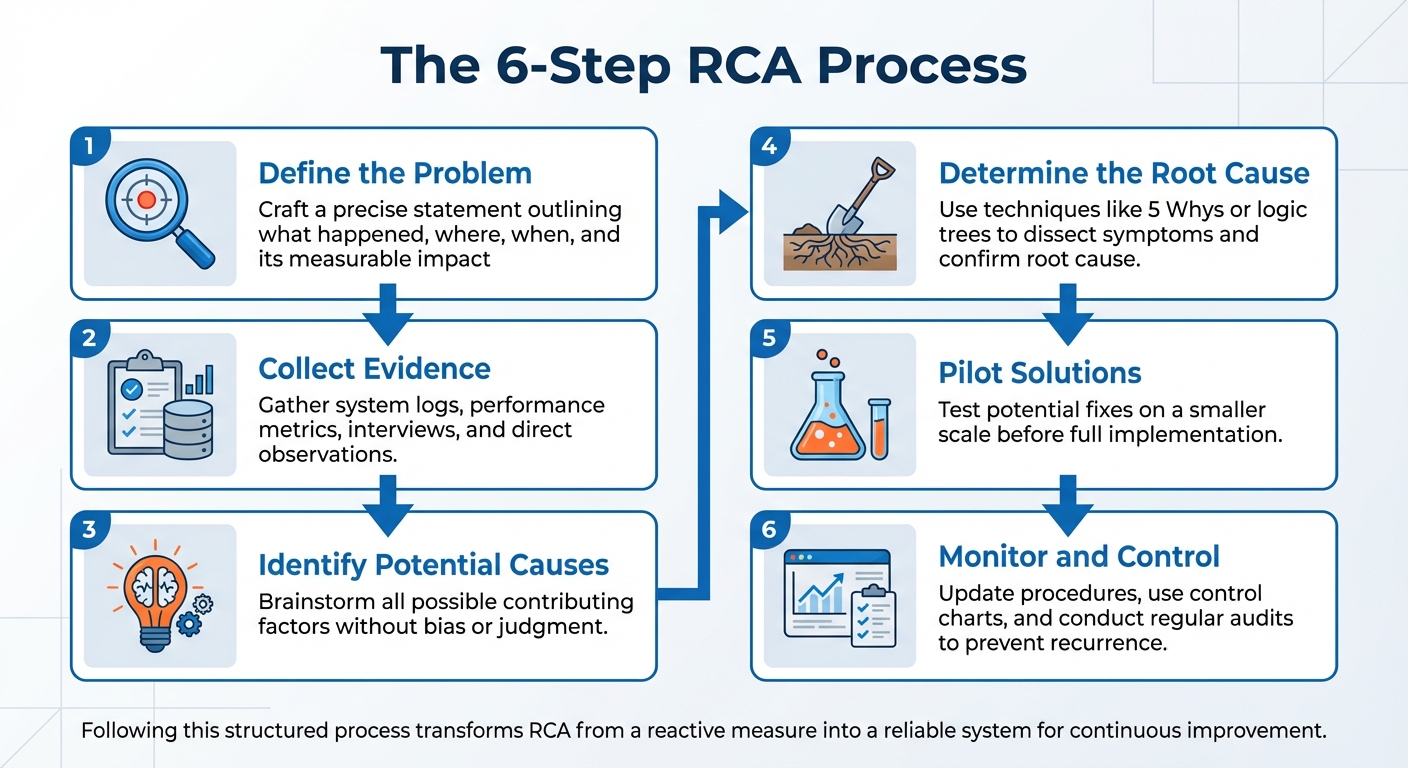
6-Step Root Cause Analysis Process for Continuous Improvement
6 Steps in the RCA Process
Root Cause Analysis (RCA) is most effective when approached methodically, following six clear steps that guide teams from identifying the problem to implementing lasting solutions. It all starts with defining the problem – crafting a precise statement that outlines what happened, where, when, and its measurable impact. This clarity keeps teams focused and avoids the temptation to jump straight to solutions [1][9].
The second step is collecting evidence. This involves gathering system logs, performance metrics, interviews, and direct observations to ensure decisions are based on facts, not assumptions [1][18]. Once the data is in place, the third step is identifying potential causes. Brainstorming sessions come into play here, encouraging exploration of all possible contributing factors without bias or judgment [1][8].
The fourth step – determining the root cause – is where deeper analysis happens. Techniques like the 5 Whys or logic trees help dissect symptoms and confirm the root cause using the evidence collected [1][18]. After pinpointing the root cause, the next step is to pilot solutions. Testing these potential fixes on a smaller scale ensures effectiveness before a full-scale implementation [1][9].
Finally, monitoring and control secures the solution. This includes updating procedures, utilizing control charts, and conducting regular audits to ensure the problem doesn’t resurface [1][18]. By following this structured process, RCA becomes more than just a reactive measure – it evolves into a reliable system for continuous improvement [5].
These steps provide the groundwork for choosing the right techniques to uncover root causes effectively.
Common RCA Techniques
Alongside the six-step process, several techniques can be used to dig into root causes, each suited to different problem types and complexities. These tools help teams uncover underlying issues efficiently.
The 5 Whys is one of the simplest methods. By repeatedly asking "Why?" – typically five times – you can trace symptoms back to their source. It’s quick and intuitive, making it ideal for straightforward issues. However, without a skilled facilitator, it risks oversimplifying more complex problems [1][8][18].
For problems with multiple contributing factors, the Fishbone Diagram (or Ishikawa Diagram) organizes potential causes visually. It categorizes them into the "6 Ms": Man (People), Machine (Equipment), Method (Process), Material, Measurement, and Mother Nature (Environment). This approach fosters broad thinking but can become overwhelming without data to narrow down the possibilities [18][8].
Pareto Analysis applies the 80/20 rule, focusing on the "vital few" causes that account for the majority of a problem. This helps teams prioritize fixes that will deliver the biggest impact [18][8]. On the other hand, Fault Tree Analysis is a more detailed method, using logic gates to map how smaller failures combine to cause major breakdowns. It’s especially useful in safety-critical environments but requires specialized expertise [1][18].
As Harvard Business School Professor Michael Tushman points out:
A core idea is you must do a thorough diagnosis first, determine the root causes of your gap, and only then can you move to an integrated intervention based on this diagnosis
[3].
These techniques, when paired with the structured RCA process, equip teams to tackle problems systematically and achieve meaningful solutions.
sbb-itb-5c9cdaf
Integrating RCA into Lean Six Sigma and Organizational Frameworks
RCA and DMAIC Cycles

Root Cause Analysis (RCA) plays a key role in the DMAIC framework (Define, Measure, Analyze, Improve, Control) used in Lean Six Sigma. Here’s how it fits into each phase:
- Define: RCA helps clearly outline problems using tools like SIPOC diagrams and Voice of the Customer analysis.
- Measure: Data collection tools such as process mapping and Pareto charts establish baselines and quantify the issues at hand.
- Analyze: Techniques like the 5 Whys, Fishbone Diagrams, and Failure Mode and Effects Analysis (FMEA) pinpoint the root causes of problems.
- Improve: Once causes are identified, solutions are implemented. Methods like Poka-Yoke (mistake-proofing) are often used to eliminate the chance of recurrence.
- Control: Tools such as Control Charts, checklists, and Standard Work ensure that the improvements are sustained over time [1].
Harvard Business School Professor Michael Tushman highlights the importance of taking a deliberate approach:
Leaders often rush to solutions. A core idea is you must do a thorough diagnosis first, determine the root causes of your gap, and only then can you move to an integrated intervention based on this diagnosis [3].
For example, a global electronics manufacturer faced recurring defects in solder joints that disrupted production. Using the 5 Whys within the DMAIC cycle, the team traced the issue to inconsistent temperature control in a reflow soldering oven. A Fishbone Diagram revealed the deeper cause: a neglected maintenance schedule due to insufficient training and documentation for a newly formed maintenance team. By introducing standardized operating procedures (SOPs), monthly maintenance routines, and comprehensive training, the company reduced defect rates by 60% within three months, saving over $100,000 annually [7].
While DMAIC provides a structured, technical approach, sustaining these improvements requires fostering a supportive and proactive organizational culture.
HEARTnomics HEART and BEAT Frameworks
Technical tools like DMAIC are essential, but they need to be paired with a culture that encourages openness and accountability. HEARTnomics offers two frameworks that help organizations build this foundation:
- HEART Framework: Focuses on fostering psychological safety through Hope, Empowerment, Accountability, Results, and Trust. This encourages team members to communicate openly and take ownership of their roles.
- BEAT Framework: Guides both personal and organizational transformation through four pillars: Believe, Engage, Act, and Transform.
By combining these frameworks, HEARTnomics aligns leadership development with operational goals. According to their data, organizations using these methods see a 20–35% improvement in alignment, engagement, and trust within just 90 days [heartnomics.com].
Incorporating both technical precision and cultural empowerment equips organizations to not only solve problems but also build resilience for ongoing improvement.
Research and Case Studies: Proven Impact of Root Cause Analysis
Measuring Results of RCA
The impact of Root Cause Analysis (RCA) on both financial and operational performance is undeniable. When organizations adopt RCA systematically, they transition from constantly reacting to problems ("firefighting") to addressing issues proactively. This shift allows resources to focus on activities that add value instead of repeatedly fixing the same errors [2]. Consider this: the "cost of poor quality" (COPQ) often accounts for 10%–15% of operations costs and can climb as high as 15%–20% of sales revenue [5]. On top of that, downtime costs are estimated to hit around $5,600 per minute [5]. These numbers highlight the financial stakes of not addressing root causes effectively.
The real-world results of RCA speak volumes. For instance, Gatwick Airport introduced RCA-driven IT solutions in October 2024 to optimize its single runway, which handles 55 air traffic movements per hour. By pinpointing and resolving inefficiencies in security processes, they achieved a remarkable milestone: 95% of passengers cleared security within five minutes [19]. Similarly, Niki Golf automated RCA workflows to enhance cybersecurity and customer experience. The results? A 75% improvement in incident response times and a 50% reduction in manpower needed for analysis [19]. These examples demonstrate how RCA can deliver immediate operational benefits while setting the stage for long-term improvements.
It’s worth noting that over half of digital infrastructure operators reported major outages within a recent three-year span, largely due to poor diagnostic practices [5]. When RCA is applied effectively, it doesn’t just solve problems – it transforms operations.
HEARTnomics Success Stories
Sustained improvement goes beyond technical solutions; it requires alignment at every level of an organization. HEARTnomics combines RCA’s operational focus with leadership development to create lasting change. By leveraging its proprietary frameworks, HEARTnomics enables organizations to achieve a 20–35% improvement in alignment, engagement, and trust within just 90 days [heartnomics.com].
One key insight from HEARTnomics is that 29% of customers are more likely to remain loyal to a company if they see their complaints lead to meaningful changes [10]. This underscores the importance of blending RCA’s analytical approach with leadership strategies that prioritize accountability and psychological safety. When teams feel empowered to address problems openly, they move from merely fixing defects to fostering a culture of continuous improvement. This integration ensures that RCA doesn’t just reduce errors – it reshapes how teams think, collaborate, and tackle challenges for long-term success.
Best Practices for Long-Term Success with RCA
Guidelines for Implementing RCA
To make Root Cause Analysis (RCA) truly effective, there are a few key practices to keep in mind. First, fostering a blameless culture is critical. When teams focus on identifying and fixing systemic issues instead of pointing fingers, it creates an environment of psychological safety. This encourages open and honest reporting. Using language that attributes failures to processes rather than individuals helps maintain a constructive, solution-oriented approach [10][11].
Another cornerstone of successful RCA is standardizing data collection from the start. Frontline staff should have the tools they need to document complaints accurately during the initial interaction. Poor data at the outset can derail the entire RCA process later on [10]. When it comes to solutions, opt for meaningful, high-impact corrective actions rather than temporary fixes. For instance, instead of relying on refresher training (which often has limited impact), consider implementing stronger measures like automation, system redesigns, or mistake-proofing techniques like Poka-yoke [5]. Research shows that projects combining effective change management with RCA are seven times more likely to achieve their goals [11].
Collaboration across departments is another essential ingredient. When teams from various functions work together, it prevents siloed thinking and leads to more thorough analyses [3][6]. Establishing dedicated RCA forums can facilitate this collaboration, offering a space for departments to share findings and contextualize them with real-world examples of customer impact [10]. Lastly, tracking key performance indicators (KPIs) – such as resolution rates for root-level issues and reductions in recurrence – ensures that improvements are not only achieved but sustained over time [20][6].
By following these practices, organizations can create a solid foundation for integrating RCA into their continuous improvement efforts.
Embedding RCA into Continuous Improvement Culture
Taking these implementation steps further, embedding RCA into your organization’s day-to-day operations requires tying it directly to your strategic goals. When RCA aligns with your company’s overarching objectives, it becomes a driver for meaningful action at every level, supporting long-term progress [20]. One effective approach is adopting a structured "72-hour operating rhythm." This involves containing the initial impact within six hours, validating the root cause within 48 hours, and approving corrective actions within 72 hours. This method transforms RCA into a dynamic, repeatable process that emphasizes learning and agility rather than getting bogged down by excessive paperwork [5].
Celebrating wins is another way to reinforce RCA’s value. Sharing success stories in dedicated forums not only highlights the positive outcomes but also motivates teams and underscores the importance of the process [10]. By embedding RCA into everyday workflows, organizations can tackle root causes effectively while fostering resilience and trust. Over time, this shifts the focus from reactive problem-solving to proactive, systemic changes that fuel sustainable growth and continuous improvement.
Conclusion
Root Cause Analysis (RCA) lays the groundwork for organizations focused on continuous improvement rather than constantly putting out fires. By addressing the underlying causes of issues instead of just the symptoms, RCA offers a way to resolve problems for good. As Splunk explains:
RCA isn’t about fixing what’s broken – it’s about ensuring continuous improvement and optimizing processes for long-term success
[19].
The benefits of RCA are well-documented. Case studies highlight its ability to streamline operations and cut down response times [19]. But the impact goes beyond just efficiency. Projects that incorporate effective change management practices, supported by RCA, are seven times more likely to achieve or exceed their goals [11].
However, RCA alone isn’t enough. As ASQ emphasizes:
root cause analysis in itself will not produce any results; it must be part of a broader quality improvement effort
[16].
This is where structured frameworks like the HEARTnomics CORE and HEART principles come into play. The HEARTnomics CORE Framework – Cultivate, Optimize, Reach, Elevate – provides a strategic blueprint for embedding RCA into daily operations. Meanwhile, the HEART principles – Hope, Empowerment, Accountability, Results, Trust – foster the blame-free culture necessary for open and honest analysis. Together, these approaches turn RCA into more than just a problem-solving tool; they make it a catalyst for proactive growth.
Organizations that fully integrate RCA into these broader strategies don’t just address issues – they build resilience, improve collaboration, and sharpen analytical skills. By combining RCA’s precision with frameworks that align people and processes, leaders create environments where continuous improvement becomes second nature. This approach not only delivers operational excellence but also drives cultural transformation, setting the stage for long-term success.
FAQs
How do I know when a problem needs an RCA?
Root cause analysis (RCA) becomes essential when a problem keeps coming back, creates major disruptions, or points to underlying systemic flaws. It’s particularly helpful when temporary fixes don’t work, critical performance indicators take a hit, or when customer satisfaction and operational performance are in jeopardy. By tackling the core issues, RCA not only prevents problems from resurfacing but also promotes ongoing improvement and sustainable progress through forward-thinking solutions.
Which RCA tool should I use first?
Start with the 5 Whys technique. This method involves asking "Why?" repeatedly – usually five times – to drill down to the root cause of a problem. It’s straightforward, quick to implement, and doesn’t rely on complicated data or tools.
For more intricate problems, you might want to use tools like Fishbone diagrams. These diagrams help visually outline cause-and-effect relationships, making it easier to see contributing factors. Begin with the 5 Whys to gain initial clarity, then turn to structured tools like Fishbone diagrams for a more in-depth analysis and long-term solutions.
How do we stop the same issue from coming back?
To tackle problems effectively and avoid them cropping up again, it’s crucial to dig deep and address their root causes instead of just managing the symptoms. Root Cause Analysis (RCA) is a method designed to uncover the real reasons behind issues, paving the way for lasting solutions. Tools like the "5 Whys", fishbone diagrams, or the DMAIC framework are excellent for identifying deeper, systemic problems. Once you’ve pinpointed the cause, take corrective actions, track how well they work, and integrate the changes into your processes. This approach helps ensure long-term improvement and reduces the chances of the same problems happening again.