Total Quality Management (TQM) often fails because leaders struggle to align actions with goals. Despite TQM’s promise to improve quality across organizations, studies show that nearly 40% of companies abandon these initiatives, and only 16% find them highly successful. The main reasons? Lack of leadership commitment, employee resistance, poor training, misuse of tools, and short-term thinking.
Key takeaways:
- Leadership matters: A gap between words and actions undermines TQM, but leaders can Unlock Your HEART Leadership Code™ to bridge it.
- Employee trust: Fear of blame stifles problem-solving.
- Training gaps: One-off sessions don’t prepare teams for systemic changes.
- Short-term focus: Chasing quick wins derails long-term improvements.
To make TQM work, leaders must prioritize quality, invest in training, empower teams, and commit to long-term goals. Success comes from addressing root causes, not just symptoms.
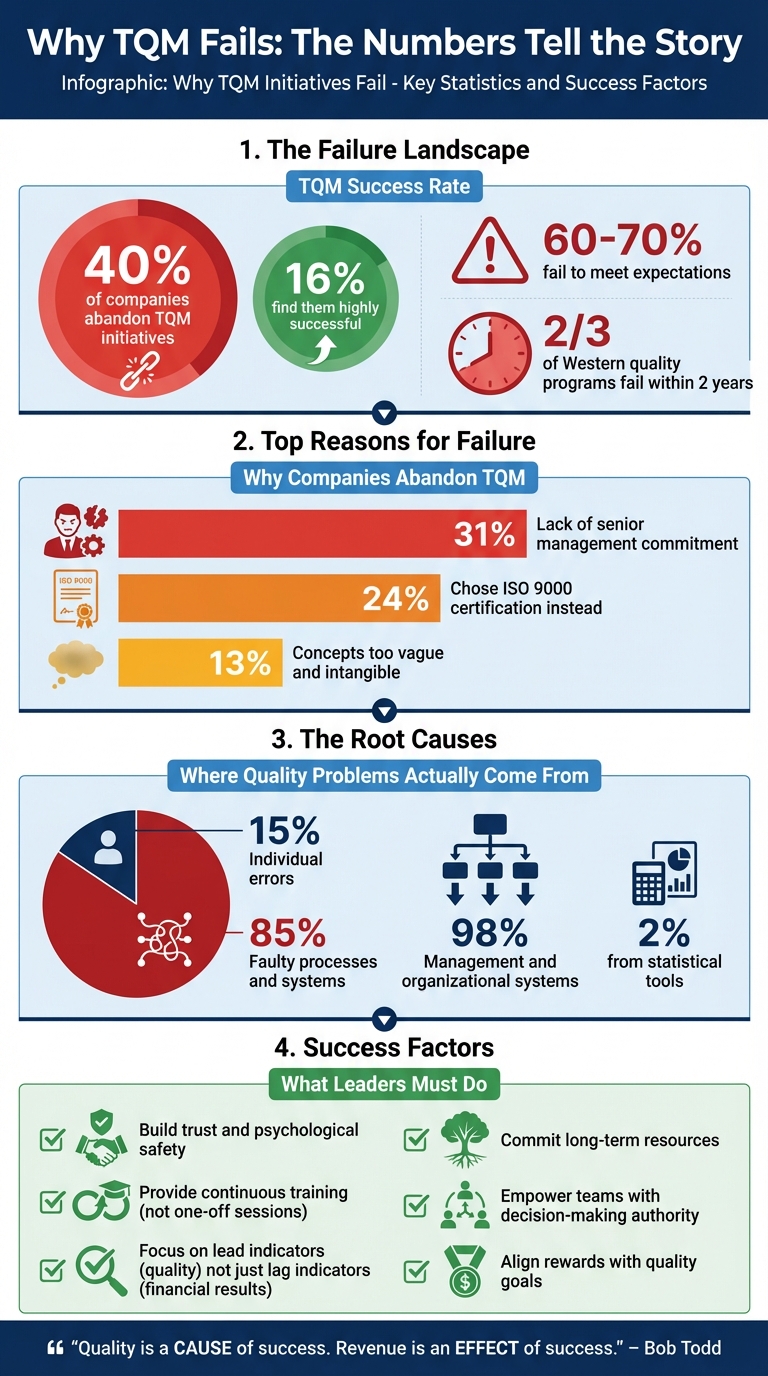
Why TQM Initiatives Fail: Key Statistics and Success Factors
Why Business Excellence Without TQM Always Fails | B. Muthuraman | Ex-MD Tata Steel
sbb-itb-5c9cdaf
Why TQM Initiatives Fail
When Total Quality Management (TQM) initiatives fall short, it’s often because leadership, workplace culture, training, tool usage, and resource allocation fail to fully support the program’s goals.
Missing Leadership Commitment
One of the biggest obstacles to TQM success is a gap between what leaders say and what they actually do. In a five-year study of 109 companies, 31% of those that abandoned TQM blamed a lack of senior management commitment as the main reason [3]. Often, leaders give verbal support to TQM but remain focused on financial metrics and surface-level tactics. This approach neglects the deeper systemic changes and employee empowerment that TQM requires. As Bob Todd from Bridgeport, CT, noted, many leaders prioritize “lag indicators (financial results)” like revenue and stock price – the outcomes of success – while ignoring the root causes, such as product quality, service excellence, and employee engagement [2].
Additionally, many managers struggle to understand their role in a TQM framework. Without proper leadership development programs, they fail to transition from traditional oversight to quality-focused leadership, leading to inconsistent application of TQM principles across the organization [5]. Without strong leadership alignment, cultural resistance becomes another major hurdle.
Cultural Resistance to Change
Even when leadership is on board, resistance from employees can derail TQM efforts. Past experiences with short-lived programs often breed skepticism, and fear of blame discourages open problem-solving. Misaligned reward systems only make things worse by reinforcing old habits. Employees may see quality initiatives as vague or secondary compared to more defined certifications like ISO 9000. When workers fear that pointing out process failures will lead to punishment rather than improvement, they choose to stay silent [2]. This silence creates what Harvard’s Michael Beer calls “organizational defenses” – barriers that prevent the honest conversations needed for meaningful quality improvements [1].
Organizations that continue to reward traditional metrics – like production volume, closed sales, or cost-cutting – while expecting employees to prioritize quality send mixed signals. Unsurprisingly, the cultural shift never takes hold. In one study, 13% of companies that abandoned TQM said the concepts felt “too vague and intangible” to integrate into their culture, while 24% opted for ISO 9000 certification instead, seeing it as less disruptive [3]. These cultural challenges often stem from and are worsened by inadequate training.
Poor Training and Employee Preparation
One-day workshops or superficial training sessions fail to provide the systemic understanding that TQM demands. Continuous education, focused on systems rather than individual blame, is critical. Unfortunately, many organizations fail to clearly explain TQM principles or their benefits, leaving employees to dismiss the initiative as just another passing trend [5]. Compounding the issue, some training programs focus on frontline workers, when in reality, about 85% of quality problems are tied to faulty processes, not individual errors [6]. The real emphasis should be on leadership training and fostering a systems-thinking approach.
Wrong Use of Quality Tools and Data
Tools like statistical process control and process mapping are valuable but can mislead if used without addressing underlying management systems. This can result in overconfidence or misinterpreted data. Interestingly, statistics-based tools only address about 2% of quality issues, while the remaining 98% stem from broader management and organizational systems [7]. Leaders who fail to confront systemic issues often rely too heavily on technical tools, hoping they’ll solve deeper problems.
As quality expert Philip Crosby once said:
The problem of quality management is not what people don’t know about it. The problem is what they think they do know [6].
This misplaced confidence can lead to the misuse of tools, poor data analysis, and ineffective improvement efforts. Collecting quality data is not enough – organizations need the expertise to turn it into meaningful action.
Short-Term Thinking and Limited Resources
Treating TQM as a short-term initiative undermines its potential. When organizations prioritize quick wins over long-term investment, they cut essential resources, stalling progress. In fact, two-thirds of quality programs in Western firms fail within two years because they don’t produce immediate, measurable results [7]. Impatient leadership often shifts focus when quarterly earnings don’t improve, redirecting resources to projects with faster payoffs.
This short-term mindset can lead to what one observer called the “anorexia risk” – extreme cost-cutting that weakens a company’s ability to sustain quality improvements [2]. When budgets are tight, training programs are slashed, quality roles are eliminated, and improvement projects are abandoned. Overcoming these challenges requires a long-term commitment to TQM, with consistent resource allocation and patience to see meaningful transformation take root.
Lessons for Leaders to Make TQM Work
To avoid the pitfalls that often derail Total Quality Management (TQM) efforts, leaders need to address the root causes of failure. Here are some practical strategies for building TQM initiatives that last.
Build a Culture of Quality and Trust
Trust is the backbone of any successful TQM program. Without it, employees may shy away from reporting issues or suggesting improvements. Leaders need to create an environment where workers feel safe discussing problems without fear of blame or punishment [2]. Harvard professor Michael Beer emphasizes the importance of fostering “honest organizational-wide conversations that surface valid data about the quality of management” [1].
This cultural shift starts at the top. When senior leaders actively engage in quality initiatives, rather than passing the responsibility to middle management, it sends a clear message: quality is a priority [8]. Leaders can further build trust by admitting they don’t have all the answers and sharing their personal growth stories, which helps foster psychological safety [2]. Empowering employees by decentralizing decision-making also encourages shared responsibility for quality outcomes [2][4].
Incorporating quality metrics into executive evaluations and compensation plans reinforces this commitment [8]. As quality expert Bob Todd puts it:
If you want your people to pay attention to important things, you must measure and reward important things [2].
Recognition programs that celebrate both individual and team contributions – highlighting the efforts and innovations behind improvements – help sustain this culture. Once trust is established, the next steps involve skill-building and clear communication.
Prioritize Training and Transparent Communication
One-off training sessions won’t cut it. Effective training involves ongoing mentoring and practical application of quality principles [8]. Programs should balance technical skills, like statistical process control, with cultivating a mindset focused on quality [8]. When senior managers join training sessions, it signals that quality isn’t just a delegated task but a shared strategic priority [2][8].
Communication needs to go beyond buzzwords. Sharing tangible examples – such as the financial impact of quality failures, like costs from rework or customer complaints – helps employees see why quality matters [8]. Formal feedback systems allow employees to voice concerns about TQM implementation without fear of backlash [1]. This kind of open dialogue bridges the gap between management’s quality rhetoric and the reality on the ground [1].
Align Strategy, Metrics, and Customer Focus
For TQM to have a lasting impact, it must tie directly to business goals. Initiatives often fail when they feel disconnected or overly abstract. In a study of 109 firms, 13% of those that abandoned TQM described the concepts as “too vague and intangible” [3]. Leaders should replace broad objectives like “improve quality” with specific, measurable targets, such as “reduce customer complaints by 40% within 12 months” [8].
Bob Todd’s perspective highlights this focus:
Quality (of product, service, employees, management, processes) is a CAUSE of success in business. Quantity (of revenue, sales, market share, stock price) is an EFFECT of success in business [2].
By focusing on process quality and employee satisfaction, leaders can ensure metrics guide continuous improvement rather than just measure outcomes. Tracking both leading indicators (process performance) and lagging indicators (results) allows for quicker adjustments [8]. Monitoring metrics like customer satisfaction, transaction errors, and employee engagement ties quality efforts to overall business performance [8].
Every quality goal should have a clear owner, defined metrics, and a regular review process [8]. This makes quality a tangible, actionable part of the business strategy.
Commit to Long-Term Resources
Research shows that 60% to 70% of quality initiatives fail to meet expectations [8]. Leaders must resist the urge to chase quick wins and instead set realistic timelines that allow continuous improvement to take hold. Consistent funding for training, quality roles, and improvement projects is crucial – even when quarterly earnings pressures loom.
Reward systems must align with long-term quality objectives, not just short-term financial gains. When incentives focus solely on production volume or cost-cutting, they send mixed signals that can undermine quality efforts. Leaders should avoid what’s been called the “anorexia risk” – cutting resources so deeply in pursuit of profit that the organization loses its ability to innovate or function effectively [2]. Achieving sustainable TQM requires patience, steady investment, and a focus on long-term success over immediate results.
How Leaders Drive TQM Success
Leadership in Total Quality Management (TQM) isn’t just about words – it’s about action. To make TQM more than just a buzzword, leaders must actively participate, build trust, and adopt a systems mindset that connects every part of the organization. Here’s how leaders can turn their commitment into measurable success.
Lead by Example and Show Accountability
Effective TQM leaders don’t just delegate – they actively engage to overcome common leadership challenges. By attending training sessions alongside employees, they show that quality is a shared priority. When executives participate in the same workshops as frontline workers, it sends a powerful message: quality matters to everyone.
Accountability plays a big role here. Leaders who focus only on quarterly numbers while ignoring process quality risk undermining their organization. A short-term obsession with cost-cutting can lead to a loss of real value for customers. Leaders who prioritize quality processes over immediate results address the root causes of success rather than chasing temporary outcomes.
Being accountable also means admitting when you don’t have all the answers. Leaders who are open about their own challenges create an atmosphere of psychological safety, encouraging employees to report problems without fear of blame. This approach is backed by research showing that understanding an organization’s history is key to diagnosing why quality initiatives fail – accounting for nearly 90% of the reasons behind such failures [2].
Give Teams Ownership of Quality
Leadership alone isn’t enough – teams need to feel empowered to take ownership of quality improvements. Pushing decision-making down the hierarchy is critical in TQM. Employees closest to the work often spot issues and suggest solutions that higher-ups might miss. Data shows that around 85% of quality problems stem from faulty processes, not individual mistakes [6]. To address these systemic issues, teams need the authority to act.
Some companies use collaborative strategies, like Japan’s “Ringi” system, where proposals circulate across departments for feedback before approval. This method ensures that decisions are shaped by diverse perspectives and fosters collective responsibility.
Creating a safe space for employees to report errors and propose solutions is essential. When workers fear punishment for admitting mistakes, problems can stay hidden until they escalate into costly failures. Leaders must actively eliminate this fear, treating employees as partners in improving processes.
Use a Systems Approach to Leadership
Personal accountability and team empowerment lay the groundwork for a systems-focused leadership style. Effective TQM leaders see their organization as an interconnected network where every part influences the whole. Ignoring this interconnectedness – by focusing solely on financial results – means missing the root causes of both success and failure. As Bob Todd puts it, “Management attention should be directed more to causes than effects” [2].
To make TQM a core part of operations, leaders must integrate quality objectives into strategic planning [3]. This involves bridging the gap between what senior management says about quality and what actually happens across departments [1]. Harvard professor Michael Beer highlights the importance of “honest organizational-wide conversations that surface valid data about the quality of management” in various units [1].
A systems perspective also helps leaders avoid “symptomatic” fixes – quick solutions that don’t address deeper organizational problems. Aligning reward systems with quality goals is another key step. As Todd reminds us, “If you want your people to pay attention to important things, you must measure and reward important things” [2]. Shifting focus from lag indicators (like financial results) to lead indicators (like process quality and employee engagement) ensures long-term success.
Conclusion: Making TQM Last Through Better Leadership
TQM doesn’t fail because its principles are flawed – it fails when leaders fall short in putting those principles into action. The disconnect between management’s stated commitment to quality and the day-to-day realities of operations often leads to the collapse of these initiatives. Research shows many companies abandon TQM simply because leadership struggles to effectively implement its core ideas.
Bridging this execution gap requires a major shift in leadership perspective. Success in business stems from a true commitment to quality. As Bob Todd aptly explains:
Quality (of product, service, employees, management, processes) is a CAUSE of success in business. Quantity (of revenue, sales, market share, stock price) is an EFFECT of success in business [2].
To make TQM a lasting standard, leaders need to combine emotional intelligence with operational discipline. This means creating a workplace where employees feel safe to report problems without fear of blame while also establishing rigorous systems to measure and manage quality with the same seriousness as financial performance. Honest, organization-wide discussions that uncover both strengths and areas for improvement are essential [1].
Embedding quality into strategic planning, rewarding the right behaviors, and empowering teams to take ownership of improvement processes are key steps. When leaders integrate quality goals with a culture of trust and ongoing improvement, TQM evolves from a temporary initiative into a permanent part of how the organization operates. Leaders who take decisive action and foster a culture of continuous improvement can ensure TQM becomes a cornerstone of their business.
FAQs
How can leaders prove real commitment to TQM?
Leaders show their dedication to Total Quality Management (TQM) by backing it consistently at the highest level. This means committing resources, defining clear quality objectives, and making TQM a core part of the organization’s culture. They need to be hands-on with quality initiatives, emphasize their importance through communication, and lead by example when it comes to accountability. By promoting a collective vision and focusing on ongoing improvement, leaders cultivate trust and ensure TQM becomes an integral and enduring element of the organization.
How do you measure quality without creating a blame culture?
To measure quality effectively without creating a culture of blame, prioritize refining processes, encouraging open communication, and uniting teams around shared objectives. Instead of pointing fingers at individuals, focus on improving systems and ensuring they are well-supported throughout the organization. These principles, drawn from lessons in Total Quality Management (TQM) missteps, help establish trust and accountability while paving the way for lasting quality enhancements.
What should a realistic TQM timeline and budget look like?
A realistic timeline for implementing Total Quality Management (TQM) usually spans 6 months to 2 years, depending on factors like the organization’s size, complexity, and overall readiness. The process typically involves several key phases: assessment, training, process improvement, and evaluation. Each stage plays a crucial role in ensuring the successful adoption of TQM principles.
When it comes to budgeting, there are several elements to consider. These include costs for training programs, process redesign efforts, quality tools, and consulting services. The expenses can range significantly – from a few thousand dollars to several hundred thousand – depending on the scope and scale of the initiative. However, these investments should always align with the organization’s strategic goals and aim to deliver lasting improvements in quality and efficiency.