Systems thinking helps organizations see the big picture by focusing on how interconnected elements influence one another. This mindset is key for meaningful, lasting change in workplace culture. Instead of addressing isolated issues, it tackles deeper patterns and feedback loops that drive behaviors and outcomes.
Key takeaways from the article:
- What is Systems Thinking? It views organizations as interconnected systems, emphasizing feedback loops, causality, and mapping relationships.
- Why it Matters: It addresses root issues rather than quick fixes, creating alignment between people and processes.
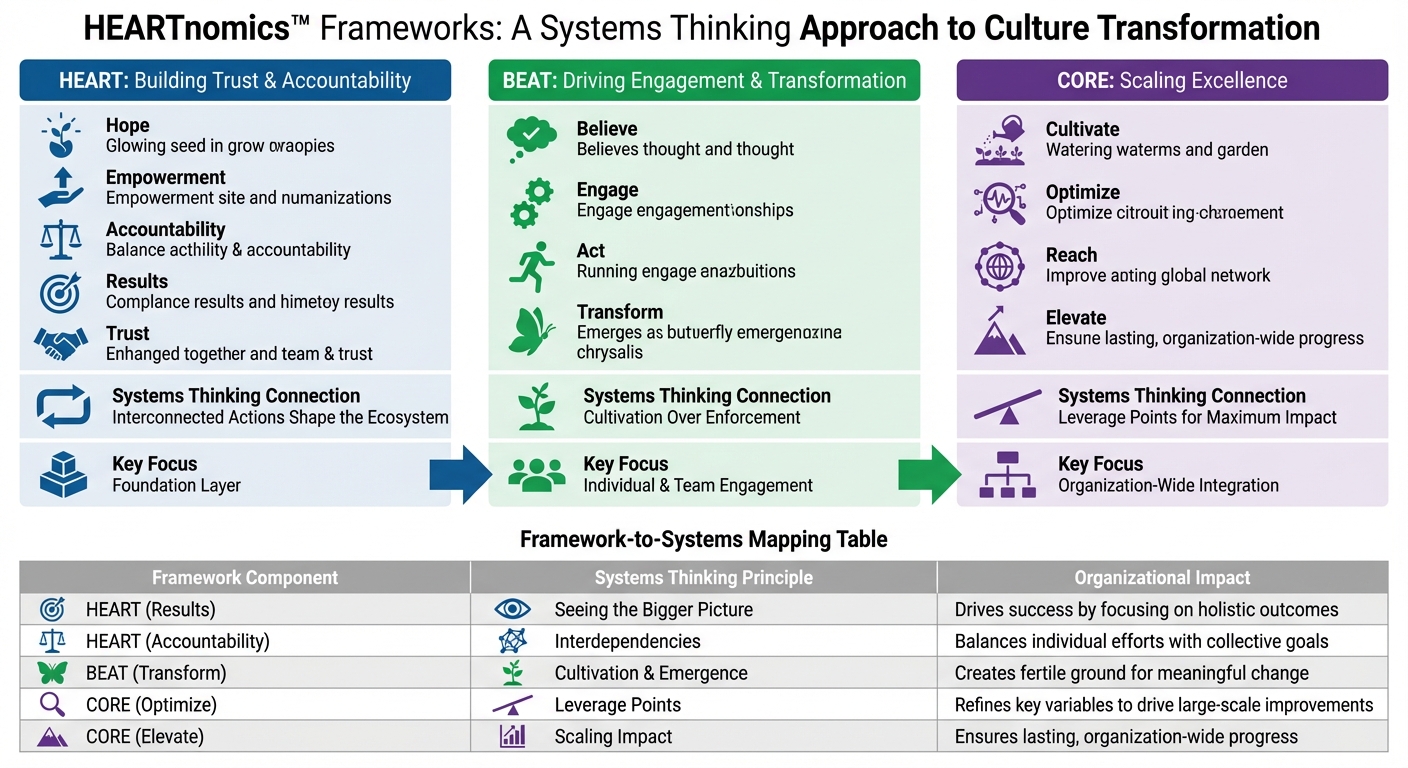
- HEARTnomics™ Frameworks: Tools like HEART (Hope, Empowerment, Accountability, Results, Trust), BEAT (Believe, Engage, Act, Transform), and CORE (Cultivate, Optimize, Reach, Elevate) provide actionable steps for achieving systemic change.
- Case Studies: Examples like Biach Industries and AIA Minnesota show how this approach transforms leadership, trust, and engagement.
The lesson? Sustainable transformation happens when leaders focus on systemic improvements, align actions with goals, and prioritize trust and accountability.
Core Principles of Systems Thinking in Organizations
Seeing the Bigger Picture
Organizations often fall into the trap of viewing departments as separate silos, but systems thinking reveals how every action ripples across the entire organization. When one team adjusts a policy or process, it inevitably affects workflows, morale, and outcomes in other areas. This interconnected perspective encourages leaders to look beyond isolated issues and focus on the broader patterns that may be perpetuating challenges.
To embrace this mindset, leaders must shift from linear thinking – where one cause leads to one effect – to circular thinking, which recognizes influence as part of a continuous loop. For example, high employee turnover isn’t just an HR problem. It can create a feedback loop: as people leave, workloads increase for those who remain, leading to lower morale and even more departures.
A compelling case for this approach comes from Biach Industries, a 40-person manufacturing firm led by Managing Directors William L. Biach and Mike Nash. By adopting a systemic perspective, they transformed the company’s culture from rigid "command-and-control" to one rooted in learning and shared vision. They introduced creative tension workshops to align personal and corporate goals, opened financial records to employees, and implemented profit-based monthly bonuses. These changes fostered trust, reduced risk aversion, and encouraged collaboration. This kind of holistic thinking naturally connects to the importance of feedback loops for ongoing improvement.
Feedback Loops and Continuous Improvement
Feedback loops are at the heart of how organizations evolve. Reinforcing loops amplify behaviors, while balancing loops help stabilize systems. As Mary-Margaret Zindren, CAE, AIA Minnesota, puts it:
"Systems thinking involves… the ability to recognize how interconnections can combine to form cause-effect feedback loops." [1]
A real-world example of this comes from a Dutch housing development. In some homes, electric meters were placed prominently in the front hall, while in others, they were hidden in the basement. The homes with visible meters saw residents using one-third less electricity than those with hidden meters. This simple change highlights how transparency and feedback can influence behavior, emphasizing why continuous feedback is vital for improvement.
Using Interdependencies for Alignment
Feedback loops provide valuable insights, but understanding interdependencies takes systems thinking a step further. Mapping these connections helps align organizational goals and reduces inefficiencies. Misalignment – whether between people, processes, or objectives – creates friction and wastes resources. Organizations communicate their culture through three main channels: behaviors (what employees do), symbols (what they see), and systems (like policies or KPIs). When these channels send conflicting messages, employee engagement suffers.
Donella Meadows, author of Thinking in Systems, offers this insight:
"If you want to understand the deepest malfunctions of systems, pay attention to the rules and who has power over them." [7]
To address these challenges, leaders can ask diagnostic questions: Who holds influence within the organization? What unspoken rules shape behavior? How do resources and information flow? Identifying these dynamics reveals whether current systems reinforce outdated practices or support a desired cultural shift.
The U.S. General Services Administration (GSA) provides a strong example of leveraging interdependencies. Through its "OneGov Strategy", the GSA tackled inefficiencies in procurement by breaking down silos. Instead of allowing individual agencies to purchase software independently, the GSA moved to a coordinated, government-wide procurement approach. This shift not only reduced duplication but also improved cybersecurity and delivered significant cost savings across federal agencies.
Case Studies: Systems Thinking in Action
Biach Industries: From Rigid Hierarchy to Shared Vision

Biach Industries once operated under a strict, top-down hierarchy that left little room for innovation or growth. To break free from this structure, the company turned to systems thinking, focusing on key areas that could inspire a cultural shift across the organization.
They introduced several initiatives, including "creative tension" workshops to help employees align their personal goals with the company’s objectives, open-book management that gave employees full access to financial records, and profit-based monthly bonuses to connect individual contributions to the company’s overall success [2].
These changes sparked a significant transformation. Biach Industries became a learning organization where trust and collaboration replaced rigidity. Employees began to embrace experimentation, share ideas freely, and take calculated risks. This cultural shift created a foundation for ongoing systemic improvements.
| Before Transformation | After Transformation |
|---|---|
| Command-and-control hierarchy | Collaborative decision-making with shared vision |
| Financial data limited to leadership | Transparent open-book management |
| Fixed salaries without incentives | Performance-linked profit-based bonuses |
| Risk-averse, innovation-stifling culture | Encouraged experimentation and innovation |
| Low trust between management and staff | High trust with employee ownership of outcomes |
PepsiCo: Connecting Goals with Ecosystems

PepsiCo took systems thinking beyond internal operations, using it to align its goals with broader external ecosystems. The company recognized that its success wasn’t just about optimizing supply chains or marketing strategies – it depended on understanding its role within larger environmental, social, and economic systems.
By mapping these interdependencies, PepsiCo identified opportunities to create value for multiple stakeholders. Teams began examining feedback loops to understand how their actions affected the broader ecosystem and adjusted strategies to stay ahead of disruptions. This approach fostered a culture of learning and resilience, enabling the company to adapt proactively and thrive in a rapidly changing world.
London Borough of Barnet Housing: Lean Systems for Empowered Leadership
In the public sector, the London Borough of Barnet Housing faced challenges familiar to many government organizations: slow bureaucratic processes, siloed departments, and a disconnect between frontline staff and decision-makers. By applying systems thinking alongside lean methods, they reshaped their organizational culture and empowered employees.
Instead of enforcing solutions from the top down, leaders focused on understanding how information moved through the system and identifying bottlenecks that slowed service delivery. By addressing these key leverage points, they restructured workflows to give frontline employees more decision-making power.
This shift transformed the workplace. Employees who had previously been restricted by rigid protocols were now solving problems directly, leading to higher engagement and better service quality. The case highlights how systems thinking can help public sector organizations overcome bureaucratic inertia and create meaningful change.
Systems Thinking as an Enabler of Cultural Change in Industrial Environments
sbb-itb-5c9cdaf
Integrating HEARTnomics™ Frameworks with Systems Thinking
HEARTnomics Frameworks for Systems Thinking and Culture Transformation
Transforming organizational culture requires a systemic approach, treating culture as a "behavioral operating system" where small changes can lead to significant outcomes [4]. The HEARTnomics™ methodology introduces three interconnected frameworks – HEART, BEAT, and CORE – designed to align values, systems, and strategies. Together, these frameworks turn broad insights into practical strategies by addressing different dimensions of an organization while reinforcing one another.
The HEART Framework: Building Trust and Accountability
The HEART framework – Hope, Empowerment, Accountability, Results, Trust – lays the groundwork for cultural transformation by fostering trust and accountability. It mirrors the principles of systems thinking, emphasizing how interconnected actions shape the broader organizational ecosystem [5].
The Results component ties directly to systems thinking by encouraging leaders to focus on the bigger picture. Instead of isolating tasks, they learn to assess how their decisions ripple across the organization [8]. Accountability, meanwhile, shifts the focus from individual performance to collaborative impact, reflecting the interconnected nature of organizational systems [8][1].
Trust addresses a critical challenge of systems thinking: the delayed visibility of change. As the HEARTnomics™ framework explains:
"Sustain the heartbeat of your legacy by having faith in the process, even when immediate differences aren’t visible" [8].
This aligns with the concept of feedback loops in complex systems, where results may take time to surface.
| Framework Component | Systems Thinking Principle | Organizational Impact |
|---|---|---|
| HEART (Results) | Seeing the Bigger Picture | Drives success by focusing on holistic outcomes [8] |
| HEART (Accountability) | Interdependencies | Balances individual efforts with collective goals [8] |
| BEAT (Transform) | Cultivation & Emergence | Creates fertile ground for meaningful change [1] |
| CORE (Optimize) | Leverage Points | Refines key variables to drive large-scale improvements [4] |
| CORE (Elevate) | Scaling Impact | Ensures lasting, organization-wide progress [8] |
BEAT: Driving Employee Engagement and Transformation
Once trust and accountability are established through HEART, the BEAT framework – Believe, Engage, Act, Transform – focuses on engaging individuals and teams in the transformation process. This approach mirrors systems thinking by emphasizing "cultivation" over enforcement, allowing change to grow organically [1].
The process begins with Believe, which sets the mindset for change. Engage strengthens connections to the transformation effort, Act translates belief into tangible behaviors, and Transform locks these behaviors into the organization’s culture.
A great example of this in action is the AIA Minnesota Culture Change Initiative. Between 2015 and 2022, the organization moved beyond focusing solely on diversity metrics. Instead, they targeted deeper leverage points, such as altering mindsets and power dynamics. By 2022, the board included 34% people of color – up from just 4% of the overall membership – and members described the culture as more authentic and collaborative [1]. This shift exemplifies BEAT’s principle of cultivating change through deliberate, ongoing efforts.
CORE: Scaling Organizational Excellence
The CORE framework – Cultivate, Optimize, Reach, Elevate – focuses on scaling cultural transformation across the organization [4]. While HEART sets the foundation and BEAT drives individual and team engagement, CORE ensures that these changes are embedded into the organizational structure.
Optimize aligns with systems thinking by identifying leverage points – specific areas where small adjustments can yield significant results [4]. Elevate ensures that these improvements are not only sustained but also expanded across the organization [8]. Together, these components integrate systemic changes into daily operations, treating culture as a measurable asset shaped by leadership, innovation, and adaptability.
One illustrative example involves a leader named Gareth, who aimed to promote a "caring" culture within his team. Initially, the team remained fixated on financial KPIs. By demonstrating how caring behaviors reduced sick days and redesigning processes to address recurring issues, Gareth successfully embedded care into the system [3]. This highlights how identifying and leveraging key system points can drive meaningful cultural shifts.
Conclusion: Systems Thinking for Lasting Cultural Change
Key Lessons for Leaders
Transforming organizational culture isn’t a one-time fix – it’s an ongoing process that requires alignment, feedback, and real adjustments. The evidence is clear: surface-level efforts often fall flat, while deeper, systemic changes create meaningful and lasting results.
For example, a staggering 72% of organizations that launched formal culture initiatives since 2022 saw no real improvement in trust, engagement, or retention after a year [6]. On the other hand, companies where senior leaders adjusted their own behaviors – like how they conducted meetings, made decisions, or allocated resources – experienced an average 26% boost in trust scores, even without flashy campaigns [6]. This highlights a critical principle of systems thinking: when incentives reward behaviors that clash with stated values, employees will follow the rewards, not the messaging [3].
Effective leaders focus on leverage points that drive meaningful change rather than quick fixes. Take the example of a Latin American telecommunications company. By tying 13% of senior leaders’ bonuses to leadership quality, team development, and fostering a feedback culture, they saw an 18% improvement in employee retention and a significant rise in internal promotions within just 12 months [6]. This approach realigned the system, ensuring that desired behaviors had both tangible rewards and consequences.
The HEARTnomics™ frameworks – HEART, BEAT, and CORE – offer a practical roadmap for these systemic shifts. HEART lays the groundwork with trust and accountability. BEAT engages individuals and teams in the change process, allowing transformation to grow organically. CORE ensures these changes scale across the organization and become part of everyday operations.
These examples illustrate that true culture transformation happens when leaders commit to systemic improvements that evolve alongside their organizations.
The Future of Culture Transformation
The organizations that thrive in the years ahead will treat culture as a dynamic, evolving system – not just a static list of values framed on a wall. Melissa Daimler, Chief Learning Officer at Udemy, captures this idea perfectly:
"Culture is a verb, not a noun. When we view culture as a living, continuous set of actions, we realize that every decision, every communication, every connection is either strengthening or weakening the culture" [5].
The HEARTnomics™ approach, with its HEART, BEAT, and CORE frameworks, embodies a systems-thinking strategy for long-term change. It shifts the focus from blaming individuals to examining and improving the system itself. After all, even the most talented employees can’t thrive in a poorly designed environment [9]. This mindset encourages curiosity over blame, prompting leaders to ask, “What in our system caused this outcome?”
The future belongs to leaders who embrace the discomfort of asking tough questions, challenge deeply held assumptions, and accept that values only hold meaning when they come with a cost [6]. By balancing current realities with a clear vision of what’s possible, these leaders can navigate complexity with purpose. Culture transformation, at its core, is a continuous process of refinement and growth – the very essence of the HEARTnomics™ philosophy.
FAQs
How can I identify the root cause of culture problems?
To understand the root cause of culture issues within your organization, it’s essential to take a systems thinking approach. This means viewing your organization as a network of interconnected elements rather than isolated parts. Culture doesn’t just emerge from stated values – it’s shaped by deeper systemic patterns like performance systems, communication, and behaviors.
One common issue is misalignment. For example, leadership might advocate for one type of culture but reward behaviors that contradict it. By examining these systemic elements as a whole, you can pinpoint inconsistencies and address them effectively. This approach allows for meaningful and lasting cultural change.
What’s the fastest way to map our key feedback loops?
To map key feedback loops effectively using systems thinking, start by pinpointing the core components and relationships that drive feedback – things like processes, culture, and decision-making. Next, sketch out diagrams to show how changes in one area ripple through others. Pay special attention to both reinforcing loops (those that amplify change) and balancing loops (those that stabilize systems). Tools like causal loop diagrams can help you visualize these dynamics and identify leverage points. The goal? Align behaviors, systems, and culture to create meaningful, lasting change.
Where should we start with HEART, BEAT, and CORE?
Start with HEART – a framework that emphasizes hope, empowerment, accountability, results, and trust. This sets the emotional groundwork needed to spark meaningful change. Next, implement BEAT, which bridges personal development with organizational objectives through belief, engagement, action, and transformation. Finally, apply CORE to cultivate, optimize, reach, and elevate systems, ensuring the changes are scalable and built to last. By combining emotional intelligence with operational precision, this method creates a path for impactful, enduring transformation.