High-performance leaders face constant pressure to make the right decisions. Poor decision-making can cost Fortune 500 companies over $250 million annually and contribute to 70% of project failures. To tackle this, structured decision frameworks provide clarity, accountability, and efficiency. Here’s a quick summary of seven frameworks tailored for different challenges:
- HEART Framework: Focuses on balancing emotional intelligence in leadership with performance through pillars like Hope, Empowerment, and Trust. Ideal for decisions involving values and human impact.
- Cynefin Framework: Categorizes problems (Simple, Complex, Chaotic, etc.) to guide appropriate responses. Best for unpredictable or ambiguous situations.
- RAPID Framework: Assigns clear roles (Recommend, Agree, Perform, Input, Decide) to streamline decision-making in multi-departmental settings.
- Eisenhower Matrix: Prioritizes tasks based on urgency and importance, helping leaders focus on what truly matters.
- OODA Loop: A fast, iterative cycle (Observe, Orient, Decide, Act) for quick decisions in high-pressure environments.
- SPADE Framework: A structured process (Setting, People, Alternatives, Decide, Explain) to ensure alignment and transparency in complex decisions.
- DARE Framework: Defines roles (Deciders, Advisors, Recommenders, Execution Stakeholders) to avoid delays and confusion in large organizations.
Each framework addresses specific decision-making challenges. Choosing the right one depends on the complexity, urgency, and context of the situation.
The Cynefin Framework – A Leader’s Framework for Decision Making and Action.
sbb-itb-5c9cdaf
1. HEART Framework
The HEART Framework, created by HEARTnomics™, is a system that combines emotional intelligence with operational precision. It stands apart from traditional approaches by focusing on both values and performance, structured around five key pillars: Hope, Empowerment, Accountability, Results, and Trust.
This framework is tailored for high-stakes decisions where subjective data and conflicting perspectives dominate [5]. When analytics alone can’t provide clear answers, or when the human impact of a decision outweighs raw numbers, HEART offers a methodical way to balance relational factors with performance goals. It helps leaders make decisions that are not only effective but also grounded in organizational values.
Best Use Case
The HEART Framework shines in scenarios like modern workplace challenges, such as cultural shifts, team reorganizations, ethical challenges, or major strategic changes – situations where emotions and values are just as important as outcomes [5]. Organizations that adopt HEART have reported 20–35% improvements in alignment, engagement, and trust within just 90 days, making it a powerful tool for leaders managing high-pressure transitions.
Strengths
HEART stands out by merging empathy with accountability. It enables leaders to make decisions that enhance team culture while still achieving measurable results. By making the decision-making process clear and collaborative, HEART fosters trust and simplifies even the most complex choices.
Potential Drawbacks
The HEART Framework requires a deep level of commitment and may not be the fastest option for decisions that demand quick, tactical responses.
2. Cynefin Framework
The Cynefin Framework, created by Dave Snowden, offers leaders a way to analyze problems and choose the right response. It moves away from a one-size-fits-all approach to decision-making by sorting challenges into five categories: Obvious (Clear), Complicated, Complex, Chaotic, and Disorder. Each category calls for a distinct leadership style.
Here’s how it works: in the Obvious domain, where cause and effect are straightforward, leaders use a “Sense – Categorize – Respond” method. For the Complicated domain, where expert knowledge is needed to untangle uncertainties, the approach shifts to “Sense – Analyze – Respond.” The Complex domain deals with unpredictable outcomes, requiring leaders to experiment and adapt using “Probe – Sense – Respond” with safe-to-fail trials. In the Chaotic domain, immediate action is key, employing “Act – Sense – Respond” to stabilize crises. Finally, the Disorder domain represents situations where it’s unclear which category applies, often leading to mistakes or indecision.
Best Use Case
This framework shines in VUCA environments – those marked by volatility, uncertainty, complexity, and ambiguity – where traditional step-by-step planning often falls short. It’s especially useful for leaders in fast-paced industries who need to quickly assess whether a situation calls for routine procedures, expert advice, or experimental solutions.
Strengths
Cynefin stands out by steering leaders away from applying the same approach to every situation. It helps teams navigate fast-changing environments and interconnected systems by offering a structured way to evaluate the context. By distinguishing between best practices (for Obvious problems), good practices (for Complicated ones), and emergent practices (for Complex challenges), it ensures leaders use the right tools for the task at hand. This flexibility is crucial in managing dynamic problems effectively.
Potential Drawbacks
The main challenge lies in misdiagnosing the problem. Treating a complex issue as a simple one can lead to disastrous outcomes or erratic decision-making. Leaders may also struggle in the Disorder domain if they can’t quickly determine the nature of the problem. Additionally, rigidly applying best practices in situations that need expert judgment or innovative thinking can hinder the adaptability required for success. These risks highlight the importance of using Cynefin thoughtfully and as part of a broader decision-making strategy.
3. RAPID Framework
The RAPID Framework, developed and trademarked by Bain & Company, tackles the issue of decision paralysis caused by unclear responsibilities and lack of accountability. It assigns five specific roles to streamline cross-functional decision-making: Recommend (the person responsible for gathering data and proposing a solution), Agree (stakeholders whose approval is required), Perform (those tasked with executing the decision), Input (experts who provide relevant insights), and Decide (the individual with final decision-making authority and accountability).
This structured approach eliminates confusion from overlapping veto power and ambiguous accountability. Research shows that unclear roles contribute to 70% of project failures, costing Fortune 500 companies over $250 million annually [1]. By delineating roles, RAPID creates a framework for effective decision-making in high-pressure, collaborative environments.
Best Use Case
Like the HEART and Cynefin frameworks, RAPID is designed to bring clarity to complex decision-making. It is most effective for high-stakes, cross-functional decisions involving multiple departments – such as Product, Finance, and Engineering – that need to align without slowing progress. Scenarios like launching a product, allocating budgets, or making strategic shifts benefit from RAPID’s structured process. However, for simpler, low-risk decisions that can be reversed easily, a less formal approach or individual autonomy often works better.
Strengths
RAPID enhances decision-making speed while ensuring accountability. By assigning a single “Decide” role, it avoids the pitfalls of diffused responsibility. The inclusion of an “Input” role allows for expert advice without granting veto power, striking a balance between inclusivity and efficiency. Companies like Netflix have successfully used RAPID to maintain a culture of “freedom and responsibility” as they scale, enabling decisions to move forward without compromising on quality or alignment.
Potential Drawbacks
One challenge with RAPID is the potential for bottlenecks in the “Agree” role. Requiring too many sign-offs can slow down the process. To avoid this, leaders must invest time in clearly defining roles at the outset. Without this clarity, the framework risks adding confusion instead of resolving it. Additionally, shifting from instinct-based or hierarchical decision methods to a structured framework often demands a cultural adjustment and targeted training, which some teams may find difficult to embrace.
4. Eisenhower Matrix
The Eisenhower Matrix is a practical tool for prioritizing daily tasks based on two key factors: Urgency and Importance. Named after President Dwight D. Eisenhower, this framework helps leaders focus on what truly matters, steering them away from the trap of constantly reacting to urgent issues at the expense of long-term goals [3]. It divides tasks into four actionable categories: Do (Urgent and Important), Schedule (Important but Not Urgent), Delegate (Urgent but Not Important), and Eliminate (Neither Urgent nor Important) [13, 14].
This approach is especially valuable considering that 64% of executives struggle with conflicting priorities, which often leads to wasted energy and slowed progress [9]. As keynote speaker David Meade aptly puts it:
When everything’s a priority, nothing is.
Best Use Case
The Eisenhower Matrix shines when leaders face an overwhelming number of demands and need to quickly regain focus. It works particularly well for managing daily or weekly tasks in fast-paced environments like startups or IT operations, where competing priorities can derail broader objectives [13, 15]. While it’s a powerful tool for sorting tasks, it may need to be paired with other frameworks for more complex or multi-layered decisions.
Strengths
One of the matrix’s standout features is its ability to simplify decision-making into clear, actionable steps. Its emphasis on Quadrant 2 (Important but Not Urgent) is especially impactful, as this area encourages leaders to dedicate time to strategic initiatives like long-term planning, leadership development strategies, and aligning with organizational goals. This proactive approach helps prevent the constant “firefighting” that drains energy and resources [3, 13].
Additionally, the matrix provides clarity on tasks that can be delegated (Quadrant 3) or eliminated entirely (Quadrant 4), freeing up time and resources for more meaningful work [3, 6].
Potential Drawbacks
The effectiveness of the Eisenhower Matrix depends heavily on accurately distinguishing between “Urgent” and “Important.” This can be tricky, especially when every task feels critical [8]. Moreover, while it’s excellent for quick prioritization, the matrix may not be sufficient for decisions requiring in-depth analysis or collaboration across teams [10]. In such cases, pairing it with tools like the OODA Loop can provide a more comprehensive approach [1].
5. OODA Loop
The OODA Loop – short for Observe, Orient, Decide, Act – is a four-step cycle designed to help leaders make quick, effective decisions, especially in high-pressure situations. It provides a structured way to continuously adapt and respond to changing circumstances.
Here’s a breakdown of the process:
- Observe: Collect real-time data to understand what’s happening.
- Orient: Analyze the data by considering dependencies, stakeholder impacts, and past experiences.
- Decide: Select the best course of action based on the analysis.
- Act: Execute the decision immediately, then re-enter the loop to refine future actions. This ongoing cycle ensures decisions remain timely and relevant, making it especially useful in dynamic environments.
Best Use Case
The OODA Loop shines in tactical, fast-moving scenarios like system outages, ransomware attacks, security breaches, or sudden market changes. Its emphasis on speed provides a crucial edge in volatile and uncertain situations. As Nehal Kazim aptly states:
In business, speed matters. Process information and adapt quickly to gain your advantage.
Strengths
This framework promotes agility and allows leaders to pivot effectively in real time. Its iterative nature ensures that every action provides valuable feedback, driving continuous improvement. The Orient phase stands out as a critical step, filtering data through the lens of past experiences and established mental models. By compressing decision-making timelines, the OODA Loop helps leaders stay ahead of competitors and navigate uncertainty with confidence.
Potential Drawbacks
While the OODA Loop is highly effective, it doesn’t eliminate the unpredictability of complex situations. Rapid decision cycles can lead to “decision whiplash”, confusing teams if communication isn’t clear. Additionally, the rush to act can result in reactive decisions that address symptoms rather than root causes. To counter these risks, pairing the OODA Loop with tools like the Eisenhower Matrix can help maintain focus on strategic priorities. Clear communication with stakeholders is also essential to avoid misalignment during rapid iterations.
6. SPADE Framework
Netflix created the SPADE Framework to simplify cross-functional decision-making. SPADE stands for Setting, People, Alternatives, Decide, and Explain – a structured process designed to keep decisions moving forward without unnecessary delays [2].
Here’s a breakdown of how it works:
- Setting: Establishes the context and defines the goals of the decision.
- People: Assigns specific roles like the driver (responsible for pushing the decision forward), the approver, and key contributors.
- Alternatives: Encourages listing multiple options to avoid narrow thinking.
- Decide: Commits to a final decision within a set timeline.
- Explain: Involves sharing the decision and its reasoning publicly, promoting transparency and learning while recognizing differing viewpoints [2].
Netflix has applied this framework in real-world scenarios. For instance, in 2025, they used SPADE to make decisions about product recommendations. They documented various proposals, shared the final decision and reasoning across teams, and revisited the process six months later to evaluate its effectiveness. By clearly defining roles and ensuring transparency, SPADE supports the leadership principles needed to maintain high performance.
Best Use Case
SPADE works best for complex decisions that involve multiple departments – like product, design, engineering, and finance – where alignment is both essential and challenging. It’s particularly helpful when an accessible, timestamped record of decisions is needed to ensure long-term accountability [2].
Strengths
One of SPADE’s standout features is the Explain step, which boosts transparency by clearly identifying decision ownership and providing the reasoning behind the outcomes. This structured yet straightforward approach minimizes the confusion that often plagues cross-functional projects. It also nurtures an environment where differing perspectives are acknowledged and valued [2].
Potential Drawbacks
While SPADE is highly effective, it’s not without challenges. Extensive consultations can slow down the process and lead to “feedback fatigue”, especially if participants misunderstand their input as a guarantee of consensus. This can create frustration if the final decision doesn’t align with group suggestions. Leaders can address this by setting expectations early, clarifying that while input is appreciated, the ultimate decision lies with them [11]. Additionally, skipping the Explain step – or failing to address why certain options were rejected – can harm trust among stakeholders [11].
7. DARE Decision Framework
The DARE Decision Framework, developed by McKinsey, is all about structured and efficient decision-making. It’s designed to cut through the delays and confusion that can come with complex decisions, especially when multiple stakeholders are involved. By assigning clear roles – Deciders, Advisors, Recommenders, and Execution Stakeholders – this framework aims to prevent “analysis paralysis”, which can slow progress and rack up costs [6].
Here’s how it works: Deciders, typically one to three people, have the final say and are responsible for making quick, authoritative decisions. Advisors contribute important insights but don’t hold decision-making power. Recommenders handle the research and present actionable options, while Execution Stakeholders ensure the decisions are practical and carry them out [6].
Unlike consensus-based models, which can bog teams down in endless discussions, DARE prioritizes speed and clarity. By limiting the number of final decision-makers and clearly defining roles, it avoids the common pitfalls of disputes over “who decides?” [6].
Best Use Case
This framework shines in environments like matrix organizations or cross-departmental teams, where reporting structures can be complicated. It’s particularly useful when quick, strategic decisions are needed without getting stuck in prolonged consultations [6].
Strengths
One of DARE’s biggest strengths is its focus on role clarity. Keeping the Decider group small helps prevent delays that often plague consensus-driven processes. By mapping recurring decisions to specific roles, team members know exactly where authority lies. Additionally, involving Execution Stakeholders early ensures that potential implementation challenges are identified before they become roadblocks [6].
Potential Drawbacks
However, the framework isn’t without its challenges. It’s crucial that everyone involved fully understands and accepts their roles. For instance, Advisors and Recommenders might feel sidelined if they expect to have equal say in final decisions. Clear communication about how the framework operates is key to addressing these concerns.
Ultimately, DARE equips leaders to make confident decisions in complex, high-pressure situations. It’s a tool for cutting through the noise and moving forward with purpose.
Comparing the 7 Frameworks
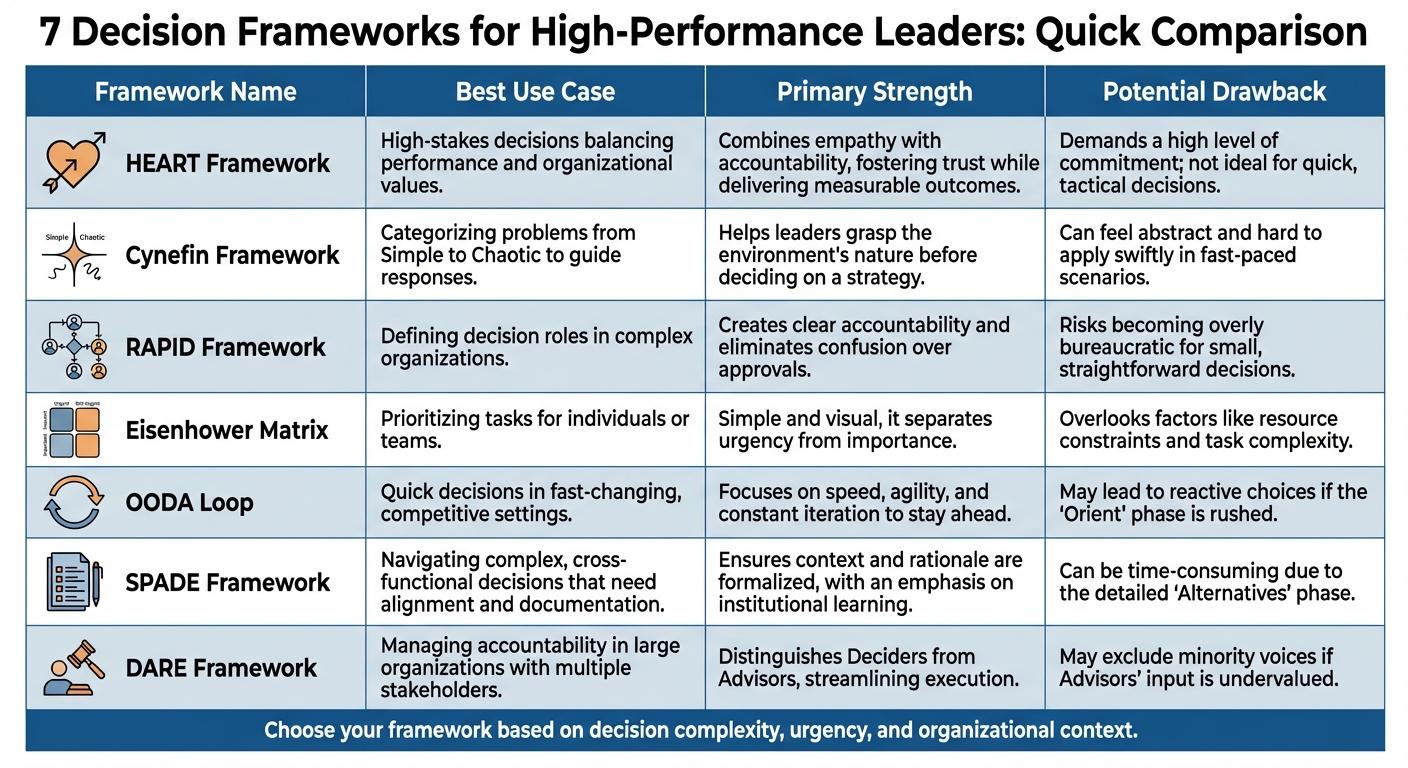
Comparison of 7 Decision-Making Frameworks for Leaders
After diving into each framework, it helps to lay them out side by side to see how they stack up. The table below highlights their best use cases, key advantages, and potential downsides.
| Framework | Best Use Case | Primary Strength | Potential Drawback |
|---|---|---|---|
| HEART | High-stakes decisions balancing performance and organizational values | Combines empathy with accountability, fostering trust while delivering measurable outcomes | Demands a high level of commitment; not ideal for quick, tactical decisions |
| Cynefin | Categorizing problems from Simple to Chaotic to guide responses | Helps leaders grasp the environment’s nature before deciding on a strategy | Can feel abstract and hard to apply swiftly in fast-paced scenarios |
| RAPID | Defining decision roles in complex organizations | Creates clear accountability and eliminates confusion over approvals [2] | Risks becoming overly bureaucratic for small, straightforward decisions |
| Eisenhower Matrix | Prioritizing tasks for individuals or teams | Simple and visual, it separates urgency from importance | Overlooks factors like resource constraints and task complexity |
| OODA Loop | Quick decisions in fast-changing, competitive settings | Focuses on speed, agility, and constant iteration to stay ahead | May lead to reactive choices if the “Orient” phase is rushed |
| SPADE | Navigating complex, cross-functional decisions that need alignment and documentation | Ensures context and rationale are formalized, with an emphasis on institutional learning [2] | Can be time-consuming due to the detailed “Alternatives” phase [2] |
| DARE | Managing accountability in large organizations with multiple stakeholders | Distinguishes Deciders from Advisors, streamlining execution | May exclude minority voices if Advisors’ input is undervalued |
This comparison underscores the importance of understanding your situation before picking a framework. Sometimes, blending tools can be the smartest move. For instance, you could use the Eisenhower Matrix to prioritize tasks and pair it with the OODA Loop for quick feedback and iteration [1].
Matching the framework to your environment is crucial. Tackling volatile markets? The OODA Loop shines. Struggling with unclear accountability in a complex organization? RAPID or DARE can help. Facing a high-stakes transition where values and performance both matter? HEART gives you the clarity to align both.
Key takeaway: Accurately diagnosing the problem is half the battle. Mislabeling a “Complex” issue as “Simple” can waste time and lead to poor decisions – like relying on rigid checklists during a crisis [4]. Start with Cynefin to identify the problem type, then choose the right framework for the job [4].
Conclusion
The average person makes about 35,000 decisions every day[9], and for leaders, that number is even higher. Without a clear system in place, decision-making can sap energy, erode trust, and slow progress.
The seven frameworks discussed here help bring order to the chaos. They guide leaders from impulsive choices to repeatable strategies – whether it’s defining accountability with RAPID, understanding complexity with Cynefin, or balancing empathy and results using HEART. Speed is critical: Larry Page once said, “Fast decisions, unless they’re fatal, are always better”[7]. This underscores the need to distinguish between decisions that can be reversed (Type 2) and those that cannot (Type 1).
These tools empower leaders to replace knee-jerk reactions with thoughtful, consistent strategies. Start small – apply a single framework to critical decisions, then gradually expand its use. Documenting your decision-making principles ensures alignment across your team, much like Stripe’s approach with guidelines such as “Think Rigorously”[7]. You can even combine frameworks – use the Eisenhower Matrix to prioritize tasks, then implement OODA loops for quick adjustments[1].
Transparency is key. Explaining the reasoning behind decisions fosters trust and alignment. As James Everingham, Instagram’s Head of Engineering, pointed out:
When folks say that things aren’t transparent, what they’re probably getting at is that decision-making isn’t transparent[7].
When teams understand the “why”, they’re more likely to trust the process – even if they don’t agree with every outcome.
While no framework eliminates uncertainty, each provides tools to navigate it effectively. They help leaders build trust, maintain focus under pressure, and balance strategic thinking with empathy to drive performance.
FAQs
How do I choose the right framework for a specific decision?
To pick the best decision-making framework, consider how complex the decision is, how quickly it needs to be made, and whether it can be undone. For instance:
- The Type 1/Type 2 framework helps you decide if the situation calls for quick, instinctive action or a more deliberate approach.
- SWOT analysis works well for strategic decisions, breaking down strengths, weaknesses, opportunities, and threats.
- Decision trees are ideal for navigating complicated scenarios with multiple possible outcomes.
By aligning the framework with the specific traits of the decision, you can ensure better clarity, accountability, and results.
When should I combine two frameworks instead of using one?
Sometimes, a single decision-making framework isn’t enough to handle the complexity or urgency of a situation. That’s where combining frameworks can make all the difference. For example, pairing a fast-response model like the OODA Loop (Observe, Orient, Decide, Act) with a more analytical approach like SWOT analysis (Strengths, Weaknesses, Opportunities, Threats) can strike the perfect balance between speed and thorough evaluation.
Another effective combination involves frameworks like HEART and CORE from HEARTnomics™. These tools bring emotional intelligence into the mix while ensuring operational precision. Together, they help create decisions that are both thoughtful and action-oriented – particularly valuable in high-pressure scenarios where both logic and empathy are crucial.
How can I prevent role-based frameworks from slowing decisions down?
To prevent delays caused by rigid role-based frameworks, concentrate on the steps that are most relevant to the specific situation. Cut out unnecessary complexities and focus on what truly matters. Distinguish between decisions that can be reversed and those that cannot – this helps speed up the decision-making process. Encourage a mindset of quick, decisive action within frameworks like HEART or CORE. These systems blend emotional awareness with operational efficiency, ensuring decisions are made promptly, align with core values, and uphold strong performance standards.