Leading with heart makes teams stronger. This approach prioritizes empathy, trust, and meaningful connections, helping employees thrive while driving better results. Here’s why it works:
- In 2024, workplace mistreatment cost the U.S. economy $914 billion.
- Happier employees are 13% more productive, but 45% feel stressed weekly.
- Emotional intelligence and self-awareness help leaders manage stress, support teams, and make better decisions.
The HEART framework – Hope, Empowerment, Accountability, Results, and Trust – translates emotional intelligence into practical strategies. By creating psychological safety and balancing compassion with accountability, leaders can guide their teams through challenges while reducing turnover and boosting engagement.
Bottom line? Resilient leadership isn’t just about results – it’s about making decisions with empathy, building trust, and creating a workplace where people feel valued and motivated.
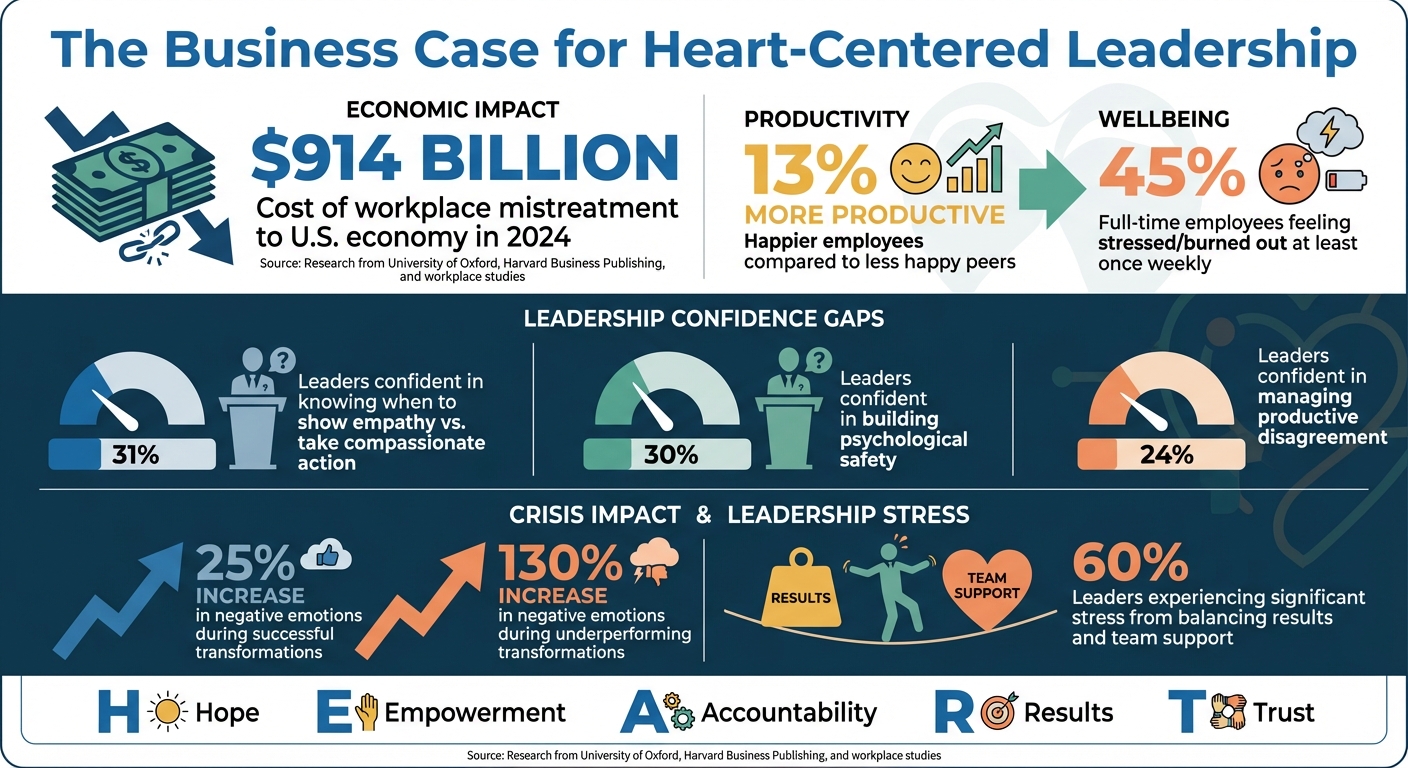
Heart-Centered Leadership Impact: Key Statistics on Workplace Productivity and Employee Wellbeing
How Heart-Centered Leadership Changes the Way You Live, Love & Lead | Cheryl DeSantis | HR Leaders
sbb-itb-5c9cdaf
How Emotional Intelligence Builds Resilience
Emotional intelligence turns feelings of overwhelm into opportunities for strong leadership, aligning closely with the HEART framework’s emphasis on Trust and Empowerment. Leaders who can understand and manage their emotions create a sense of stability for their teams, even during uncertain times. Instead of brushing emotions aside, effective leaders see them as valuable insights that guide better decisions.
The numbers back this up: happier employees are 13% more productive compared to their less happy peers [1]. Yet, 45% of full-time employees report feeling stressed or burned out at least once a week [5]. This highlights a critical need to transform stress into a source of strength. As Martha Wooding-Young, author of The Resilient Executive, puts it:
"Emotional intelligence is the middle way – it allows leaders to recognize, understand, and manage emotions while making thoughtful, strategic decisions" [6].
This skill becomes even more essential during times of organizational change. Negative emotions can spike by 25% during successful transformations, and by over 130% when changes fall short [5]. Leaders with high emotional intelligence are better prepared to handle these shifts, helping their teams stay steady under pressure.
Self-Awareness in Leadership
Self-awareness is the cornerstone of resilience. Leaders who understand their emotional triggers, biases, and patterns can respond thoughtfully instead of reacting impulsively. This is crucial because stress often leads to "threat rigidity" – a tendency to fall back on familiar but ineffective behaviors when under pressure [5][6].
Here’s where neuroscience offers a practical tip: naming your emotions can help reduce their intensity. For example, if you feel stressed, take a moment to identify whether it’s frustration, fear, or anxiety. This process turns emotions into actionable insights. Frustration might signal a values conflict, while fear could indicate a need for better preparation.
Terre Short from Thriving Leader Collaborative emphasizes this point:
"Self-awareness is where it begins. Heart-centered leaders take the time to understand their own triggers, patterns, and motivations" [1].
By recognizing when emotions are clouding their judgment, self-aware leaders can pause, reset, and realign with their organization’s values. This calm and collected approach builds trust and confidence within the team [1].
Simple ways to improve self-awareness:
- Label your emotions: Identify stress-related feelings to lessen their intensity [6].
- Reflect regularly: Set aside time to examine your motivations and seek feedback from trusted colleagues to uncover blind spots [1].
- Set healthy boundaries: Share personal experiences to build connection, but avoid burdening your team with issues they can’t resolve [6].
Using Empathy to Build Connection
Empathy allows leaders to truly understand different perspectives, fostering trust and making team members feel valued. But empathy isn’t just about listening – it’s about using that understanding to create an environment where people can thrive.
Interestingly, only 31% of leaders feel confident in knowing when to show empathy versus taking compassionate action [5]. The best leaders strike a balance between listening deeply and offering timely support tailored to their team’s needs. During organizational change, empathy also helps ease resistance and encourages adaptability. Yet, only 30% of leaders feel confident in building psychological safety within their teams [5].
Martha Wooding-Young clears up a common misunderstanding:
"Empathy isn’t about agreeing with everyone; it’s about understanding perspectives" [6].
This mindset paves the way for open communication and teamwork. When employees sense that their leader genuinely cares, they’re more likely to admit mistakes, share ideas, and take calculated risks – all of which fuel innovation.
How to practice empathy effectively:
- Listen first and treat emotions as data: Use feelings as signals to determine what kind of support is needed [6].
- Set clear limits: Show care without taking on responsibility for solving others’ personal challenges [6].
This empathetic approach creates a foundation for psychological safety, helping teams feel secure enough to collaborate and grow.
Creating Psychological Safety in the Workplace
Psychological safety plays a key role in how well teams perform and adapt to challenges [5]. Without it, teams often fall into "threat rigidity", relying on outdated habits that fail under pressure [5]. The issue is more complex than it seems. While creating a space where people feel safe to speak up is critical, it must be balanced with what Harvard Business Publishing calls "intellectual honesty" – the ability to engage in open, constructive debates without fear of offending others [5]. Interestingly, only 24% of leaders feel confident in managing this kind of productive disagreement [5]. As a result, many teams either avoid honest feedback to keep the peace or stay silent to dodge conflict.
Terre Short from Thriving Leader Collaborative highlights the essence of psychological safety:
"When people know their leader is ethical and authentic, they feel safe to be their true selves. They are more likely to speak up, share ideas, admit mistakes, and collaborate without fear" [1].
This sense of authenticity lays the groundwork for resilience. Employees who trust their leaders to act with integrity rather than punishment are more willing to take risks that drive innovation and growth. With this in mind, here are some practical ways to build a culture of trust and openness.
Encouraging Open Communication
Open communication is a cornerstone of team resilience, complementing earlier ideas about self-awareness and empathy. Leaders can set the tone by showing vulnerability. When you acknowledge a mistake and explain how you’ll address it, you demonstrate that honesty is valued, not penalized [3].
Active listening is another key element. Instead of just hearing words, focus on understanding the emotions and perspectives behind them. This means asking thoughtful follow-up questions, pausing before responding, and affirming what’s been said before offering solutions [3].
The HEARTnomics framework highlights Empowerment by encouraging teams to take risks and learn from setbacks [3]. This doesn’t mean avoiding accountability – it means treating failures as opportunities to grow. For instance, after a project falls short, ask, "What did we learn?" before assigning blame.
Flattening hierarchies can also encourage open dialogue. People from diverse or underrepresented backgrounds might hesitate to share their thoughts if they’re unsure their input will be valued. Make it clear that every voice matters, and back it up by incorporating their ideas into decisions [3].
Building Trust Through Consistent Actions
Trust isn’t built overnight – it’s earned through consistent alignment between words and actions. According to the HEARTnomics framework, Trust is the heartbeat that sustains leadership over time [3]. When leaders fail to follow through on their promises, trust erodes, and psychological safety suffers. Balancing open dialogue with intellectual honesty strengthens the trust that underpins a healthy workplace culture.
Transparency is critical. Share company goals, challenges, and changes openly and in a timely manner. This reduces uncertainty and fosters the trust needed for resilience [3].
Consistency becomes even more important in times of crisis. If your team has experienced transparent and ethical leadership during calm periods, they’re more likely to trust you when things get tough. On the other hand, inconsistency can cause people to withdraw into self-protection – just when bold decisions are most needed. By staying consistent, leaders not only build trust but also reinforce the performance and resilience strategies discussed earlier.
The data supports this: happier employees are 13% more productive than those who are less happy [1]. Yet, 45% of full-time employees report feeling stressed or burned out at least once a week [5]. Leaders who prioritize psychological safety through consistent and trustworthy actions create an environment where well-being and productivity go hand in hand.
Professor Jan-Emmanuel De Neve from the University of Oxford’s Wellbeing Research Centre explains it well:
"Employee wellbeing is not simply a byproduct of high performance – it’s actually a driver of it" [1].
Focusing on psychological safety isn’t about adopting "soft" leadership. It’s a strategic approach that equips organizations to handle disruptions and come out stronger.
Leading With Compassion During Crisis
Crises test leadership in ways that reveal its core. Balancing the pressure to deliver results with the responsibility of supporting teams under stress is no easy task – 60% of leaders admit this tension significantly adds to their stress levels[5]. Yet, these moments are when leading with compassion becomes essential. The key lies in integrating care and performance into every choice. This balance allows leaders to make tough decisions without losing sight of empathy.
Mark Marone, PhD, from Harvard Business Publishing, explains it perfectly:
"Being human-centered doesn’t mean being one or the other [empathy or compassion]; it means understanding the needs of the individual and the situation to know whether listening is enough or action needs to be taken." [5]
During critical transformations, emotions can run high. While successful transformations see a 25% increase in negative emotions among employees, underperforming ones lead to a staggering 130% spike[5]. The HEARTnomics approach encourages leaders to treat emotions as valuable data. For instance, frustration might signal misaligned values or insufficient preparation[6]. By interpreting these emotions strategically, leaders can turn reactive feelings into actionable insights.
Balancing Compassion and Accountability
In a crisis, leaders must walk a fine line between empathy and decisive action. Compassion without accountability can foster dependency, while accountability without compassion risks creating resentment. The HEARTnomics framework highlights the importance of Accountability, which aligns personal responsibility with the broader mission[3]. This means making decisions that benefit the organization while maintaining clear, empathetic boundaries. For example, if an employee is struggling, listen with care but avoid taking on their burdens. Instead, ask, "What support do you need to move forward?"
Victoria, CEO of Heart and Soul, captures this balance well:
"Leading with heart doesn’t mean being weak – it means being strong enough to make decisions from wisdom rather than reaction." [7]
Interestingly, only 31% of leaders feel confident in knowing when to simply empathize versus when to take compassionate action[5]. While empathy involves understanding and listening, compassion goes a step further, requiring decisive actions that address both individual and situational needs.
Demonstrating Resilience Through Your Actions
Resilience in leadership is about showing integrity – acknowledging mistakes and explaining the steps to correct them. By doing so, you set an example for your team on how to handle pressure effectively[3]. This approach reinforces the idea that challenges are temporary and progress is always possible. The HEARTnomics Hope pillar urges leaders to share a vision that recognizes current struggles while focusing on achievable goals[3]. Being transparent about the situation and outlining specific steps can help ease the anxiety that 45% of employees feel during uncertain times[5].
Small, consistent actions often have a greater impact than dramatic gestures. Consider adopting "mini-shifts" – small, intentional adjustments that counteract draining thoughts and foster positivity[4]. For instance, after a major setback, focus on taking one practical step forward rather than trying to fix everything at once. This method not only keeps you grounded but also provides your team with a clear, manageable path through the chaos.
Business Results of Heart-Centered Leadership
Heart-centered leadership isn’t just about fostering a positive work environment – it delivers tangible business outcomes that directly influence the bottom line. Research from the University of Oxford reveals that happier employees are 13% more productive, highlighting how employee well-being actively drives performance rather than being a byproduct of it [1]. Companies embracing this leadership style report stronger retention rates, higher engagement levels, and better financial performance [1]. Leaders who prioritize meaningful connections and a sense of purpose create workplaces where teams communicate effectively and solve problems more efficiently [3]. This approach not only boosts productivity but also cultivates deeper employee engagement and motivation.
Employee Engagement and Motivation
When employees feel genuinely valued and understood, their commitment to their work strengthens – even in tough times. Heart-centered leadership shifts the focus from rigid hierarchies to collaborative communities, fostering agility and self-direction [1]. Through the HEARTnomics Empowerment pillar, individual roles are connected to a broader mission, promoting shared accountability. This creates an environment of psychological safety, where employees can share ideas, admit mistakes, and collaborate without fear – key ingredients for driving innovation and growth [1].
Today’s workforce prioritizes purpose, connection, and respect over just financial rewards [1]. Organizations that align with these values see teams that are not only more resilient during periods of change but also more willing to contribute their best ideas and efforts [2][5]. As engagement increases, so does loyalty, which directly impacts retention.
Reducing Turnover Through Strong Leadership
Heart-centered leadership fosters loyalty that transcends traditional perks like pay and benefits, significantly reducing turnover costs while retaining critical institutional knowledge [3][8]. Beyond improving retention, this leadership style helps cut recruitment and training expenses, allowing organizations to redirect resources toward growth strategies. The HEARTnomics CORE framework – Cultivate, Optimize, Reach, Elevate – provides a structured way to align people and processes for sustained success. Over time, this alignment creates a competitive edge that continues to grow.
The combined impact of increased productivity, higher engagement, and reduced turnover strengthens organizational resilience. This ensures that teams can navigate challenges effectively and maintain their momentum, even during periods of disruption.
Conclusion
Resilience in today’s workplace isn’t about simply toughing it out – it’s about leading with purpose, understanding, and trust. When leaders focus on emotional intelligence alongside strategy, they create environments where teams can adapt, grow, and succeed even in the face of uncertainty. This kind of leadership transforms stress into strength and challenges into opportunities.
Research highlights that organizations prioritizing employee wellbeing and fostering psychological safety achieve tangible benefits. These findings align with what effective leaders already understand: modeling accountability, practicing empathy, and encouraging open communication builds a culture where people feel secure enough to share ideas and take thoughtful risks.
Heart-centered leadership isn’t about avoiding hard decisions – it’s about making them with empathy while maintaining firm boundaries and accountability. Striking this balance is what sets apart true leaders from those who merely manage.
Small, intentional actions are key. By acknowledging emotions, listening with empathy, acting with kindness, and encouraging honest dialogue, leaders create the resilience their teams need. These actions embody the HEART principles – Hope, Empowerment, Accountability, Results, and Trust – forming the backbone of organizational strength [3]. Compassion and accountability have been the thread connecting every strategy discussed.
Building resilience is a gradual process, shaped by every decision, conversation, and interaction. The real question isn’t whether leading with heart is an option – it’s whether you can afford not to.