In a fast-changing business landscape, old leadership strategies no longer work. Leaders must now focus on skills that help them respond effectively to uncertainty, adjust strategies in real-time, and guide their teams through complex challenges. This is where adaptive leadership skills become essential.
Key takeaways:
- What it means: Adaptive leadership involves anticipating needs, solving systemic problems, and staying flexible in decision-making.
- Why it matters: Leaders with these skills are 3x more likely to boost team engagement and 4x more likely to drive innovation.
- Real-world example: AstraZeneca pivoted during COVID-19, aligning operations for vaccine development and diagnostics, showcasing the importance of flexibility.
- How to develop: Programs like HEARTnomics™ combine emotional intelligence and operational focus to help leaders grow these skills, improving team alignment, engagement, and trust by up to 35% in 90 days.
This approach isn’t just about reacting to change; it’s about creating environments where teams can thrive and innovate under pressure. Leaders who prioritize continuous learning, emotional resilience, and collaborative problem-solving will be better equipped to face the challenges of today’s unpredictable world.
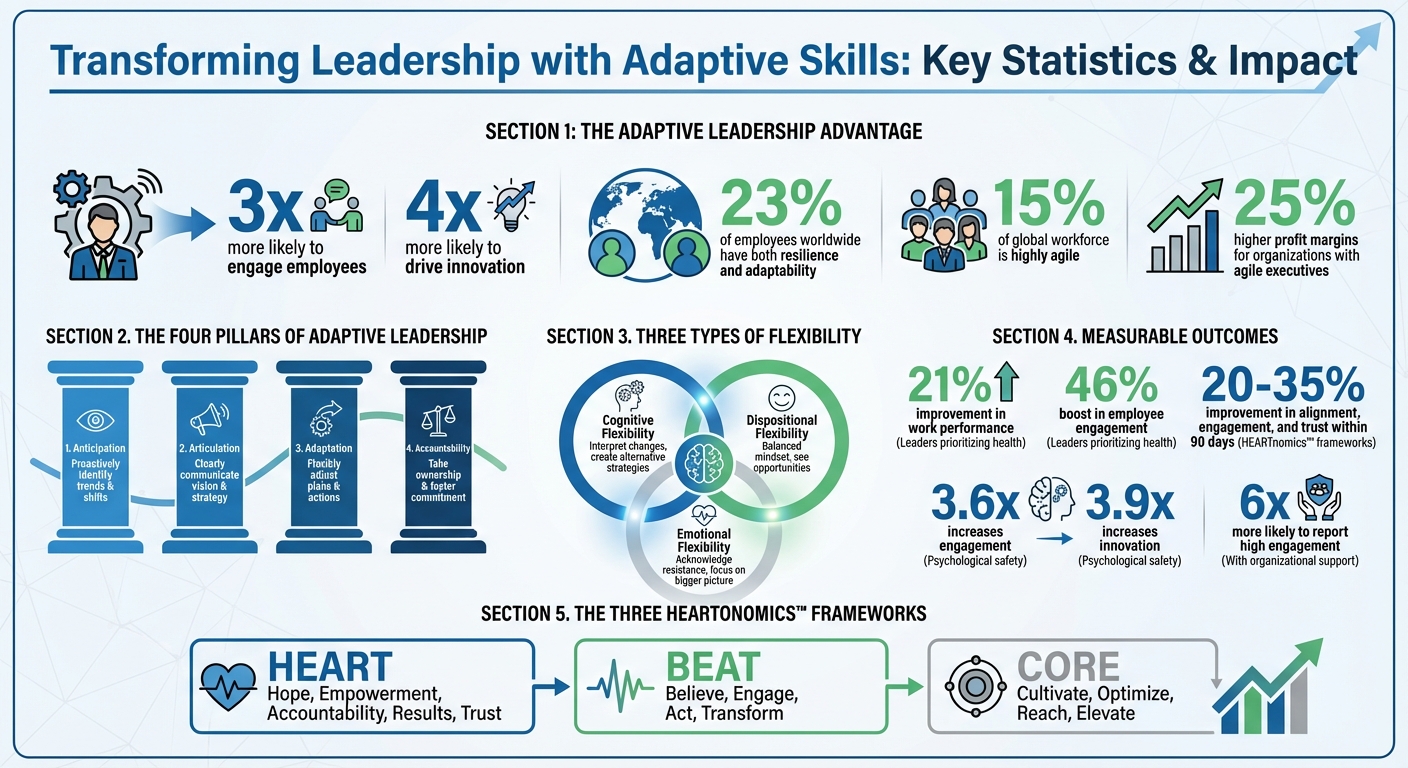
Adaptive Leadership Impact: Key Statistics and Frameworks
Core Principles of Adaptive and Transformational Leadership
Understanding Adaptive Leadership
Adaptive leadership is all about tackling complex leadership challenges that don’t have straightforward, technical fixes. It’s built on four key pillars: Anticipation, Articulation, Adaptation, and Accountability [1].
This leadership style relies heavily on three types of flexibility: cognitive, dispositional, and emotional. Cognitive flexibility allows leaders to interpret changes and come up with alternative strategies. Dispositional flexibility helps leaders maintain a balanced mindset – seeing disruptions as opportunities rather than threats. And emotional flexibility involves acknowledging resistance while staying focused on the bigger picture [2]. Together, these elements create a strong framework for navigating uncertainty and evolving circumstances. This framework also provides a natural bridge to transformational leadership.
How Transformational Leadership Connects to Adaptability
At its core, transformational leadership is about vision, inspiration, and motivating teams to perform at their best. But even the most inspiring leader can falter without the ability to adapt. The connection between these two approaches lies in the concept of a "North Star" – a set of shared goals and values that keep teams grounded during times of rapid change [2]. This guiding principle ensures alignment, even as strategies and tactics evolve.
A lack of adaptability is one of the top reasons executives fail in their roles [2]. Viktor Frankl captured this sentiment perfectly when he said:
"When we are no longer able to change a situation, we are challenged to change ourselves" [2].
By anchoring leadership in shared values and vision, blending adaptability with transformational qualities creates a leadership style that’s both inspiring and responsive.
Blending Adaptability with Transformational Impact
The real magic happens when leaders combine a transformational vision with adaptive flexibility. This shift – moving from a directive approach to one that empowers – creates an environment where teams can thrive and long-term growth becomes possible.
Striking a balance between the "human" side – emotional intelligence and psychological safety – and the "systemic" side – operational efficiency and clear performance metrics – enables leaders to do more than just respond to change. It allows them to shape conditions where their teams can grow, innovate, and succeed.
sbb-itb-5c9cdaf
Key Adaptive Skills for Transformational Leaders
Emotional Regulation and Resilience
Managing emotions under pressure isn’t just a nice-to-have – it’s a game-changer for performance. Leaders who excel in both resilience and adaptability are over three times more likely to stay engaged and nearly four times more likely to show innovative behaviors[2]. Yet, only 23% of employees worldwide report having both qualities[2].
Stress can push leaders into rigid, counterproductive patterns when flexibility is most needed[4]. Recognizing physical signs of stress, like sweaty palms or a racing heartbeat, can help shift from a reactive state to a more thoughtful, learning-focused mindset[4].
Physical and mental well-being serve as the backbone of effective leadership. Leaders who make their health a priority see a 21% improvement in work performance and a 46% boost in employee engagement[4]. Even short breaks can help sharpen skills and improve performance under pressure[4].
Mastering self-regulation not only helps leaders stay calm but also sets the stage for embracing a growth mindset.
Growth Mindset and Continuous Learning
Building on emotional resilience, the next step for leaders is cultivating a mindset of continuous learning. Adaptability is essentially about "learning how to learn" – applying knowledge flexibly across different challenges[4]. Adopting a "beginner’s mind" can be transformative, where curiosity and inquiry take precedence over having all the answers[4].
An “expert” mindset can actually limit growth, as it creates pressure to appear all-knowing, closing off opportunities for new insights. On the other hand, a beginner’s mind encourages asking questions and exploring diverse perspectives rather than clinging to established ideas[4].
Leaders who embrace ongoing learning don’t just recover from challenges – they evolve, adjusting their strategies to fit shifting circumstances[2]. For example, in September 2024, John Plant, CEO of Howmet Aerospace, highlighted the importance of versatility. He explained that leaders hired for restructuring must later pivot toward growth strategies to remain effective[2]. This ability to adapt drives meaningful progress and energizes teams to innovate.
Collaborative Problem-Solving and Psychological Safety
Adaptability isn’t just an individual skill – it’s crucial for team dynamics, too. Creating an environment where team members feel safe to speak up, challenge ideas, and admit mistakes can dramatically enhance performance. When psychological safety is paired with resilience and adaptability, teams achieve higher levels of engagement and innovation[2].
A powerful example comes from the UK National Health Service during the pandemic. Leaders initiated open conversations about systemic biases in COVID-19 treatment, admitting mistakes at senior levels. This fostered a culture of honesty and psychological safety, allowing teams to discuss errors without fear, while still maintaining accountability and high standards[1].
To build this kind of culture, leaders can invite input from quieter team members, conduct after-action reviews focusing on decision-making processes, and share personal stories of navigating change[1][2][4]. These practices promote transparency and continuous learning, reinforcing the ability of adaptive leaders to inspire growth and innovation within their teams. I often explore these themes in my most requested keynotes for organizations navigating change.
Frameworks and Strategies to Build Adaptive Leadership
Assessing Your Adaptive Leadership Capacity
Before diving into new habits, it’s crucial for leaders to take stock of where they currently stand. Tools like 360-degree feedback and leadership assessments help paint a clearer picture by gathering input from peers, direct reports, and supervisors. These tools often reveal blind spots that self-assessments tend to miss.
Here’s a striking reality: only 15% of the global workforce is considered highly agile. Yet, organizations with agile executives see 25% higher profit margins and advance learning-agile leaders twice as fast as their competitors[5]. The gap between where most leaders are and where they could be is both real and measurable.
One way to dig deeper into decision-making patterns is by using the Multi-Criteria Decision Analysis (MCDA) framework. This method involves defining problems, setting measurable criteria, and ranking alternatives[3]. It uncovers whether leaders rely on routine solutions or adapt effectively to evolving challenges.
Another helpful tool is conducting after-action reviews. These reviews focus on evaluating the decision-making process rather than just the outcomes[1]. They help identify what worked, what didn’t, and where adjustments are needed. Understanding your current capacity is the first step toward embedding adaptive behaviors.
Building Adaptive Habits and Behaviors
Knowing your strengths and gaps is one thing, but shifting daily behavior is where the real work begins. Moving from an "expert mindset" to embracing a "beginner’s mind" takes deliberate effort. During crises, fear often pushes leaders to fall back on familiar methods[4]. Breaking this cycle requires specific, repeatable habits.
One foundational practice is reflection. At the end of each day, leaders can review challenging moments and consider how default patterns might have limited their responses[4]. This process fosters self-awareness without judgment. Pairing reflection with a "To Be" list – a set of values like "I want to be curious" or "I want to be calm" – acts as a guide for personal growth[4].
Reflection and prioritizing physical health together can significantly boost work effectiveness by over 20% and improve team engagement by 46%[4]. Even short breaks between high-pressure tasks can accelerate learning more effectively than working without pause[4]. For instance, a CEO of a global mobility tech company transformed his daily runs into moments of reflection, which helped him better support his team during the pandemic[4].
Scenario planning is another powerful tool. By simulating various future scenarios, leaders can test their assumptions and practice adapting in real time[1]. Setting "triggers" – clear data-driven signals that prompt action – ensures decision-making is proactive and based on evidence rather than reactive responses[1].
A global pharmaceutical company provides a great example of building adaptability at scale. In December 2024, they launched a resilience and adaptability training program for 9,000 employees. The program was rolled out in three waves: in-person workshops for the top team, digital self-paced tools for 4,000 people leaders, and social learning apps for individual contributors. Over three months, with weekly touchpoints, participants showed marked improvements in adaptability and well-being compared to a control group[2]. This social learning approach – developing skills in groups rather than in isolation – proved highly effective for accelerating behavioral change[2].
HEARTnomics™ Frameworks for Adaptive Leadership
HEARTnomics™ takes adaptive leadership to the next level by combining emotion and logic through three proprietary frameworks. These systems don’t just teach adaptive skills – they weave them into the fabric of an organization.
The HEART framework (Hope, Empowerment, Accountability, Results, Trust) lays the groundwork for psychological safety and engagement. Employees who feel supported by their organization and have a clear purpose – a "North Star" – are 6 times more likely to report high engagement[2]. This creates an environment where adaptability thrives without fear of failure.
The BEAT framework (Believe, Engage, Act, Transform) focuses on personal growth. It guides leaders through the mindset shifts required to transition from rigid expertise to flexible learning. By emphasizing deliberate action and measurable progress, BEAT ensures that adaptive habits lead to tangible results. Organizations using this framework report 20-35% improvement in alignment, engagement, and trust within just 90 days.
The CORE framework (Cultivate, Optimize, Reach, Elevate) addresses scalability across teams. It helps leaders build adaptive capacity, streamline processes for continuous learning, achieve performance goals under pressure, and uplift the organization toward sustainable growth. This is particularly important given that only 16% of global employers invest in adaptability programs, even though 26% of employees rank it as a top skill need[2].
Together, these frameworks transform adaptability from an individual trait into an organizational strength. Leaders learn to anticipate future challenges, inspire collective support for their vision, adapt through continuous learning, and maintain accountability through transparency[1]. While similar to the 4 A’s Framework, HEARTnomics™ integrates emotional intelligence with operational discipline to deliver measurable results.
Through impactful keynotes, strategic training, focused consulting, and executive coaching, HEARTnomics™ equips leaders with the tools to embrace change. It’s a blend of courage and discipline – balancing the heart to lead with the logic to measure impact.
Measuring and Sustaining Adaptive Leadership Impact
Defining Metrics for Adaptive Leadership
Measuring adaptive leadership goes beyond the usual performance reviews. Organizations that aim to excel focus on employee engagement using tools like the Utrecht Work Engagement Scale. This scale assesses energy, enthusiasm, and immersion in work. They also monitor how often teams come up with and implement new ideas. Research highlights that when psychological safety is prioritized, engagement increases by 3.6 times, and innovative behavior rises by 3.9 times. Combine this with strong organizational support, and employees become six times more likely to report high engagement or innovation [2].
Some companies also use an Adaptability Index, which links a company’s ability to adapt with its total shareholder return over periods ranging from 5 to 30 years. Other valuable metrics include decision-making efficiency – how quickly teams can process complex information under pressure – and sense-and-respond capacity, which measures how effectively teams interpret data and market signals [6].
Integrating Adaptive Leadership into Organizational Systems
Defining metrics is only the first step. To truly embed adaptive leadership, organizations need to integrate these insights into their core systems. This can include hiring individuals who thrive in dynamic environments, encouraging proactive feedback through after-action reviews, and weaving these practices into performance management [1][2]. For example, a large travel company faced safety challenges and decided to reward employees for identifying and reporting issues. This cultural shift not only improved retention and engagement but also strengthened their ability to manage operational risks [2].
The HEARTnomics™ frameworks streamline this integration. The HEART framework makes psychological safety a measurable part of the workplace culture. The BEAT framework turns personal growth into achievable milestones, while the CORE framework embeds adaptability into scalable systems across teams. Together, these frameworks deliver measurable outcomes, such as increased trust, engagement, and alignment. Organizations using these tools report a 20–35% improvement in these areas within just 90 days. These results demonstrate how adaptive leadership can drive real, measurable change.
Building Future-Ready Organizations
Sustaining adaptive leadership requires a clear "North Star" – shared goals and values that provide direction during times of change [2][6]. This shared purpose allows teams to adapt their strategies while staying aligned. Future-ready organizations use sense-and-respond mechanisms, such as customized data mining, dashboards, and real-time monitoring, to identify meaningful trends amidst the noise [6]. They adopt a "freedom within a framework" mindset, setting ambitious goals while giving teams the freedom to experiment and treating failures as learning opportunities [6].
The combination of clear metrics, system integration, and tools like HEARTnomics™ helps organizations turn adaptive leadership into a sustainable practice. By bridging the gap between current investments and employee needs, they don’t just weather disruptions – they turn them into competitive advantages. These organizations foster a culture of open communication between senior leaders and middle management, reward autonomy when objectives are met, and create an environment where adaptability is a team effort, not an individual burden.
The payoff? Resilient organizations that thrive in uncertain times, teams that innovate under pressure, and leaders who transform challenges into opportunities for growth.
Adaptive Leadership in 12 minutes – Ron Heifetz
Conclusion
In today’s fast-changing world, adaptive leadership is what separates organizations that just get by from those that truly excel. Leaders who show resilience and flexibility are almost four times more likely to drive innovation and over three times more likely to see high levels of engagement among their teams [2].
This highlights the importance of having a clear strategy. Success requires frameworks that connect emotional intelligence with operational efficiency and link personal growth to the scalability of an organization. The HEART, BEAT, and CORE frameworks from HEARTnomics™ offer such a strategy. These tools transform abstract ideas like adaptability and psychological safety into measurable results. Organizations using these frameworks have reported 20–35% gains in trust, engagement, and alignment within just 90 days – solid evidence that adaptive leadership can be cultivated and maintained.
Thriving leaders today aren’t the ones with all the answers. Instead, they adopt a "beginner’s mind", set clear priorities, view failure as an opportunity to learn, and prioritize their own well-being [4]. They realize adaptability doesn’t mean letting go of core values – it’s about staying true to a guiding vision while being flexible in how they achieve it.
Organizations that succeed will go beyond just measuring adaptability. They’ll weave it into hiring practices, performance reviews, and everyday operations using the HEART, BEAT, and CORE frameworks. These companies won’t just respond to challenges – they’ll anticipate them, adapt, and deliver results [1]. By embedding these practices into their culture, leaders can turn uncertainty into an opportunity for lasting growth and build the future they aim to create.
FAQs
How does adaptive leadership enhance team engagement and drive innovation?
Adaptive leadership equips leaders to handle uncertainty by promoting collaboration and fostering a mindset focused on learning. By identifying challenges, testing potential solutions, and involving team members in decision-making, leaders create an environment of psychological safety. This not only increases engagement but also encourages thoughtful risk-taking. The result? Teams remain motivated and find innovative ways to tackle challenges, even in high-pressure situations.
HEARTnomics™ brings adaptive leadership to life with practical tools and frameworks. Its HEART model – Hope, Empowerment, Accountability, Results, Trust – builds team trust and reinforces a shared sense of purpose. The BEAT framework – Believe, Engage, Act, Transform – guides leaders in co-creating solutions and turning diverse perspectives into inventive results. Meanwhile, the CORE system – Cultivate, Optimize, Reach, Elevate – focuses on refining and scaling those ideas, blending emotional intelligence with operational efficiency. Together, these principles enable leaders to develop resilient, high-performing teams that thrive on innovation.
What is the difference between adaptive leadership and transformational leadership?
Adaptive leadership is all about tackling change head-on, solving tough challenges, and gearing up for what’s ahead. These leaders are skilled at identifying disruptions, promoting continuous learning, and encouraging experimentation to uncover new solutions. They shine in building strong, flexible teams that can handle uncertainty and see change not as a threat, but as a chance to grow.
Transformational leadership, in contrast, revolves around inspiring and motivating teams to pursue a common vision. Leaders in this style work to build trust, empower individuals, and drive meaningful organizational or cultural shifts by fostering collaboration and commitment. While both leadership approaches deal with navigating change, adaptive leadership leans into problem-solving and flexibility, whereas transformational leadership focuses on vision and inspiration.
How can leaders develop the adaptability needed to tackle today’s complex challenges?
Leaders can grow and thrive in unpredictable environments by adopting a mindset that prioritizes continuous learning and flexibility. This starts with self-awareness – understanding personal strengths and blind spots – and extends to questioning assumptions and viewing challenges as chances to improve and innovate. Effective leaders also work on building emotional intelligence, establishing trust, and welcoming a variety of perspectives within their teams.
Some practical steps include active listening, experimenting with small, manageable solutions, and creating feedback loops to stay responsive in uncertain situations. Tools like HEARTnomics™ frameworks – such as HEART (Hope, Empowerment, Accountability, Results, Trust) and BEAT (Believe, Engage, Act, Transform) – offer practical ways to combine emotional intelligence with operational effectiveness. These frameworks provide guidance for navigating ambiguity while maintaining focus on growth and resilience.
By developing these capabilities, leaders can transform uncertainty into opportunities, strengthen team collaboration, and perform effectively under pressure.