High-pressure roles, like CEOs managing crises or startup founders scaling rapidly, demand quick decisions with limited information while under immense stress. Yet, traditional leadership training often ignores the unique challenges of these environments.
Key insights from the article:
- 40% of leaders fail within 18 months due to stress and decision fatigue.
- Leaders make critical decisions with only 40–70% of necessary information.
- Coaching improves leadership performance, with a 529% ROI and a 70% promotion likelihood within a year.
- Tailored frameworks like HEART (Hope, Empowerment, Accountability, Results, Trust) and BEAT (Believe, Engage, Act, Transform) help leaders build resilience and drive results.
Why it works: Custom coaching blends empathy and performance, helping leaders manage stress, improve decision-making, and align teams. For instance, leaders using these methods report 30% higher productivity and improved team retention.
The takeaway? Personalized coaching equips leaders to handle high-pressure challenges, delivering measurable growth for both individuals and organizations.
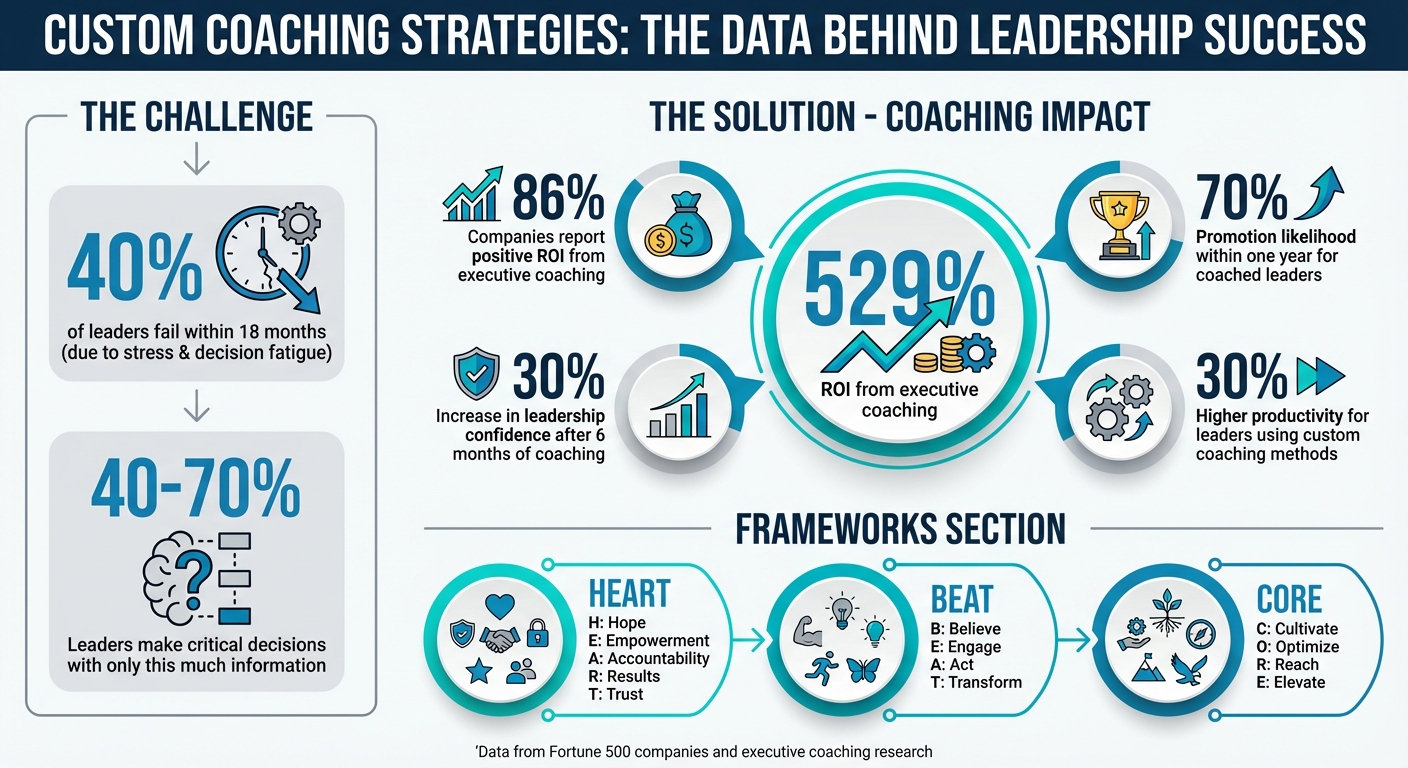
Custom Coaching Impact: Key Statistics for High-Pressure Leadership Success
Leading Under Pressure 🔥 Dr. Carol Kauffman on The Coaching Studio Podcast

Assessing Leadership Needs in High-Pressure Environments
The journey to effective coaching begins with understanding a leader’s unique stress triggers and areas for growth. For example, a striking 86% of companies report seeing a positive return on investment from executive coaching[5]. However, standard assessments often overlook how pressure impacts decision-making, leaving critical blind spots. That’s why this diagnostic phase is essential – it sets the stage for coaching strategies that are both relevant and personalized.
Leadership Diagnostics and 360-Degree Feedback
Accurate diagnostics are the backbone of aligning coaching efforts with the challenges leaders face under pressure. One of the most effective tools for this is 360-degree feedback, which compares a leader’s self-perception with how their team views them[2]. This approach can uncover revealing gaps. For instance, a leader might believe they excel at delegation, while team feedback highlights feelings of micromanagement during stressful periods. The focus here isn’t on static traits but on actionable behaviors that can drive real improvement[6].
Before the first coaching session, leaders should complete readiness documents to outline their current challenges and stressors[2]. This step ensures coaching remains practical and grounded in real-world concerns rather than hypothetical scenarios. Pairing these readiness documents with validated tools – like the Brief Resilience Scale, the 10-item Connor-Davidson Resilience Scale, or the Cognitive Hardiness Scale – provides a clear starting point for understanding how quickly leaders bounce back from setbacks[2].
Measuring Resilience with the HEART Framework
The HEART framework – which stands for Hope, Empowerment, Accountability, Results, and Trust – offers a structured way to evaluate resilience across multiple dimensions. Research highlights that leaders with high levels of hope are better equipped to navigate uncertainty[6]. Similarly, assessing empowerment and accountability can reveal whether a leader feels capable of influencing outcomes, even under intense pressure. Tracking results ensures coaching remains tied to measurable business goals, while evaluating trust helps identify whether a leader is moving away from defensive “fight-or-flight” tendencies toward collaborative engagement[4].
This holistic approach bridges the emotional and operational aspects of leadership. For example, a leader who scores high on accountability but low on trust might lean too heavily on control, potentially stifling team collaboration. Tools like the Robertson Cooper i-resilience assessment can pinpoint these stress-related tendencies and guide targeted interventions[2]. By addressing both emotional resilience and practical effectiveness, this method ensures coaching delivers meaningful, lasting results.
Core Coaching Frameworks for Resilience and Performance
Once diagnostics are complete, the next step is to apply frameworks that address the emotional and operational challenges of high-pressure leadership. The HEARTnomics™ system brings together three core frameworks – HEART, BEAT, and CORE – to connect personal resilience with broader organizational impact. These frameworks work as a continuum, guiding leaders from building personal resilience to achieving strategic leadership goals. Together, they reshape how leaders think, respond, and act under pressure.
HEART: Building Trust and Emotional Resilience
High-pressure situations often trigger the “fight-or-flight” response, a natural reaction that can hinder collaboration and learning. The HEART framework – Hope, Empowerment, Accountability, Results, and Trust – is designed to help leaders move from a defensive mindset (Level 2) to a more open and connected mindset (Level 3). At this level, the release of oxytocin helps quiet defensive instincts, paving the way for trust-based teamwork and collaboration[4].
Practical steps to apply the HEART framework include active listening. Leaders should fully engage in conversations, ask thoughtful questions, and summarize key points to show they truly understand and empathize[7]. Pairing active listening with cognitive reappraisal – reframing challenges as opportunities for growth – can help leaders approach difficulties with a more constructive mindset[3][7]. Physical self-care also plays a crucial role in emotional regulation, as maintaining physical health strengthens a leader’s ability to manage stress[3][7].
“When leaders take care of their physical well-being, they are better equipped to handle stress and adversity”[7].
Another key aspect of emotional resilience is building a support system. Trusted colleagues or mentors can provide fresh perspectives and guidance during tough times[3][7].
With the foundation of emotional resilience in place, the BEAT framework takes personal growth to the next level.
BEAT: Driving Personal Growth
The BEAT framework – Believe, Engage, Act, Transform – focuses on overcoming limiting beliefs and self-doubt that can derail leaders under stress. By reflecting on past successes, leaders can counter feelings of imposter syndrome or decision fatigue, building confidence in their ability to handle new challenges. This method is especially valuable in high-stakes environments where self-assurance is critical.
As leaders strengthen their personal growth through BEAT, they naturally extend their impact by aligning their teams and delegating effectively – a process guided by the CORE framework.
CORE: Scaling Leadership Impact
Scaling leadership requires a shift from managing day-to-day tasks to focusing on strategic priorities. The CORE framework – Cultivate, Optimize, Reach, Elevate – empowers leaders to delegate responsibilities, align their teams, and create the mental space needed for high-value work. Research highlights the effectiveness of this approach, with executive coaching delivering a 529% return on investment. Leaders who receive coaching are 70% more likely to be promoted within a year, and their confidence in leadership roles increases by 30% after just six months[5].
A key principle of the CORE framework is moving away from micromanagement. Leaders are encouraged to identify one routine, low-value task they handle and either delegate, automate, or eliminate it immediately. This not only allows them to focus on strategic initiatives but also strengthens team trust and reduces burnout[5].
sbb-itb-5c9cdaf
Strategies for Overcoming High-Pressure Challenges
Navigating leadership challenges under pressure requires strategies that can be consistently applied to help leaders stay effective, even in the most stressful situations. The HEARTnomics™ frameworks provide actionable tools to tackle these challenges head-on.
Making Better Decisions Under Uncertainty
High-pressure situations can make decision-making feel overwhelming. The HEART and BEAT frameworks offer a five-step process to help leaders maintain mental clarity when it matters most: recognize stress as a natural biological response, notice physical cues, recall past successes, set purposeful intentions, and trust the process. This approach helps shift the mind from a reactive “fight-or-flight” mode to a state of connection and focus [4]. With clear decision-making as a foundation, managing emotions effectively becomes the next critical step.
Managing Emotions During Crises
In moments of crisis, self-regulation becomes non-negotiable. The HEART framework supports leaders in moving from a reactive state (Level 2: fight-or-flight) to a more constructive one (Level 3: engagement and connection). This shift enables leaders to foster collaboration and emotional co-regulation by openly sharing ideas and feelings. As Stephen W. Porges explains:
“It is at this level [engagement and connection] that a uniquely mammalian vagal pathway becomes functional and quiets the defensive features of both the fight/flight and shutdown pathways.” – Stephen W. Porges [4]
By embracing vulnerability during crises, leaders create a sense of psychological safety, empowering their teams to navigate challenges collectively. Once emotions are managed, the focus can shift to keeping teams aligned during periods of change.
Aligning Teams During Change
Change often brings uncertainty, and maintaining team alignment is key to navigating it successfully. The CORE framework helps leaders achieve this through open communication and genuine inquiry. When teams feel disconnected from leadership decisions, friction can arise. Leaders can address this by actively listening to team concerns and responding with transparency. As Theodosius Dobzhansky famously said, “the fittest may also be the gentlest because survival often requires mutual help and cooperation” [4]. Research also highlights the importance of coaching and compassion in fostering resilience, as these practices provide both psychological and physiological benefits [8]. Strong social bonds within teams further enhance their ability to adapt and thrive [3].
Preventing Burnout with Energy Management
Managing energy effectively is essential for sustaining performance under pressure. The BEAT framework encourages leaders to regularly evaluate their physical, mental, emotional, and social well-being to spot early signs of burnout. Studies show that executive coaching – such as weekly one-hour sessions over ten weeks – can significantly reduce burnout by alleviating emotional exhaustion, cynicism, and feelings of ineffectiveness while boosting overall energy levels [9]. Additionally, setting firm boundaries and practicing psychological detachment from work are practical ways to combat stress-induced fatigue, ensuring leaders have the stamina to make high-stakes decisions [9].
Implementing and Measuring Coaching Success
Rolling out a structured, five-phase coaching program can create both immediate results and long-term improvements. The most effective approach starts with a detailed assessment and concludes with leaders independently applying resilience strategies in their daily work [2]. This phased process builds on earlier evaluations to deliver measurable leadership growth.
The journey begins with using validated feedback tools, like the Connor-Davidson Resilience Scale, to establish a baseline. This helps track progress over time. After identifying strengths and areas for development, leaders participate in collaborative goal-setting sessions. Here, they define clear objectives that align with their personal values and organizational goals [2]. Over the next 3–12 months, regular coaching sessions focus on reviewing progress, reflecting on resilience behaviors, and adjusting strategies to address real-world challenges [2][5].
Phased Coaching Rollout
In the rollout phase, the HEARTnomics™ frameworks guide ongoing development. Initial sessions use the HEART framework to foster trust and create psychological safety, enabling open and constructive feedback. As leaders advance, the BEAT framework helps them focus on their physical, mental, emotional, and social well-being. To extend the impact across teams, the CORE framework connects individual coaching insights to broader organizational systems [2].
Leaders prepare for each session by completing readiness documents, ensuring discussions remain actionable [2]. Documenting insights and action plans fosters accountability and tracks behavioral changes over time [2]. Research highlights the value of executive coaching, showing a 529% ROI and reporting that 86% of companies experience positive outcomes [5].
Measuring Progress and ROI
Evaluating coaching success involves monitoring progress across three timeframes. Short-term metrics (within the first three months) include participation rates, leader satisfaction via pulse surveys, and engagement with coaching materials [11]. Medium-term indicators (3 to 6 months) focus on behavioral changes, as seen in follow-up 360-degree feedback, self-assessments, and performance reviews that capture measurable leadership improvements [11][13]. Long-term organizational impact (6 to 12 months and beyond) is assessed through metrics like leader retention rates, internal promotions, and financial outcomes such as revenue growth or cost savings [11][12][14].
To quantify coaching’s financial impact, a confidence level can be applied to a formula like this: (Financial Impact × Confidence Level) ÷ Coaching Cost [10]. This calculation reinforces the effectiveness of the HEARTnomics™ process, ensuring that every phase contributes to resilience and leadership growth. Beyond metrics, compiling success stories – such as linking improved conflict resolution to increased team productivity – adds depth to the results [11].
Data supports the benefits of coaching: coached leaders are 70% more likely to be promoted within a year, and leadership confidence typically improves by 30% after six months of structured coaching [5]. As Nicky Terblanche, Associate Professor at the University of Stellenbosch Business School, explains:
“Coaching serves as a proactive strategy for enhancing psychological resilience” [2].
Conclusion
Custom coaching strategies provide leaders in high-pressure roles with a focused and effective way to grow – something traditional training often falls short of delivering. When leaders operate in volatile, uncertain, complex, and ambiguous environments, personalized coaching helps tackle challenges across physical, mental, emotional, and social dimensions. Research involving over 40 Fortune 500 companies highlights that resilience has become a top priority for executive development [1].
The HEARTnomics™ approach stands out by equipping leaders with tools to build resilience through its unique frameworks: the HEART framework fosters trust and psychological safety, the BEAT framework promotes personal growth and a mindset of continuous learning, and the CORE framework amplifies leadership impact across organizations. By blending emotional intelligence with operational excellence, this system ensures leaders don’t just endure challenges – they excel in them. Notably, behavioral changes – critical for leadership transformation – have shown the greatest impact compared to shifts in attitudes alone [6].
This approach aligns values, systems, and strategies, enabling leaders to grow with purpose, lead effectively, and scale their influence with empathy. The results speak for themselves: when leaders refine their clarity and crisis management skills, the positive effects ripple through their teams, fostering lasting organizational growth well beyond the coaching experience.
FAQs
How does the HEART framework support leaders in high-pressure roles?
The HEART framework – standing for Hope, Empowerment, Accountability, Results, and Trust – offers leaders in demanding roles a structured way to handle stress while achieving meaningful outcomes.
- Hope keeps leaders focused on their goals and purpose, even when facing tough challenges.
- Empowerment emphasizes delegating tasks and trusting team members, which reduces decision fatigue and boosts efficiency.
- Accountability clarifies ownership, making it easier to spot successes and areas needing improvement.
- Results ensure every action aligns with measurable goals.
- Trust fosters a safe environment where teams can collaborate openly and address risks head-on.
By blending emotional awareness with actionable strategies, the HEART framework helps leaders maintain resilience and clarity, enabling them to guide their teams effectively and achieve success together.
What results can leaders achieve by using the BEAT framework?
Leaders who apply the BEAT framework often see real, measurable benefits. These can include greater resilience, better decision-making under pressure, and deeper trust within their teams. Such improvements frequently lead to higher engagement, smoother collaboration, and consistent performance growth – even in demanding, high-pressure situations.
By emphasizing belief, engagement, action, and transformation, the BEAT framework provides leaders with practical tools to handle challenges and motivate their teams to achieve excellence, driving results that stand the test of time.
How can companies measure the ROI of custom coaching programs for their leaders?
To evaluate the ROI of custom coaching, start by tying the program to specific business objectives like revenue growth, lower turnover rates, improved productivity, or enhanced customer satisfaction. Collect baseline data for these metrics, along with leadership-focused indicators such as 360-degree feedback, engagement scores, or decision-making efficiency. Once the HEARTnomics™ coaching frameworks – which blend emotional intelligence with operational excellence – are in place, track these metrics again at regular intervals (e.g., 3, 6, and 12 months). The difference in performance, after accounting for external factors, reveals the program’s impact.
To calculate ROI, use this formula: (financial gain ÷ total coaching cost) × 100. Factor in costs like coaching fees, leader time (calculated based on their salary), and any resources or tools used. While financial returns are important, HEARTnomics™ also brings qualitative benefits, including stronger team trust, quicker decision-making, and reduced burnout – factors that research links to long-term organizational success.
By blending hard data with qualitative insights, such as leader testimonials or case studies, organizations can clearly showcase how HEARTnomics™ coaching strengthens resilience, improves decision-making, and boosts overall performance. This approach highlights measurable value and supports continued investment in leadership development.