Nonverbal communication matters more than you think – 93% of communication effectiveness comes from body language, facial expressions, and posture. Teams that understand these cues can improve trust, connection, and productivity by up to 66%.
Key techniques to focus on:
- Eye Contact: Direct eye contact builds trust and encourages participation. Avoiding it can signal disinterest or disagreement.
- Posture: Open posture (uncrossed arms, visible hands) conveys approachability, while closed posture can create barriers.
Practical tips:
- Maintain 70% eye contact when listening and 50% when speaking.
- Use an "open stance" to show attentiveness and reduce psychological barriers.
- In virtual meetings, look at the camera to simulate direct eye contact.
1. Direct Eye Contact vs. Averted Gaze
Trust-Building
Nonverbal cues, like steady eye contact, play a critical role in fostering trust and building connections. Maintaining direct eye contact sends a clear message of attentiveness, sincerity, and reliability [7][5]. In fact, 70% of people report feeling more secure and open during conversations when direct eye contact is maintained [6]. On the flip side, looking away – whether at a phone, laptop, or just avoiding the speaker – can signal disinterest or even defensiveness, which can harm credibility [1].
From a neuroscience perspective, eye contact triggers mirror neurons, which help us understand others’ intentions [8]. When eye contact is broken, neural synchrony between individuals drops immediately, disrupting the connection that supports effective teamwork [8]. This makes eye contact a cornerstone for trust, not just in one-on-one interactions but also in team dynamics.
Team Dynamics
In team settings, eye contact isn’t just polite – it actively encourages participation. Dr. Carol Kinsey Goman emphasizes:
"Eye contact is a powerful catalyst for participation, because people feel that they have your attention and interest as long as you are looking at them" [1].
On the other hand, when leaders or teammates avoid eye contact, it can have the opposite effect. Even something as subtle as turning slightly away can communicate disengagement, causing speakers to lose confidence and shut down [1]. This is especially harmful during collaborative decision-making. An averted gaze often hints at hidden disagreement or a lack of genuine commitment, even if the person’s words suggest otherwise [4][9].
Alignment Effectiveness
Consistent and meaningful eye contact does more than just build trust – it strengthens team alignment. Studies show that steady eye contact can improve morale by 38% and enhance the clarity of shared ideas by 35% [6]. To strike the right balance, leaders should aim for 70% eye contact when listening and 50% when speaking, ensuring they connect without overwhelming others.
In virtual meetings, this principle translates into looking directly at the camera instead of participants’ images on the screen [4]. Interestingly, research shows that just two minutes of sustained eye contact can significantly boost neural synchrony, leading to better team performance [8]. It’s a simple yet powerful way to align teams and drive progress toward shared objectives.
sbb-itb-5c9cdaf
2. Open Posture vs. Closed Posture
Trust-Building
Your posture speaks volumes before you even say a word. An open posture – uncrossed arms and legs, hands clearly visible – signals approachability and honesty. On the flip side, crossed arms or hidden hands create a subtle but powerful barrier that can spark mistrust. This reaction is deeply ingrained in human behavior, as Dr. Carol Kinsey Goman explains:
"In our prehistory, it may have been vitally important to see an approaching person’s hands in order to evaluate his intent… you will instinctively mistrust me if my hands stay out of sight" [1].
Body language often carries more weight than words. When verbal communication clashes with nonverbal signals, people instinctively trust the body language. Studies back this up: open body language can boost buy-in by 33% and strengthen professional relationships, with 70% of professionals more likely to work with individuals who display positive nonverbal cues [6].
Team Dynamics
Posture doesn’t just affect individual relationships – it plays a crucial role in team dynamics. Facing someone directly with an open stance conveys attention and respect, encouraging participation. Even a slight turn away, often interpreted as a "cold shoulder", can discourage confidence and cause disengagement [1]. Leaning forward during conversations shows genuine interest and fosters deeper engagement.
Physical barriers like laptops, phones, or briefcases can also disrupt collaboration. These objects can act as shields, blocking connection and stifling the flow of ideas, which in turn lowers psychological safety [1][5]. On the other hand, slouching or rounding your shoulders can project insecurity, which may weaken your authority, especially in leadership roles [3][2].
By being mindful of these physical cues, you can create an environment where team members feel valued and motivated to participate.
Alignment Effectiveness
Open posture doesn’t just build trust and encourage participation – it also strengthens team alignment. Just as steady eye contact fosters trust, open body language solidifies a sense of shared focus and credibility. In fact, body language and facial expressions account for 55% of communication impact. Teams that can read and respond to nonverbal cues effectively may see productivity rise by 66% [3][6].
Interestingly, open and mirrored postures within a team can lead to neural synchrony – a state where team members’ brain activity aligns, fostering a unified mindset. Michael Platt, Director of the Wharton Neuroscience Initiative, explains:
"A high degree of synchrony has important implications for team success, leading to increased prosocial behavior, subjective liking, empathy, engagement, processing speed, learning, and cooperation" [8].
To enhance alignment, keep your hands visible in the "trust zone" (between your waist and shoulders) during presentations [3]. Stand with your feet shoulder-width apart to project confidence [2], and turn your entire body – not just your head – toward speakers to demonstrate active listening [3][1]. These small but impactful adjustments can significantly improve how your team collaborates and works toward shared goals.
Command Presence: The Body Language of Leadership | JOE NAVARRO
Advantages and Disadvantages
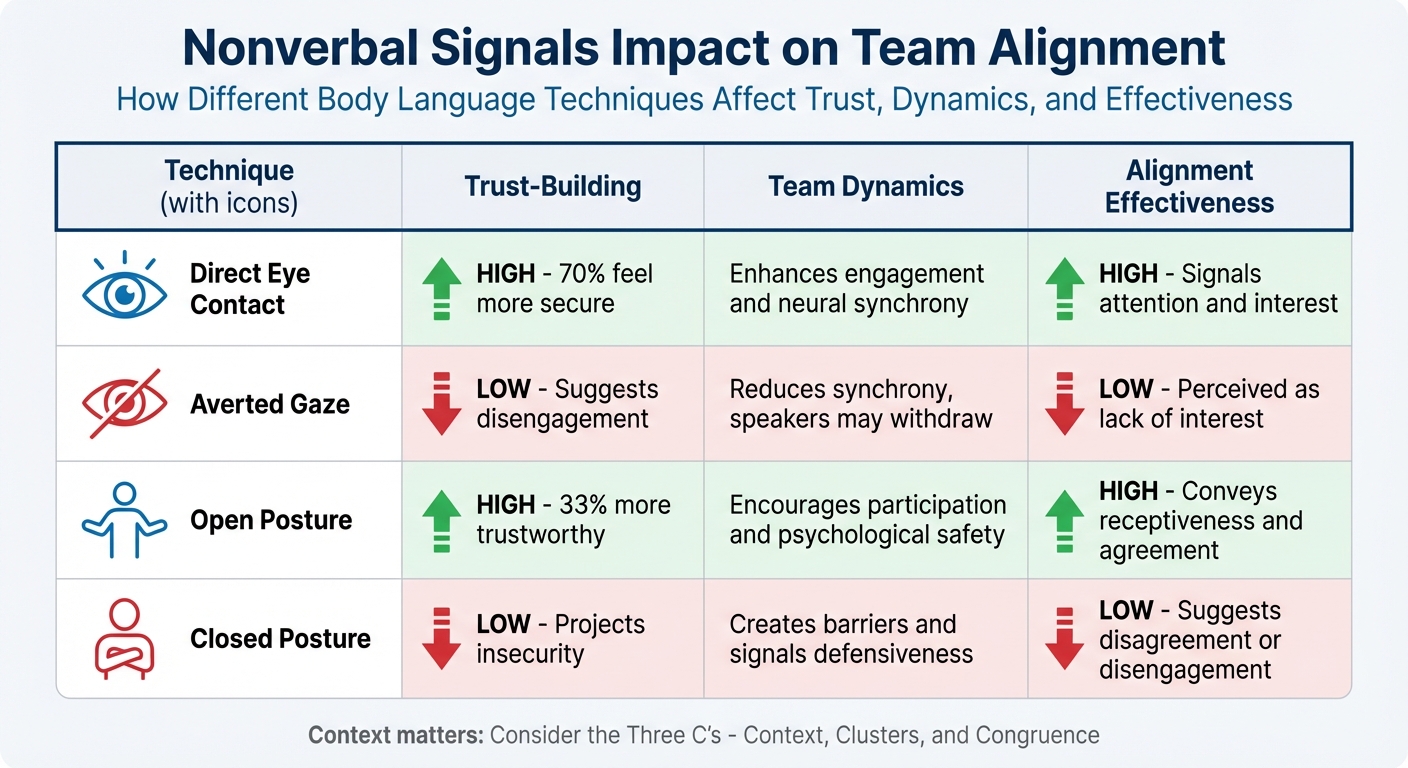
Nonverbal Communication Techniques: Impact on Trust, Team Dynamics, and Alignment
Nonverbal techniques bring both strengths and weaknesses to the table, influencing how teams build trust, collaborate, and stay aligned. Here’s a closer look at how these techniques play out in different contexts.
Direct eye contact is a powerful trust-builder in Western business settings, with 70% of participants reporting they feel more secure when engaged in steady eye contact [6]. It conveys confidence and attentiveness. However, outside of Western cultures, prolonged eye contact can sometimes come across as aggressive or disrespectful [2][5].
On the flip side, averted gaze often signals disengagement in the U.S., potentially reducing synchrony and undermining a leader’s credibility as speakers may feel ignored or shut down [1][8]. Yet, in some cultures, looking away can be a sign of respect or deference [2][5].
Open posture, which includes uncrossed arms, visible hands, and an upright stance, enhances trust by 33% and communicates openness and agreement [6][1][9]. Meanwhile, closed posture – like crossed arms or slouching – can act as a physical and psychological barrier, projecting insecurity or defensiveness and leading to mistrust [2][5].
Here’s a quick comparison of these nonverbal techniques and their impact:
| Technique | Trust-Building | Team Dynamics | Alignment Effectiveness |
|---|---|---|---|
| Direct Eye Contact | High; 70% feel more secure [6] | Enhances engagement and neural synchrony [8] | High; signals attention and interest [1] |
| Averted Gaze | Low; suggests disengagement [1] | Reduces synchrony, may cause speakers to withdraw [1][8] | Low; perceived as a lack of interest [1] |
| Open Posture | High; seen as 33% more trustworthy [6] | Encourages participation and psychological safety [2] | High; conveys receptiveness and agreement [1][9] |
| Closed Posture | Low; projects insecurity [2][5] | Creates barriers and signals defensiveness [1] | Low; suggests disagreement or disengagement [2][9] |
Understanding these nuances requires paying close attention to context. For instance, crossed arms might mean someone is cold, not defensive [9]. Similarly, an averted gaze during a tough conversation could indicate deep thought rather than disinterest [3].
To avoid misreading these signals, use the "Three C’s" framework: Context (consider the setting), Clusters (look for related cues), and Congruence (ensure signals match spoken words) [9]. This approach helps you interpret nonverbal communication accurately and respond in a way that fosters alignment and trust within your team. Recognizing these cues within your team’s unique cultural and situational dynamics is key to achieving shared goals.
Conclusion
Matching your nonverbal cues with your words strengthens team trust and effectiveness. When your body language aligns with your message, you build the credibility and connection that hold teams together. These observations highlight how crucial nonverbal communication is in team dynamics.
Research shows that teams skilled in nonverbal communication see a 66% increase in productivity and a 30% boost in mutual trust [6]. When team members understand and respond to each other’s cues, their brain activity synchronizes, leading to quicker decisions and stronger collaboration.
Start applying these techniques today. For example, try the Lighthouse Technique during your next meeting: slowly sweep your gaze across the room, pausing for 3–5 seconds on each person to ensure everyone feels included [3]. Use the 70/30 Rule: maintain eye contact 70% of the time when listening and 50% when speaking [3]. Keep an open posture – arms uncrossed and hands visible – to show you’re approachable.
To ensure your nonverbal signals align with your words, rely on the Three C’s: consider the Context of the situation, look for Clusters of related cues, and check for Congruence between verbal and nonverbal communication [9]. Avoid interpreting isolated gestures without considering the bigger picture.
Building team alignment begins with self-awareness. Pay attention to what your body language communicates, make adjustments as needed, and observe how your team reacts. Small changes in how you carry yourself – like improving posture or adjusting your gaze – can significantly enhance trust and cohesion. By consistently practicing these strategies, you can create a more aligned and high-performing team.
FAQs
How do I know if I’m making too much eye contact?
Maintaining eye contact is essential, but overdoing it can come across as intimidating or even confrontational. Striking the right balance is key: aim to hold eye contact about 50% of the time when you’re speaking and around 70% when you’re listening. Pay attention to how the other person reacts – if they start shifting their gaze frequently or fidgeting, it might signal discomfort.
In leadership, your gaze plays a big role in building trust and rapport. A steady, natural gaze can help create a sense of connection and demonstrate emotional awareness, which is crucial for aligning and engaging with your team effectively.
What if someone’s closed posture is just comfort or stress?
Sometimes, a closed posture isn’t about disengagement – it might indicate comfort or even stress. This is why it’s so important to consider nonverbal cues within the context of someone’s emotional state. By doing so, you can better understand their needs, whether they require reassurance or support, and create opportunities to build trust and strengthen connections.
How can I show eye contact and openness on video calls?
To create a sense of trust and connection during video calls, focus on maintaining steady eye contact by looking directly at the camera. Incorporate open gestures, such as sitting with a relaxed posture, keeping your arms uncrossed, and nodding occasionally to show attentiveness and confidence. Make sure your face is well-lit so your expressions – like a warm smile – are easy to see, adding a friendly touch. When your body language aligns with your words, it strengthens trust and helps everyone feel more in sync, even in a virtual environment.