Inclusive leadership is about creating workplaces where everyone feels respected, valued, and empowered to contribute. This leadership style doesn’t just improve team dynamics – it drives measurable business success. Research shows that teams led by inclusive leaders are 6x more likely to innovate and achieve 36% higher profitability. They also see 83% greater engagement and 42% lower turnover rates.
Key takeaways:
- Diverse teams excel when leaders prioritize psychological safety, enabling members to share ideas without fear.
- Organizations with inclusive cultures are 70% more likely to break into new markets and generate 19% more revenue from innovation.
- Traits of effective leaders include humility, awareness of bias, and clear communication, which build trust and collaboration.
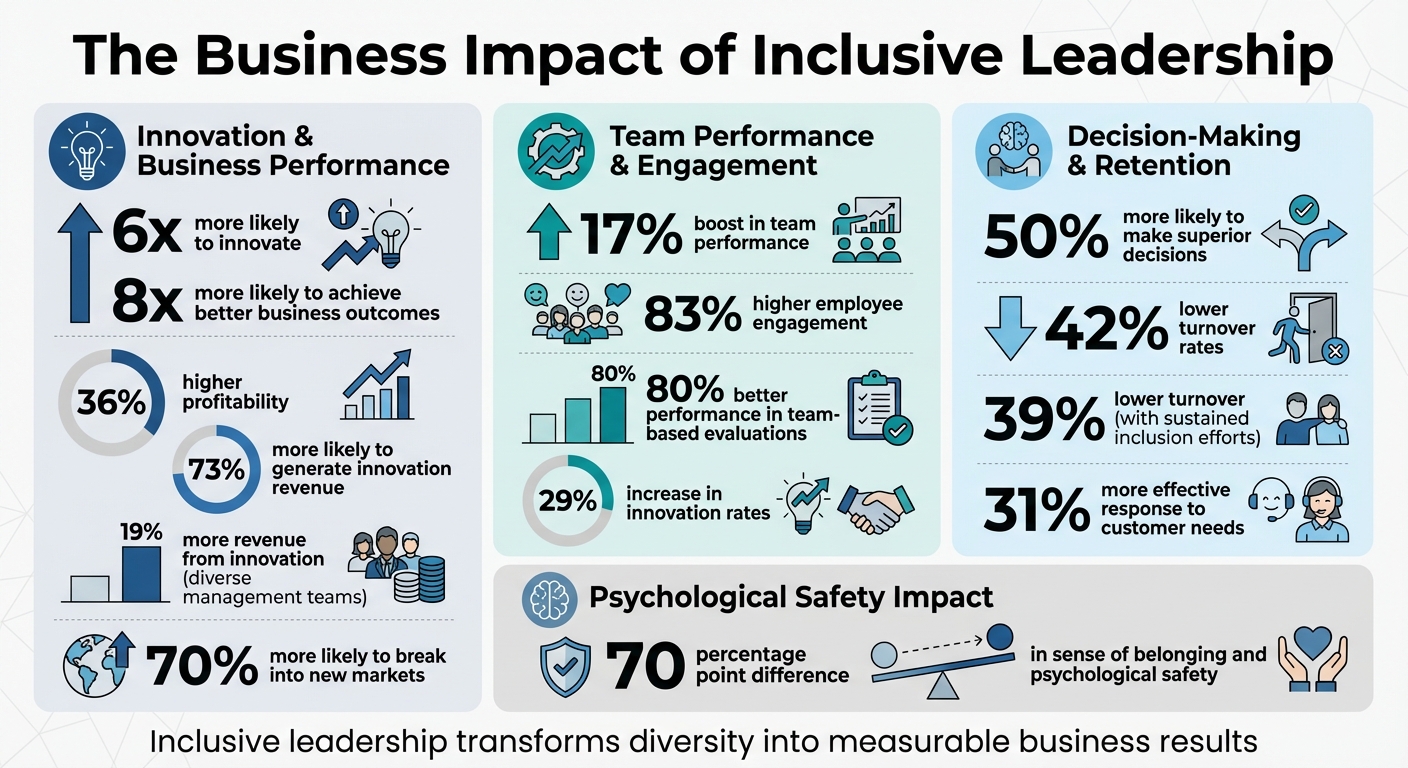
The Business Impact of Inclusive Leadership: Key Statistics and Performance Metrics
The Value of Inclusive Leadership in Diverse Teams | Research
sbb-itb-5c9cdaf
Why Inclusivity Matters for Business Performance
Inclusive leadership isn’t just about fostering a welcoming workplace – it’s also a driver of measurable business success. Research shows that companies with inclusive cultures are 6x more likely to innovate and 8x more likely to achieve better business outcomes [2]. By tapping into the strengths of diverse teams, businesses gain a competitive edge.
The numbers speak for themselves: inclusive leadership is linked to a 17% boost in team performance and increases the likelihood of above-average profitability by 36% [3]. Additionally, companies with diverse management teams generate 19% more revenue from innovation compared to their less diverse counterparts [2][5]. Beyond profits, inclusivity enhances decision-making – diverse organizations are 50% more likely to make superior decisions [3].
How Diversity Drives Innovation
Diversity alone doesn’t guarantee success – this is the essence of the "inclusion paradox." Without inclusive leadership, diverse teams may fail to reach their full potential. The real difference lies in how leaders create an environment where varied perspectives are encouraged and transformed into groundbreaking ideas.
Take McKinsey & Company’s transformation in the 1980s and 1990s as an example. Breaking away from its traditional MBA-only hiring model, the firm introduced the Advanced Professional Degree (APD) program to recruit talent from a wider range of industries and academic backgrounds. Leadership played a critical role in ensuring fair evaluations, helping APDs grow to represent 20% to 30% of North American associates by the early 2020s. This shift broadened McKinsey’s expertise and diversity of thought [2]. It’s a clear example of how leadership can embrace and nurture diversity to drive success.
Another case comes from a Wall Street research firm that prioritized gender diversity under a new research director. By hiring and empowering women analysts, the firm unlocked new methods of gathering information, particularly from underserved retail investor communities. In just three years, the research department rose from 15th to 1st place among its peers [5]. This leap was made possible because leadership actively supported diverse approaches, turning inclusion into real results.
Diversity fuels innovation by reducing groupthink and expanding the range of ideas. For instance, ethnically diverse teams are 58% more likely to price stocks accurately, while all-male teams experience 20% more groupthink errors [2]. When different perspectives are harnessed effectively, teams don’t just think outside the box – they redefine it.
Why Psychological Safety Matters
At the core of diversity’s success is psychological safety. Harvard Business School Professor Amy Edmondson explains:
"Psychological safety is not about being nice – it’s about enabling candour, productive disagreement, and the free exchange of ideas." [2]
Without psychological safety, team members often hold back their unique perspectives. They may avoid risks, self-censor, or conform to group norms, ultimately undermining the advantages their diverse backgrounds bring.
Inclusive leadership can create a 70 percentage point difference in an employee’s sense of belonging and psychological safety [3]. Google’s Project Aristotle, a study conducted from 2012 to 2015, found that psychological safety was the most critical factor in team effectiveness – more important than seniority, team size, or technical skills [2].
By reframing failure as a chance to learn rather than an opportunity for blame, psychological safety fosters the experimentation and risk-taking that innovation thrives on. When team members feel comfortable speaking up, asking questions, and challenging assumptions, they bring their full experiences to the table. The results? Teams with 83% higher engagement levels and performance that surpasses peers by 80% in team-based evaluations [2].
These findings highlight the essential role of inclusive leadership in creating environments where diversity and innovation can flourish.
What Makes an Inclusive Leader
Inclusive leadership isn’t just a buzzword – it’s a set of skills that can be developed with intentional effort. Research highlights six key traits that define inclusive leaders: visible commitment, humility, awareness of bias, curiosity about others, cultural intelligence, and effective collaboration [2][4]. These qualities help diverse teams thrive by fostering an environment where every voice matters.
The real difference between a manager who talks about inclusion and a leader who lives it lies in their actions. Inclusive leaders go beyond surface-level acknowledgments of diversity; they actively shape how their teams communicate, make decisions, and solve challenges together.
Cultural Intelligence and Empathy
Cultural intelligence, or CQ, is the ability to work effectively across different cultural settings. It includes three main components:
- Cognitive CQ: Understanding cultural differences and how they influence behavior.
- Motivational CQ: A genuine interest in engaging with other cultures.
- Behavioral CQ: The ability to adjust actions to fit different cultural norms [2].
A great example of CQ in action is Sir James Dyson, the British inventor who hires philosophy graduates alongside engineers. By blending different ways of thinking, his teams challenge traditional assumptions and come up with better solutions [2]. The goal isn’t just to gather diverse people – it’s to create an environment where their unique perspectives actively shape results.
Empathy takes CQ to another level. It involves seeing team members as individuals with unique characteristics and contributions. Empathetic leaders avoid stereotypes and instead ask meaningful questions like, "Who are you?", "What are you here to do?", and "How can I help?" [5]. These small but powerful questions show a willingness to connect on a deeper level, a core theme in my most requested keynotes on leadership and empathy.
John Lewis, Jr., Global Chief Diversity Officer at The Coca-Cola Company, sums it up perfectly:
"The business case is compelling. But for this to work, you need to connect to the minds and the hearts." [4]
Even small actions can make a big difference. Learning how to pronounce someone’s name correctly, checking in privately with a disengaged team member, or adapting communication styles to meet individual needs are all practical examples of cultural intelligence. These behaviors create an environment where everyone feels valued and can contribute fully.
Humility and Recognizing Bias
An essential trait of inclusive leaders is humility – the ability to admit limits and mistakes. This openness creates a safe space for others to take risks and grow [5]. When leaders acknowledge their blind spots, they foster trust and encourage honest conversations.
But recognizing bias takes more than just good intentions. Leaders need to actively challenge their assumptions instead of relying on automatic judgments. Common biases include:
| Bias Type | Definition | Inclusive Leader Response |
|---|---|---|
| Affinity Bias | Preferring people similar to oneself | Seek out and include diverse perspectives |
| Confirmation Bias | Favoring information that supports existing beliefs | Look for evidence that challenges assumptions |
| Halo Effect | Letting one positive trait overshadow others | Evaluate individuals on multiple dimensions |
| In-group Bias | Favoring members of your own group | Build shared identities that unite everyone |
For example, Relay Graduate School of Education implemented a Diversity Steering Committee and cultural competence training between 2012 and 2014. The result? Minority staff representation grew from 11% to 19%, and women in senior leadership roles increased from 30% to 66% [8].
One of the hardest parts of addressing bias is managing your reaction when someone points it out. If a team member calls out an insensitive comment, resist the urge to get defensive. Take a moment to reflect before responding [5]. Defensiveness can shut down dialogue, but self-awareness opens the door to learning and growth. These practices naturally lead to better communication and adaptability.
Clear Communication and Flexibility
Once leaders develop cultural awareness and self-reflection, the next step is clear and adaptive communication. Diverse teams need leaders who can bridge differences in communication styles, languages, and cultural norms. This means moving away from a "loudest voice wins" approach in meetings. Techniques like round-robin sharing or collecting written input before discussions ensure everyone has an equal opportunity to contribute [2].
Rob Brown, Director of Customer Advocacy at Telstra, highlights the importance of this leadership role:
"If leaders don’t understand how we need to think differently… then it’s hard, if not impossible, for the teams to get it." [4]
Flexibility also means accommodating practical needs. Inclusive leaders rotate meeting times to account for different time zones, provide clear guidance on unwritten workplace norms, and use multiple communication channels to match individual preferences. They adopt a "universal design" mindset, making accessibility the default rather than waiting for someone to request accommodations.
This doesn’t mean abandoning structure. In fact, clear expectations around communication norms, work schedules, and collaboration methods help create a more inclusive environment. When everyone understands the "rules of the game", team members can focus on sharing their ideas instead of worrying about fitting in.
The HEART Framework for Inclusive Teams
The HEART framework – Hope, Empowerment, Accountability, Results, Trust – offers a practical guide for leaders aiming to transform diverse teams into high-performing ones. It combines emotional intelligence with measurable goals, creating an inclusive culture that fosters connection, empathy, and psychological safety while delivering operational results.
Research underscores the impact of inclusive leadership. It can improve an employee’s sense of belonging and psychological safety by up to 70 percentage points. Teams with inclusive leaders see a 17% boost in performance, while inclusive organizations are 73% more likely to generate revenue from innovation and 70% more likely to break into new markets [3]. The HEART framework translates these insights into actionable strategies for leaders.
Hope and Empowerment
Hope begins with a shared vision. Mike Henry, President of Operations at BHP Billiton, emphasizes the importance of aligning teams around why diversity matters to the business [4]. When team members see how their unique perspectives contribute to solving challenges or seizing new opportunities, they feel more invested in their work.
"The leader needs to invest in people, building shared aspiration and building an aligned understanding of the business case. They need to work with the team on the ‘how.’" – Mike Henry, President of Operations, BHP Billiton [4]
Empowerment, on the other hand, goes beyond simply assigning tasks. It involves coaching, offering feedback, and creating opportunities for growth [4]. A great example of this is Telstra’s "connected strategy", led by Rob Brown, Director of Customer Advocacy. By training leaders to better understand customer needs and streamline processes, Telstra built a culture centered on customer-centricity. Empowerment also includes practical steps, like using round-robin speaking structures or written input sessions in meetings, ensuring everyone – introverts and non-native speakers alike – can contribute [2]. These practices blend emotional intelligence with operational focus, a hallmark of the HEART framework.
Accountability and Results
Accountability ensures diversity goals are not just lofty ideals but integrated into business strategies, management discussions, and measurable targets [4]. McKinsey & Company exemplifies this by expanding recruitment beyond traditional MBAs to include Advanced Professional Degree (APD) holders from diverse industries. By the mid-2010s, APD associates made up 20–30% of North American hires, up from just 10% in the early 1990s. Leaders played a key role in supporting these recruits and ensuring fair evaluations [4].
Similarly, Mike Henry at BHP Billiton tackled his own affinity bias by relying on diverse hiring panels. The result? He described the hires as "spectacular", with many challenging the status quo in meaningful ways. This approach aligns with the Catalyst Study’s definition of accountability: holding team members responsible for outcomes they can control [4].
Focusing on results is equally critical. Diverse teams are better equipped to adapt to market changes and customer needs. François Hudon, an executive at Bank of Montreal, explains:
"It brings far greater confidence to the decision making when you know you are being supported by people who have far more diverse points of view." – François Hudon, Executive, Bank of Montreal [4]
In remote or hybrid work environments, evaluating performance based on outputs rather than physical presence helps eliminate proximity bias [2]. Research also shows that gender-diverse and inclusive teams outperform others by 50%, and companies in the top diversity quartile are 39% more likely to achieve financial success [9].
Trust as the Foundation
Trust is the cornerstone of the HEART framework. Without it, team members may hesitate to share the diverse perspectives that drive innovation. Research identifies trust, or psychological safety, as the most critical factor in team effectiveness – more so than seniority or team composition [2]. Building trust involves treating individuals fairly and valuing their unique contributions rather than relying on stereotypes [4].
Psychological safety fosters open dialogue and innovation [2]. Leaders can sustain trust through consistent actions: responding to questions with curiosity, publicly appreciating dissenting voices, and swiftly addressing violations of inclusive norms [2]. For example, during a period of financial uncertainty, an HR leader at a global tech company addressed layoff rumors with a transparent video message that shared financial data. This, coupled with skip-level discussions, strengthened trust and engagement across the organization [10].
The benefits of trust are clear. Inclusive organizations report 83% higher employee engagement and a 42% lower likelihood of turnover [2]. Trust isn’t just a "soft skill" – it’s the foundation that enables diverse teams to thrive.
How to Build an Inclusive Culture
Creating an inclusive culture takes more than good intentions – it requires intentional changes in how organizations hire, assess, and support their teams. Studies show that diverse teams can perform at higher levels, but without inclusive leadership and structural backing, they may struggle initially [2]. Without deliberate systems in place, diversity alone can lead to friction rather than sparking innovation.
Recruitment and Representation
Expanding where and how you recruit is a key starting point. Blind resume reviews can help reduce affinity bias [2]. Using diverse interview panels and sticking to structured interview questions – asking every candidate the same questions in the same order – helps ensure fair treatment. Setting clear, objective criteria before the hiring process begins ensures decisions are based on qualifications, not subjective impressions [2][4].
But hiring is just the beginning. To maintain an inclusive environment, organizations must also establish strong feedback systems.
Creating Feedback and Accountability Systems
Inclusion should be a strategic priority, with measurable goals tied to leadership evaluations and business plans [2][4]. Tracking representation at all levels and monitoring turnover rates can reveal if certain groups are leaving at higher rates [5].
Organizations should use multiple feedback channels – like employee resource groups (ERGs), anonymous pulse surveys, and skip-level discussions – to gather honest input [2][10]. During performance reviews, calibration sessions where evaluators discuss ratings together can help counter individual biases [2]. As Robin Ely, Professor at Harvard Business School, warns:
"Metrics are indicators of how you’re doing in your culture. But I think when we manage to the metric itself, then that becomes a problem, because we’re not making the real change… We’re just doing the simple fixes to make the numbers look good" [5].
Addressing exclusionary behaviors immediately, whether through coaching or bystander intervention training, reinforces a zero-tolerance approach and helps maintain psychological safety [10].
Leadership training is equally crucial to embed these values throughout the organization.
Investing in Leadership Training
Leaders play a central role in shaping an inclusive culture. As Rob Brown, Director of Customer Advocacy at Telstra, puts it:
"Leaders are the linchpin that sets the pace and culture of our organization" [4].
Leadership training should focus on building cultural awareness, emotional intelligence, and strategies to foster psychological safety [2][11]. Programs like HEARTnomics™ combine emotional intelligence with operational effectiveness, using frameworks such as HEART (Humanity, Empathy, Accountability, Resilience, Trust) and BEAT (Believe, Engage, Act, Transform). These tools help leaders strengthen culture, boost resilience, and lead with clarity and trust. Companies implementing HEARTnomics™ have reported a 20–35% improvement in alignment, engagement, and trust within three months – turning inclusive values into tangible results.
Training should also include practical skills like responding to dissent with curiosity, recognizing when diverse perspectives shift one’s thinking, and ensuring all voices are heard [2][5]. Leaders must embrace vulnerability – acknowledging mistakes and blind spots fosters trust and encourages openness within their teams [2][5]. In hybrid work settings, training should address proximity bias and establish clear communication practices to accommodate different time zones and working styles [7].
Organizations that prioritize inclusivity are six times more likely to drive innovation and eight times more likely to achieve better business outcomes [2]. As John Lewis, Jr., Global Chief Diversity Officer at The Coca-Cola Company, emphasizes:
"The business case is compelling. But for this to work, you need to connect to the minds and the hearts" [4].
Effective leadership development bridges that gap, making inclusion a reality.
Measuring and Maintaining Progress
Creating an inclusive workplace isn’t a one-and-done task – it requires ongoing measurement and adjustments. Without clear metrics, companies risk falling into the trap of performative inclusion, where diversity looks good on paper but fails to bring about meaningful change. As Entrepreneur aptly put it:
"If you’re not measuring your inclusion efforts, you’re playing a guessing game" [6].
Key Metrics for Inclusion
To measure inclusion effectively, you need to look beyond just numbers. While quantitative data like representation at all levels, turnover rates by demographic group, and promotion parity are essential, they only tell part of the story. For a fuller picture, combine these with behavioral indicators. For instance, breaking down engagement scores by demographic groups can uncover whether certain employees feel less connected [2][5].
But even numbers and engagement scores aren’t enough on their own. Metrics around psychological safety and "voice" – the ability for employees to share ideas and concerns without fear – are critical to ensure that diverse perspectives are not only heard but valued [5]. Pulse surveys can be particularly helpful here, offering quick, anonymous feedback that can highlight brewing issues, especially for employees from marginalized groups who may be hesitant to speak up openly [10].
Inclusion also has a measurable business impact. Research shows that inclusive companies are 73% more likely to generate innovation revenue and 70% more likely to tap into new markets [1][3][5]. Diverse management teams, in particular, contribute significantly, generating nearly 19% more innovation revenue compared to their less diverse counterparts [5]. Metrics like decision-making speed, product launches, and market share growth in diverse customer segments can provide further evidence of whether inclusion efforts are driving real results.
These measurements serve as a foundation for identifying areas that need improvement and ensuring steady progress.
Continuous Improvement
Once metrics are in place, the real work begins: using them to address gaps and refine the organization’s culture. Meaningful, lasting change takes time – typically three to five years of consistent effort [2][12]. Setbacks are inevitable, but they can be valuable learning moments. For example, McKinsey & Company demonstrated this through its Advanced Professional Degree program, which increased representation by combining coaching with objective evaluation processes [4].
To keep the momentum going, inclusion metrics should be tied directly to leadership performance reviews. When leaders are held accountable, inclusion becomes a priority at the top [2]. Multiple feedback channels, like Employee Resource Groups and anonymous surveys, allow for real-time adjustments based on employees’ experiences [2][6]. Regular audits of HR processes can help identify and correct biases, particularly in hybrid work environments where proximity bias might emerge [2].
It’s also important to distribute the responsibility for inclusion more evenly across teams. Underrepresented employees often bear the brunt of this work, which can lead to burnout. Instead, make inclusion a shared responsibility across the organization. Celebrate small wins to keep morale high, and address exclusionary behaviors immediately through coaching or intervention training. This not only reinforces accountability but also helps maintain psychological safety [10].
Conclusion: Leading with Love and Excellence
Inclusive leadership is the engine that powers diverse teams to reach their full potential. Without it, diversity alone cannot drive results. As the Inclusive Leadership Institute aptly states:
"Having diversity without inclusive leadership is like having a high-performance engine without the fuel to power it – the potential remains unrealised" [13].
The evidence is clear: inclusive leadership delivers measurable benefits. Teams led by inclusive leaders see a 29% increase in innovation rates [13] and perform 17% better overall [3]. Organizations that embrace inclusivity respond 31% more effectively to customer needs [13]. These outcomes stem from leaders who prioritize trust, foster psychological safety, and align their teams with a shared purpose.
The HEART framework – Hope, Empowerment, Accountability, Results, and Trust – offers a practical approach to turning inclusion into tangible business outcomes. By following this roadmap, leaders can build resilient teams equipped to handle challenges and uncertainty while driving success.
At its core, leading with love and excellence means blending vision with passion – combining the undeniable business case for inclusion with a genuine commitment to equity and belonging. This approach not only improves performance metrics but also creates high-performing teams capable of sustained innovation.
This journey demands persistence but pays off in significant ways: 39% lower turnover and 67% higher engagement [13]. Leaders who align people, purpose, and performance create organizations where every voice is heard, and innovation flourishes.
FAQs
How can I quickly build psychological safety?
To quickly build psychological safety, focus on creating a space where team members feel comfortable sharing ideas, admitting mistakes, and speaking openly without fear of judgment. Here’s how to make that happen:
- Be open yourself: Share your own mistakes and uncertainties to set the tone for transparency.
- Invite input from everyone: Actively encourage participation to ensure all voices are heard.
- Handle feedback and errors with care: Respond in a way that supports learning rather than criticism.
- Establish clear expectations: Set ground rules that promote growth and collaboration.
When these practices are applied consistently, they help nurture trust and spark innovation.
What are the best ways to reduce bias in hiring and reviews?
Reducing bias in hiring and performance reviews plays a crucial role in creating inclusive leadership and assembling diverse teams. To achieve this, start by implementing structured and standardized processes with clear, consistent criteria for evaluations. This ensures everyone is assessed on the same basis.
Additionally, training managers on unconscious bias can help raise awareness and encourage fairer decision-making. Including diverse panels in the hiring and review process brings in multiple perspectives, while relying on data-driven decisions reduces the influence of subjective judgments.
By embedding these practices, organizations can build trust and fairness while driving continuous improvement. These efforts align seamlessly with HEARTnomics™ principles, emphasizing love, trust, and excellence in leadership and teamwork.
What inclusion metrics should we track monthly?
Track metrics that reflect demographic diversity and team inclusion to get a clearer picture of progress. Look at representation across various roles, considering factors like backgrounds, genders, and age groups. Use surveys to gauge how employees feel about belonging, fairness, and psychological safety within the workplace.
Keep an eye on participation rates in inclusion programs, levels of job satisfaction, and observable inclusive behaviors. By blending quantitative data, such as demographic stats, with qualitative insights like employee sentiment, you can develop a more complete understanding of inclusion efforts. This approach helps foster meaningful, long-term changes within the organizational culture.