Clarity in leadership communication drives better results, trust, and team performance. Ambiguity, on the other hand, creates confusion, stress, and slows progress.
When leaders communicate clearly, teams know their priorities, act decisively, and stay aligned with goals. Ambiguity leads to hesitation, wasted time, and disengagement. The key difference? Clarity reduces mental strain and builds confidence, while unclear messaging triggers stress and second-guessing.
Key Takeaways:
- Clarity: Reduces confusion, boosts trust, and enables faster decision-making.
- Ambiguity: Creates stress, slows progress, and erodes trust.
- Clear communication helps organizations outperform competitors by 3.5×.
- Ambiguity increases workplace stress and leads to 87% knowledge loss within 30 days.
Leaders can improve clarity by simplifying messages, setting clear expectations, and fostering trust through consistent communication and transparency. This approach ensures teams stay focused, aligned, and productive.
Clarity vs. Ambiguity: Key Differences
What Is Clarity in Leadership Messaging?
Clarity in leadership messaging is all about eliminating uncertainty and providing clear direction. It defines the “what” and “why” – outlining priorities and purpose – while leaving the “how” to the expertise of the team [6]. This approach removes guesswork, allowing teams to focus their energy on decisive action.
From a neurological perspective, clear communication reduces cognitive load. This makes it easier for people to process information quickly and reserve their mental energy for strategic tasks [1]. It’s not about oversimplifying complex situations – it’s about identifying the core truths that enable teams to act with confidence [3]. Dan Docherty, President of Braintrust, captures this perfectly:
“Clarity is not a communication skill. It is an act of leadership discipline” [1].
For clarity to be effective, it needs four key elements: simplicity (focusing on the essentials), structure (following a logical flow), relevance (addressing what matters most), and focus (limiting priorities to a manageable number) [1]. Research shows that the human brain struggles to prioritize more than three items at a time, so leaders must practice deliberate restraint [1]. By doing so, they not only save time but also build trust, accountability, and momentum for execution. Without this structured guidance, ambiguity inevitably takes over.
Understanding Ambiguity in Leadership
Ambiguity, on the other hand, arises from unclear or inconsistent communication. This creates a “prediction gap”, a term neuroscientists use to describe the brain’s difficulty in anticipating what comes next [6]. When faced with this gap, the amygdala kicks in, releasing cortisol and shifting focus from productive tasks to survival instincts [6].
Under ambiguous leadership, teams don’t necessarily disengage – they become overly cautious. Instead of taking initiative, they wait for clearer instructions, which slows progress [7]. This hesitation can look like apathy or lack of commitment, but it’s often just confusion [9]. When goals are vague and roles are unclear, people expend their energy trying to interpret direction rather than delivering results. This leads to stress and burnout – not because they don’t care, but because they’re stuck in a cycle of uncertainty [9].
The contrast couldn’t be sharper. Clear communication fosters psychological safety, encouraging innovation and risk-taking. Ambiguity, however, breeds anxiety, prompting teams to fill in the gaps with worst-case scenarios [4][8]. While “strategic ambiguity” can sometimes be useful in negotiations to maintain flexibility [2], it consistently disrupts day-to-day operations. Ambiguity erodes trust, slows decision-making, and drags down overall performance. This highlights the critical importance of addressing leadership challenges through clear communication – it provides the foundation teams need to feel confident, make decisions, and achieve measurable outcomes.
sbb-itb-5c9cdaf
The Costs of Ambiguous Leadership Communication
Loss of Trust and Engagement
Unclear leadership communication can seriously damage trust within an organization. When leaders fail to provide clear direction, teams are left guessing, which often leads to “narrative battles” – situations where departments create their own, conflicting interpretations of strategy [10]. The statistics are telling: only 13% of employees strongly believe their leadership communicates effectively [11]. Even more alarming, companies with poor communication coherence are 3.5 times more likely to experience major strategic failures during transitions [10].
The fallout goes beyond frustration. Top-performing employees, unwilling to wait for clarity, tend to disengage and leave well before the broader organization feels the effects [3]. Meanwhile, leadership may mistake silence for agreement, unaware that unresolved issues are simmering below the surface [10]. Simon Sinek captures it perfectly:
“Transparency fosters trust, and trust is the foundation of leadership” [12].
Without transparency, teams often resort to defensive adaptation – a state where employees prioritize safety over innovation, avoiding risks and withdrawing from proactive efforts [13].
Operational Inefficiencies
Ambiguous communication creates what researchers call “interpretation drag.” Instead of focusing on execution, teams waste time trying to decipher leadership’s intent [7]. From a neuroscience perspective, unclear messaging triggers a threat response in the brain, narrowing focus and reducing problem-solving capability [6]. This often leads to excessive meetings and duplicated work as teams chase misaligned priorities [3][6].
The ripple effects are significant. Ambiguity fuels workplace gossip, which 42% of employees identify as a major productivity killer [11]. On top of that, organizations lose 87% of knowledge within 30 days when communication lacks clarity and follow-through [1]. Middle managers, left without clear guidance, end up creating their own strategies, which fosters silos and misalignment across the organization [10]. As Jeremy from The Influence Journal puts it:
“Confusion is expensive. It drains resources, saps energy, and causes high performers to disengage long before they ever quit” [3].
Financial and Organizational Impacts
The financial consequences of ambiguous leadership often go unnoticed but act as a “hidden tax” on progress [13]. While short-term goals might still be met, trust erodes, and strategic momentum fades [10][13]. Research highlights that companies with effective internal communication are 3.5 times more likely to outperform their competitors [9]. The reverse is equally true – poor communication creates a long-term disadvantage that compounds over time.
Indecisiveness carries its own cost. Missed market opportunities, departing talent, and wasted energy on second-guessing can cripple an organization [13]. The stress is real: unclear goals and role ambiguity rank among the top three causes of workplace stress and burnout [9]. As CLARITY Research & Strategy warns:
“The greatest risk is not choosing incorrectly, but allowing indecision to become the default operating mode” [13].
When ambiguity sets in as the norm, organizations don’t just lose money – they lose the agility to adapt, innovate, and stay competitive. These challenges highlight the importance of clear, decisive communication in driving organizational success.
The Benefits of Clear Leadership Messaging
Building Trust and Accountability
Clear communication has a surprising effect – it calms the mind. When leaders communicate clearly, it frees teams from wasting energy deciphering vague instructions, allowing them to focus on meaningful tasks instead [6]. Ambiguity, on the other hand, triggers the brain’s threat response, releasing cortisol and making people more focused on self-preservation rather than collaboration [1].
Interestingly, trust isn’t about pretending to have all the answers. It’s built when leaders are honest about what they don’t know but follow up with a clear plan. Andrew Deitchman, Founder of ButterflyMX, puts it perfectly:
“Saying ‘I don’t know’ isn’t weakness; it’s honesty. What matters is what comes next: ‘But here’s what we’re doing in the meantime.'”
This kind of transparency creates a sense of psychological safety, showing employees that their leaders respect and value them. It’s a foundation for high performance [4].
Accountability thrives when expectations are tied to specific outcomes. When everyone knows exactly what’s required, they can take ownership, make quicker decisions, and deliver results confidently [5]. This clarity strengthens trust across the organization, paving the way for teams to work in sync toward common goals.
Improving Organizational Alignment
Clarity doesn’t just eliminate confusion – it saves time. Without it, teams fall into what’s often called “interpretation drag”, wasting hours trying to figure out unclear directions [7]. When leaders clearly define both the “what” (objectives) and the “why” (purpose), teams gain a shared understanding of the strategy [1]. This empowers them to make decisions independently while staying aligned with the company’s goals [6].
The result? Faster, more coordinated action. Instead of spending endless hours in alignment meetings, teams can move forward with confidence. Dan Docherty of Braintrust Growth explains it well:
“The leaders who scale are the ones who can take a large, overwhelming landscape of information and translate it into clear, simple, actionable direction” [1].
Clarity becomes a cornerstone of effective operations, supported by clear performance expectations, regular team check-ins, and strong decision-making processes [3][5].
Even in challenging times, consistent communication offers a sense of stability. Leaders who maintain a steady rhythm – like weekly updates or Friday memos – help reduce uncertainty and anxiety [8]. As Jennie Glazer, CEO of Coqual, wisely observes:
“When the world feels chaotic, consistency feels like safety” [4].
Driving Performance and Resilience
When trust and alignment come together, clear messaging drives performance, even under pressure. The HEARTnomics™ framework identifies hope as a key driver of change, especially during uncertain times [14]. By outlining a clear plan – even if the final destination isn’t fully defined – leaders inspire hope, keeping teams motivated and avoiding the energy drain caused by misalignment [14].
Trust serves as the glue holding this process together, helping teams stay committed even when results aren’t immediately visible. Hanna Bauer, Founder of HEARTnomics™, emphasizes the importance of this trust:
“Trust: Sustain the heartbeat of your legacy by having faith in the process, even when immediate differences aren’t visible” [14].
This combination of clarity and trust builds resilience, helping teams adapt and thrive under pressure.
Organizations that prioritize clarity don’t just navigate change – they grow stronger through it. As HEARTnomics™ highlights:
“If you’re not scaling in alignment, you’re losing more than momentum. You’re losing money, time, energy, and the relationships that matter most” [14].
Clear messaging ensures that values, systems, and strategies stay aligned, enabling teams to achieve what HEARTnomics™ calls “Implementation Excellence” – the perfect blend of passion (doing what you love) and precision (doing things right the first time) [14].
How to Communicate with Clarity as a Leader
Absorbing Ambiguity and Creating Clarity
Great leaders don’t let confusion trickle down. Instead, they take uncertainty and turn it into clear, actionable steps that their teams can follow [6]. Clarity doesn’t mean having all the answers – it’s about acknowledging what’s uncertain while providing a clear path forward [8]. For example, instead of overwhelming your team with a year-long plan, focus on the immediate future, like the next week. This helps maintain focus, especially in fast-moving environments. Share the facts you know, define the goal and its purpose, and empower your team to figure out the “how” [6].
One effective way to communicate clearly is by using direct, strong verbs. Swap out vague phrases like “maybe” or “if you want” with clear commands such as Send, Review, Finalize, or Confirm. This eliminates ambiguity and ensures your instructions are understood as requirements, not suggestions. To further cement clarity, ask team members to repeat back their understanding of the task [15].
By mastering this approach, you set the stage for using structured frameworks that enhance communication even further.
Using HEART Framework for Messaging
The HEART framework – Hope, Empowerment, Accountability, Results, Trust – is a tool that helps leaders communicate effectively while fostering trust and driving performance.
- Hope provides reassurance during uncertain times. Even a simple statement like “We’re working on a solution” offers more stability than silence [4].
- Empowerment involves clearly defining outcomes but allowing your team the freedom to decide how to achieve them. This not only motivates but encourages creative problem-solving [6].
- Accountability thrives on clear expectations tied to specific outcomes. Leadership expert Dave Anderson puts it best:
“High-performance cultures have crystal clear clarity.” [5]
- Results come from focusing on specific, actionable steps rather than vague goals.
- Trust is built through consistent communication, whether through regular updates, memos, or daily check-ins. This consistency signals reliability and helps reduce team anxiety [4].
Aligning Processes with CORE Framework
The CORE framework – Cultivate, Optimize, Reach, Elevate – takes clarity a step further by embedding it into everyday processes.
- Cultivate: Foster psychological safety by promoting open communication among leaders. Regular alignment rituals, like quarterly off-sites or strategy reviews, keep everyone focused on shared priorities [19]. Asking open-ended questions such as “What are we not considering?” can also uncover hidden concerns [4].
- Optimize: Simplify complex information into clear, structured narratives. Use a single source of truth to document decisions and processes, reducing mental overload for your team [16]. Research shows the brain can only prioritize about three items at a time – anything more creates unnecessary noise [1].
- Reach: Ensure your messages stick by using tools like the 1-Sentence Rule. If an initiative can’t be summarized in one clear sentence, it’s not ready to move forward. Tailor your communication to fit different audiences, from executives to frontline employees [3][17].
- Elevate: Shift the focus from busywork to meaningful outcomes. Define success through measurable results and align individual tasks with broader organizational goals using tools like OKRs [18].
“Overcommunicate Clarity” by Patrick Lencioni
Clarity vs. Ambiguity: Side-by-Side Comparison
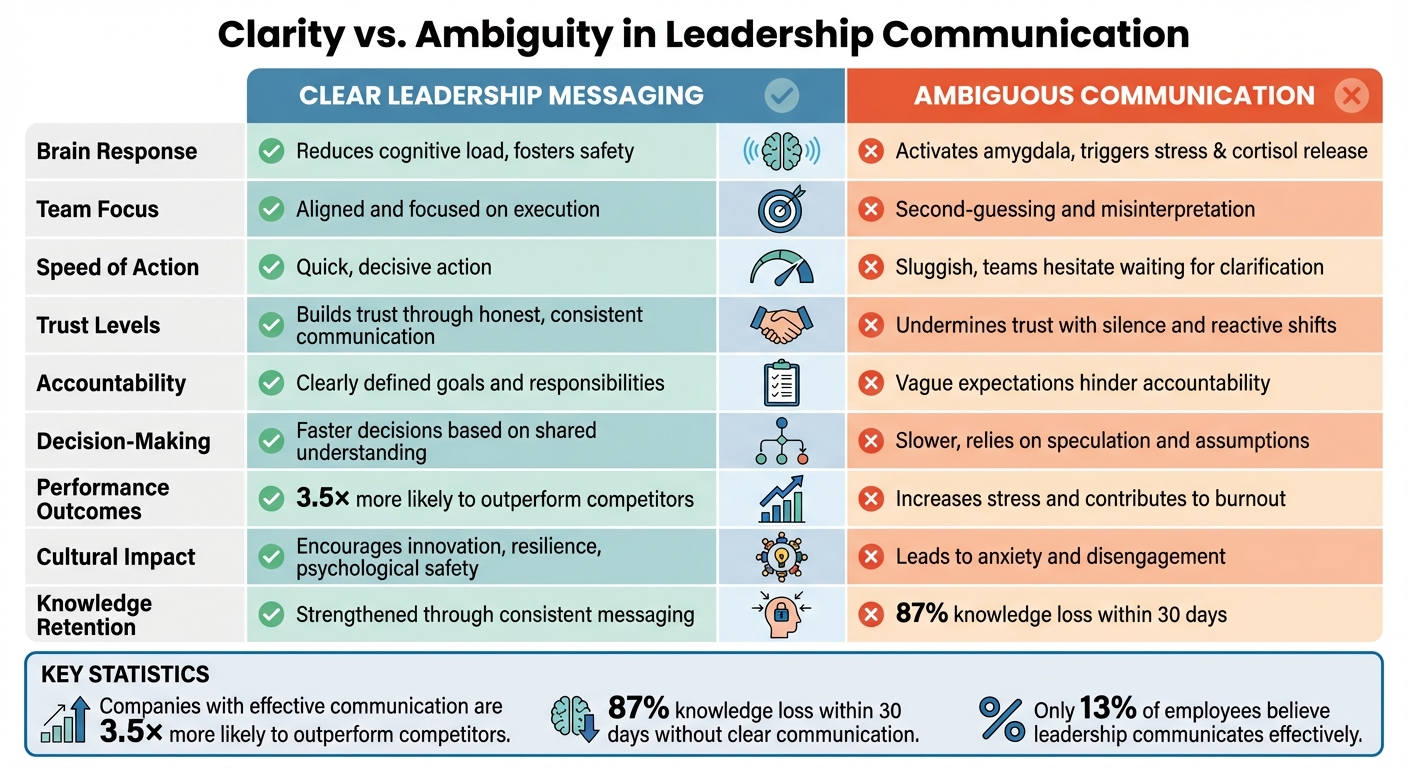
Clarity vs Ambiguity in Leadership: Impact on Team Performance and Business Outcomes
Clear communication and ambiguity have a noticeable impact on team performance. When communication is precise, teams can focus and execute effectively. On the other hand, ambiguity slows progress, creates confusion, and drains energy.
Here’s a breakdown comparing the outcomes of clear messaging versus ambiguous communication:
| Aspect | Clear Leadership Messaging | Ambiguous Communication |
|---|---|---|
| Brain Response | Reduces cognitive load, fostering a sense of safety [1] | Activates the amygdala, triggering stress and releasing cortisol [1][6] |
| Team Focus | Keeps teams aligned and focused on execution [1][7] | Encourages second-guessing and misinterpretation [1][7] |
| Speed of Action | Quick; teams act decisively with clear direction [3] | Sluggish; teams hesitate, waiting for clarification [7] |
| Trust Levels | Builds trust through honest and consistent communication [4][8] | Undermines trust with silence and reactive shifts [8] |
| Accountability | Strategies for empowering teams with accountability through clearly defined goals and responsibilities [5] | Vague expectations that hinder accountability [5] |
| Decision-Making | Faster decisions based on shared understanding [1][3] | Slower, relying on speculation and assumptions [6][7] |
| Performance Outcomes | 3.5× more likely to outperform competitors [9] | Increases stress and contributes to burnout [9] |
| Cultural Impact | Encourages innovation, resilience, and psychological safety [1][4] | Leads to anxiety and disengagement [6][8] |
| Knowledge Retention | Strengthened through consistent messaging [1] | Results in 87% knowledge loss within 30 days without reinforcement [1] |
This table highlights how clarity fuels better decision-making, stronger team dynamics, and improved overall performance.
Research shows companies with strong internal communication are 3.5× more likely to outperform their competitors [9]. On the flip side, unclear goals and role ambiguity are among the top three causes of workplace stress and burnout [9]. This confusion often results in missed deadlines, disengaged employees, and a lack of strategic direction.
Sam Walton, the founder of Walmart, famously stressed that clear communication is essential for effective management [2]. The evidence backs this up: clarity isn’t just about feeling organized – it directly impacts results.
Conclusion: Leading with Clarity for Trust and Results
Leadership clarity isn’t just a nice-to-have – it’s essential for effective decision-making and team performance. When leaders turn ambiguity into clear, actionable guidance, they ease mental strain, reduce stress, and enable teams to focus on execution rather than second-guessing directions [1][6]. Research backs this up: companies with strong internal communication practices are 3.5 times more likely to outperform their competitors [9]. On the flip side, unclear goals remain one of the top reasons for workplace stress and burnout [9].
“Clarity is not a communication skill. It is an act of leadership discipline.” – Dan Docherty, Braintrust Growth [1]
The choice between clarity and ambiguity can make or break an organization. Clear direction fosters trust and confidence, while ambiguity breeds stress and hesitation. Clarity also holds leaders and teams accountable, turning complex challenges into simple, actionable steps that everyone can understand and follow. This approach not only strengthens trust but also lays a solid foundation for leadership growth and transformation.
HEARTnomics™ offers tools to make this shift possible. Through its HEART and CORE frameworks, leaders create messaging that aligns company values with strategic goals. These systems are designed to cut through confusion, helping organizations see measurable improvements – like a 20–35% boost in alignment, engagement, and trust – in just 90 days [20].
When organizations embrace clarity at every level, the benefits ripple through their operations. With trust as the cornerstone, teams can execute confidently, even in uncertain situations [8].
FAQs
How can I tell if my message is too ambiguous?
To spot ambiguity, consider whether your audience fully grasps what they’re supposed to do, why it’s important, and how to move forward. Ambiguity can lead to confusion, misalignment, or hesitation. For example, if your team often seeks clarification, misses deadlines, or interprets instructions in varying ways, it’s a sign your message might lack clarity. Clear communication builds trust, ensures alignment, and promotes a shared understanding, helping to minimize the chances of missteps or misunderstandings.
When is strategic ambiguity actually helpful?
Strategic ambiguity can be a powerful tool in fast-moving, complex situations where adaptability matters most. By leaving room for multiple interpretations, it encourages fresh ideas and keeps stakeholders engaged. Instead of rushing to lock in a single path, this approach allows leaders to navigate uncertainty with agility, aligning decisions more effectively as circumstances shift.
What’s the fastest way to make expectations crystal clear?
Consistently communicating priorities is the quickest way to ensure expectations are clear, even when not all the details are finalized. Combine this with calm and confident actions to guide your team and provide a sense of stability during uncertain times.