Emotional intelligence (EI) is the ability to manage your emotions and understand others’. It’s a skill – not fixed like IQ – and can be improved with practice. For leaders, EI is crucial for building confidence and guiding teams effectively. Studies show EI is more impactful than IQ for success, with 71% of employers valuing it over technical skills.
Key components of EI include:
- Self-awareness: Recognizing your emotions and their impact.
- Self-regulation: Managing reactions and staying composed under stress.
- Motivation: Pursuing goals with purpose.
- Empathy: Understanding others’ emotions and perspectives.
- Social skills: Building relationships and resolving conflicts.
Improving EI involves strategies like identifying emotional triggers, seeking feedback, and practicing active listening. Tools like journaling and 360-degree assessments help refine self-awareness and address blind spots. Leaders with strong EI inspire trust, make better decisions, and create high-performing teams.
Quick Tip: Pause for 20 seconds before reacting to stressful situations. This simple practice can shift emotional responses to logical thinking, improving decision-making and team stability.
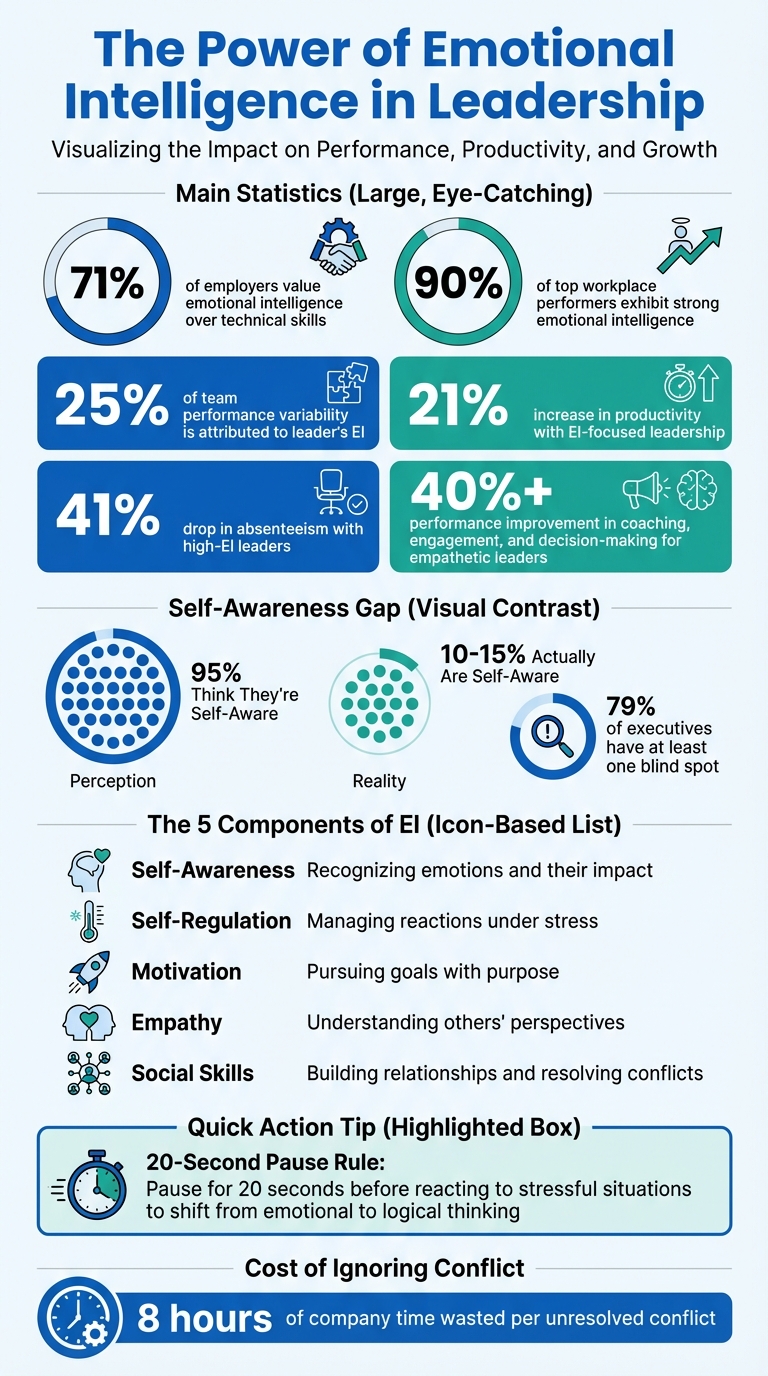
Emotional Intelligence Impact on Leadership Performance Statistics
Emotional Intelligence: How Good Leaders Become Great — UC Davis Executive Leadership Program

How Self-Awareness Builds Leadership Confidence
Self-awareness forms the bedrock of emotional intelligence and is critical for confident leadership. It’s about recognizing your emotions, understanding your strengths and weaknesses, and seeing how your reactions influence both personal performance and team dynamics [2]. When leaders understand their emotional triggers and motivators, they make thoughtful decisions that inspire trust, rather than reactive ones that hinder progress. Let’s dive into some strategies to strengthen self-awareness and build leadership confidence.
The statistics are eye-opening. While 95% of people think they’re self-aware, research shows that only 10% to 15% actually are [2]. Even more revealing, 79% of executives have at least one "blind spot" – a skill they believe is a strength but others see as a weakness [7]. These gaps in self-perception can have a direct impact on team success. Research shows that working with colleagues who lack self-awareness can cut a team’s effectiveness in half, while also increasing stress and reducing motivation [2]. Lauren Landry, Director of Marketing and Communications at Harvard Business School Online, sums it up well:
"To bring out the best in others, you first need to bring out the best in yourself, which is where self-awareness comes into play" [2].
Identifying Your Emotional Triggers
Knowing what sets off your emotions is key to making clear-headed decisions, especially in high-pressure situations. When you can pinpoint the moments that spark anger, fear, or frustration, you’re better equipped to pause and respond thoughtfully instead of reacting on impulse. Leaders who grasp their emotional triggers are more likely to stay composed during crises, which helps maintain a sense of stability and direction [7].
This isn’t just theoretical – it’s measurable. A leader’s emotional intelligence can account for nearly 25% of the variability in their team’s performance [4]. For example, in May 2024, the CEO of an architectural and engineering firm faced the difficult task of implementing the company’s first-ever layoffs. By acknowledging her own grief and the connections she had built with employees, she was able to communicate authentically. She shared her feelings first and then invited others to do the same, shifting the emotional tone from despair to hope as she outlined plans for the future [4].
To start identifying your triggers, pay close attention to recurring patterns in your emotional responses. When a strong emotion surfaces, pause for about 20 seconds before reacting. This brief pause allows emotions to settle, making room for logical thinking [7]. Reflective journaling can also be a powerful tool. By jotting down your daily interactions and meetings, you can spot what consistently frustrates or energizes you [2][7]. This practice helps you reinforce positive behaviors and steer clear of negative ones, ensuring your emotions guide rather than control your decisions.
But self-awareness doesn’t stop at recognizing emotional triggers. Understanding your broader strengths and weaknesses is equally important for effective leadership.
Evaluating Your Strengths and Weaknesses
A candid self-assessment helps you leverage your strengths while addressing areas where you fall short. This can lead to stronger teams that complement your abilities. Tools like 360-degree feedback are especially useful for uncovering blind spots that might otherwise lead to poor decisions or conflicts [2][7].
The challenge? Our self-perception often doesn’t align with reality. That’s why gathering anonymous feedback from managers, peers, and direct reports is so valuable [2][7]. In one instance, a manager faced an OSHA complaint in 2024. Instead of reacting defensively, they took the time to investigate the personal challenges underlying the issue. This approach not only resolved the complaint but also rebuilt trust with their team [4].
To deepen your self-awareness, adopt a curious mindset. Ask yourself questions like, "Why do I react with fear or anger?" and "What situations energize me?" [5]. Pair these reflections with structured tools like DISC profiles or emotional intelligence assessments to gain a clearer picture of your strengths and areas for growth [9]. By understanding yourself more fully, you’ll make better decisions and lead with greater confidence.
Using Self-Regulation to Stay Calm Under Pressure
Once you’ve pinpointed your emotional triggers, self-regulation helps you shift from impulsive reactions to thoughtful, intentional responses. Self-regulation, often referred to as self-management, is the ability to control your actions, emotions, and thoughts during stressful situations. This skill sets apart leaders who act on impulse from those who respond with intention. While reactions are knee-jerk emotional outbursts, responses involve deliberate actions after processing your emotions [2]. Research highlights that 90% of top workplace performers exhibit strong emotional intelligence, which contributes to consistently high team performance [4][8]. Maintaining composure under pressure not only sharpens decision-making but also stabilizes your team [4].
By building on self-awareness, you can use specific strategies to turn stress into purposeful action.
Managing Stress and Impulsive Reactions
Effectively managing stress starts with delaying your reaction long enough to think clearly [11]. Pay attention to physical signs of stress – like a pounding heart or tightened muscles [11]. When you feel triggered, take a brief pause to let your emotions settle. During this pause, name the emotion you’re experiencing. This simple act of labeling your feelings shifts brain activity from the emotional amygdala to the logical prefrontal cortex, reducing the likelihood of an "amygdala hijack" [10].
Michael McCarthy, Founder of Boston Executive Training, puts it plainly:
"People will never forget your amygdala hijack" [10].
Reframing challenges as opportunities to lead based on your leadership style can also help [4]. For example, in June 2024, a Senior Vice President at a healthcare insurance firm faced a crisis when a team leader took medical leave during a period of intense regulatory scrutiny. By relocating his office to the group’s conference room, he provided a calming presence, prevented panic, and guided the team through the challenge successfully [4].
Another helpful tool is the Inner Guidance Cycle: Pause, Ponder, Pivot, and Proceed [11]. When confronted with bad news, adopt an inquiring mindset – ask questions to understand the other person’s perspective rather than reacting with anger or blame [4].
While managing stress is essential, building resilience ensures you can bounce back quickly and lead effectively. Using a leadership resilience planner can help you map out these strategies.
Building Emotional Resilience
Resilience is the ability to recover swiftly from overwhelming emotions like anger or anxiety. It’s not an innate trait but a skill you can develop to maintain psychological stability, enabling better decision-making in uncertain situations [3][4]. Daniel Goleman and Cary Cherniss explain:
"Resilience means you recover more quickly from anger or anxiety. And getting calm lets you think more clearly" [4].
Building resilience begins with self-forgiveness – accepting that not every decision will be flawless. Even top performers face setbacks, much like a baseball player’s batting average. As one leader remarked, "Leaders do not need to get every decision or action right in order to be highly effective" [4]. Setting clear boundaries between work and personal life is another key step. Without these boundaries, emotional exhaustion can set in, leading to diminished self-regulation and impulsive behavior [12]. Practices like mindfulness or daily deep breathing exercises, even for just 5 to 10 minutes, can enhance mental clarity and help you stay composed under pressure [6].
In 2024, a manager at a food processing plant demonstrated resilience when an employee filed an OSHA complaint. Instead of reacting by firing the employee, the manager adopted an inquiring mindset. This revealed that the worker was dealing with stress from a family medical crisis. By responding with empathy rather than retaliation, the manager not only supported the employee but also resolved the issue effectively [4].
How Empathy Builds Trust and Influence
Empathy, alongside self-awareness and self-regulation, is a cornerstone of leadership that fosters trust and amplifies your influence. At its core, empathy is about recognizing, understanding, and connecting with the emotions and perspectives of others [4][8]. It’s not just a soft skill – it’s a transformative force in leadership. Leaders who genuinely empathize with their teams make better decisions, build stronger relationships, and inspire confidence. In fact, research highlights that leaders skilled in empathy outperform their peers by over 40% in areas like coaching, engagement, and decision-making [2]. This ripple effect enhances both individual and team performance [2].
Empathy operates on three interconnected levels. Cognitive empathy enables you to understand how someone thinks, emotional empathy allows you to feel what they’re experiencing, and empathic concern drives you to act in their best interest [4]. When these aspects of empathy are combined, they create the psychological safety essential for high-performing teams [8][9]. This triad of empathy pairs seamlessly with active listening, forming a powerful foundation for effective leadership.
Listening Actively to Understand Team Needs
Active listening is one of the simplest yet most impactful ways to show empathy. It signals to your team that you care and builds the trust that strengthens your leadership [6]. To practice active listening, eliminate distractions, use non-verbal cues like nodding, and paraphrase what you’ve heard to confirm understanding [2][9]. Social awareness also comes into play here – by observing facial expressions, body language, and tone of voice, you can pick up on emotions that may not be explicitly stated [8]. When team members feel genuinely heard, they’re more likely to share honest feedback and collaborate more openly [9].
In challenging conversations, active listening becomes even more critical. Before diving into difficult discussions, take a moment to regulate your emotions. Instead of reacting with blame, ask thoughtful questions to uncover the root of the issue [4]. This approach fosters understanding and paves the way for constructive dialogue.
Understanding Different Perspectives to Improve Collaboration
Taking the time to consider different perspectives can prevent impulsive reactions and lead to more thoughtful decisions [5]. For instance, a nursery school director once faced the delicate task of discussing a child’s behavior with their parents. Drawing on cognitive empathy, she reframed the conversation as a collaborative effort rather than a critique. This shift in approach led to a supportive and productive outcome [4].
Understanding the underlying reasons behind your team’s actions – whether it’s personal stress or external pressures – can help you address conflicts with compassion rather than discipline [4]. When giving feedback, balance constructive criticism with acknowledgment of what the employee is doing well. This approach keeps the brain from slipping into "defensive mode", which can stifle creativity and problem-solving [4]. By blending empathy with thoughtful communication, you create an environment where collaboration thrives.
sbb-itb-5c9cdaf
Improving Confidence Through Better Social Skills
After mastering self-awareness and emotional regulation, developing strong social skills becomes the next step in boosting leadership confidence. Together with empathy and authority, these skills form the backbone of emotional intelligence, which is essential for effective leadership.
What sets great leaders apart from the rest? It’s their ability to communicate clearly and handle conflicts with fairness. These actions demonstrate a calm, confident demeanor that keeps teams motivated and on track. According to research, 71% of employers prioritize emotional intelligence over technical skills when assessing candidates [2]. At the core of emotional intelligence lies social skills, which not only enhance team performance but also reinforce your credibility as a leader day in and day out.
Communicating Clearly to Align Your Team
Clear communication begins with understanding your team – what they need to hear and how they need to hear it. Leaders with strong emotional intelligence pick up on nonverbal cues and underlying concerns, enabling them to address potential issues before they escalate [4]. Responding thoughtfully rather than reacting impulsively creates a stable environment where team members feel secure and focused. This stability is especially crucial during high-pressure situations.
When giving feedback, aim to address specific behaviors rather than making personal criticisms. For instance, instead of saying, "You’re disorganized", try suggesting, "Let’s work on prioritizing tasks at the start of each day." This approach shifts the focus to actionable improvements while maintaining respect and avoiding defensiveness [4]. Keeping communication intentional and constructive fosters collaboration and ensures alignment across the team.
Clear communication also lays the groundwork for resolving conflicts effectively.
Resolving Conflicts to Maintain Team Harmony
Ignoring workplace conflicts can be costly. Studies show that unresolved disputes waste about eight hours of company time per conflict due to gossip and other distractions [2]. By addressing conflicts directly with empathy and fairness, you not only resolve the issue at hand but also build trust and strengthen your leadership presence.
The secret lies in focusing on understanding rather than assigning blame. Take the time to ask questions and uncover the deeper causes of disagreements before jumping to conclusions [4]. This approach turns potential crises into opportunities to show genuine care for your team, maintain harmony, and bolster your credibility as a leader. Empathy-driven conflict resolution doesn’t just solve problems – it strengthens the foundation of trust within your team.
Using HEARTnomics Frameworks to Build Lasting Confidence
To develop enduring leadership confidence, emotional intelligence in leadership needs more than just awareness – it requires a structured system that turns insight into action. That’s where HEARTnomics comes in. This approach blends emotional intelligence with operational precision, offering frameworks that transform understanding into measurable results.
At the core of HEARTnomics is the HEART framework – five key pillars: Hope, Empowerment, Accountability, Results, and Trust. Each plays a unique role in building leadership confidence:
- Hope strengthens resilience.
- Empowerment ignites creativity and innovation.
- Accountability nurtures honesty and transparency.
- A focus on Results can increase productivity by 21% [6].
- Trust reduces turnover and fosters deeper engagement.
Together, these pillars create a foundation for confident and effective leadership. But HEART doesn’t work alone – it’s paired with the BEAT framework, which emphasizes personal transformation.
The BEAT framework – Believe, Engage, Act, Transform – guides leaders through their own growth journey. It starts with adopting a "learn-it-all" mindset [14][15], using cognitive empathy to connect with teams, taking decisive action, and ultimately evolving into a transformational leader. By combining HEART and BEAT, leaders can align emotional insight with concrete actions, ensuring sustainable growth and success.
This approach isn’t just theoretical – research strongly supports it. Emotional intelligence has been shown to be four times more important than IQ in professional environments [1]. In leadership roles, 80% of performance differences stem from emotional competence rather than technical expertise [13]. Leaders proficient in empathy outperform their peers by more than 40% in areas like coaching, team engagement, and decision-making [2]. By integrating these EQ skills with structured frameworks, leaders can consistently deliver results, even under pressure. This isn’t about feel-good leadership – it’s about leadership that drives real, measurable outcomes.
Organizations that adopt HEARTnomics frameworks often see a 20–35% improvement in alignment, engagement, and trust within just 90 days. It’s a shift from reactive management to proactive transformation – leadership that not only inspires but delivers tangible results.
Practical Steps to Develop Your Emotional Intelligence
Strengthening emotional intelligence (EI) is about incorporating small, intentional actions into your daily leadership routine. Here’s how you can get started:
Assess and Reflect on Your EI Skills
Start by keeping a daily trigger log to document interactions that evoke strong emotions – whether they’re positive or negative [7]. This practice helps you uncover patterns you might otherwise overlook. For instance, you may notice that budget discussions consistently make you anxious, or that certain team members always leave you feeling energized.
When frustration or lack of motivation strikes, try the "Five Whys" technique [16]. Ask yourself "why" five times to dig into the root cause. For example, if you’re dreading an upcoming meeting, ask why. Maybe it’s because you feel unprepared. Why? Because the data isn’t ready. Why? This method helps you pinpoint the actual issue, not just the surface emotion.
Remember, self-assessments can only take you so far. To get a complete view, it’s crucial to seek external perspectives. Combining self-reflection with outside insights can sharpen your emotional intelligence even further.
Ask for Feedback from Others
Use 360-degree assessments to gather feedback from managers, peers, and direct reports [7][6]. This feedback often highlights blind spots you might not be aware of. For example, you may think you’re a great listener, but your team might see someone who interrupts too often.
Employee opinion surveys can also provide valuable insights into how your team perceives the emotional environment you create [8][6]. Ask specific questions like, "Do you feel heard in team meetings?" or "Can you approach me with concerns?" The responses might surprise you – and that’s the point.
"Leaders prime the emotional state of the organization. When they’re ineffective, when they set poor examples of how they treat other people, that trickles down throughout the company." – Travis Bradberry, President, TalentSmart [7]
Once you’ve gathered this feedback, use it to refine your approach to leadership.
Practice EI in Daily Leadership Situations
In the heat of the moment, pause for 20 seconds before reacting [7]. This brief pause allows your logical thinking to catch up with your emotions, helping you avoid impulsive decisions that could lead to bigger problems.
Focus on active listening during conversations. Paraphrase what your team members say and use non-verbal cues like nodding to show you’re engaged [7][6]. Keep in mind that only about 10% of people truly listen effectively [7]. For instance, if someone expresses a concern, you could respond with, "What I’m hearing is that you’re worried about the timeline. Is that correct?"
Incorporate 5–10 minutes of mindfulness or deep-breathing exercises into your daily routine to stay calm and clear-headed under pressure [16][6]. When giving feedback, target specific behaviors instead of criticizing the person to prevent defensiveness [4]. Instead of saying, "You’re always late to meetings", try, "I’ve noticed the last three meetings started without you. What’s been causing the delay?"
Finally, practice cognitive empathy by putting yourself in your team members’ shoes before making decisions [4][16]. For example, if a project is running behind, ask yourself, "What challenges might they be facing that I haven’t considered?" This shift in perspective can transform your leadership style and how your team responds to you.
Conclusion
Emotional intelligence (EI) lies at the heart of confident and effective leadership. By cultivating self-awareness, empathy, and strong social skills, leaders can see tangible improvements in both personal performance and team engagement.
The numbers back it up: EI accounts for 25% of the variability in worker performance, surpasses IQ by more than double in predicting entrepreneurial success, and has been linked to a 21% increase in productivity alongside a 41% drop in absenteeism [4][6].
As Daniel Goleman and Cary Cherniss point out, "a leader’s EI enhances both performance and well-being" [4].
Unlike IQ, EI isn’t fixed – it’s a skill you can actively develop. Simple practices like keeping a reflective journal, seeking honest 360-degree feedback, or pausing for 20 seconds before reacting can make a big difference in strengthening your emotional intelligence.
At its core, EI is about fostering human connection, managing emotions effectively, and staying resilient under pressure. By committing to these practices, you can shape a leadership style that not only delivers results but also builds trust and team engagement. These skills pave the way for long-term success and a more cohesive, motivated workplace.
FAQs
How does emotional intelligence help leaders build confidence?
Emotional intelligence (EI) plays a crucial role in helping leaders develop confidence by sharpening their ability to understand and manage their emotions while building meaningful relationships. Core EI skills like self-awareness and empathy allow leaders to identify their strengths, address areas for improvement, and navigate challenges with thoughtfulness. This approach fosters trust and clarity, both essential traits for effective leadership.
Leaders can enhance their EI through intentional practices such as reflective journaling, mindfulness exercises, and active listening. These habits not only improve self-regulation and reduce stress but also boost social awareness, paving the way for better decision-making and stronger team connections. By consistently applying these skills, leaders can cultivate confidence and achieve impactful results.
HEARTnomics™ introduces a distinct method for developing emotional intelligence, blending personal growth with structured leadership strategies. Through its proprietary frameworks, HEARTnomics™ equips leaders to build resilience, maintain peak performance under pressure, and unlock transformative growth.
How can leaders identify emotional triggers to build confidence?
Understanding what sparks your emotions is a crucial part of building confidence as a leader. A practical way to start is by keeping a journal. Record moments when you feel strong emotions – whether it’s frustration, excitement, or anything in between. Note the details: what happened, who was involved, and how you responded. Over time, reviewing these entries can help you spot patterns and recurring emotional triggers.
Pay close attention to how your body reacts during intense emotions. Physical cues like a tight chest, a clenched jaw, or even shallow breathing often show up before you act. These signals can serve as early warnings. Additionally, consider asking trusted colleagues for feedback. They might notice situations where you appeared stressed or defensive, offering insights you may overlook.
Another useful resource is the HEARTnomics™ “Self-Awareness Pulse.” This tool can help you reflect on emotional spikes and uncover their root causes. Regular self-check-ins like these allow you to turn observations into actionable steps, helping you approach challenging moments with greater clarity and confidence.
Why is self-awareness so important for effective leadership?
Self-awareness plays a crucial role in effective leadership. It enables leaders to recognize their own strengths, limitations, and emotional triggers. By understanding how their thoughts and feelings shape their decisions, leaders can make thoughtful choices instead of reacting on impulse. This approach leads to better decision-making and supports long-term success.
Being self-aware also helps leaders stay composed under pressure, communicate more clearly, and earn the trust of their teams. When leaders understand how their actions affect others, they can adjust their behavior to inspire confidence, resolve conflicts, and foster a collaborative atmosphere. In the end, self-awareness not only promotes personal growth but also leads to noticeable improvements in team performance and overall organizational success.