Great leaders don’t just manage tasks – they connect on a deeper, emotional level. This article explores how leaders like Nelson Mandela, Oprah Winfrey, Satya Nadella, Jacinda Ardern, and Hanna Bauer use empathy, trust, and honesty to inspire teams and drive success. Key takeaways include:
- Empathy: Listening deeply to understand others’ emotions and needs.
- Trust: Built through consistent actions, honesty, and vulnerability.
- Honesty: Being open about challenges and showing integrity strengthens bonds.
- Inspiration: Leaders motivate by aligning personal values with shared goals.
These emotional strategies lead to measurable results – such as improved team performance, stronger loyalty, and increased innovation. Whether through Mandela’s reconciliation efforts, Winfrey’s storytelling, Nadella’s workplace empathy, Ardern’s compassionate leadership, or Bauer’s HEARTnomics framework, the lesson is clear: emotional connection transforms leadership.
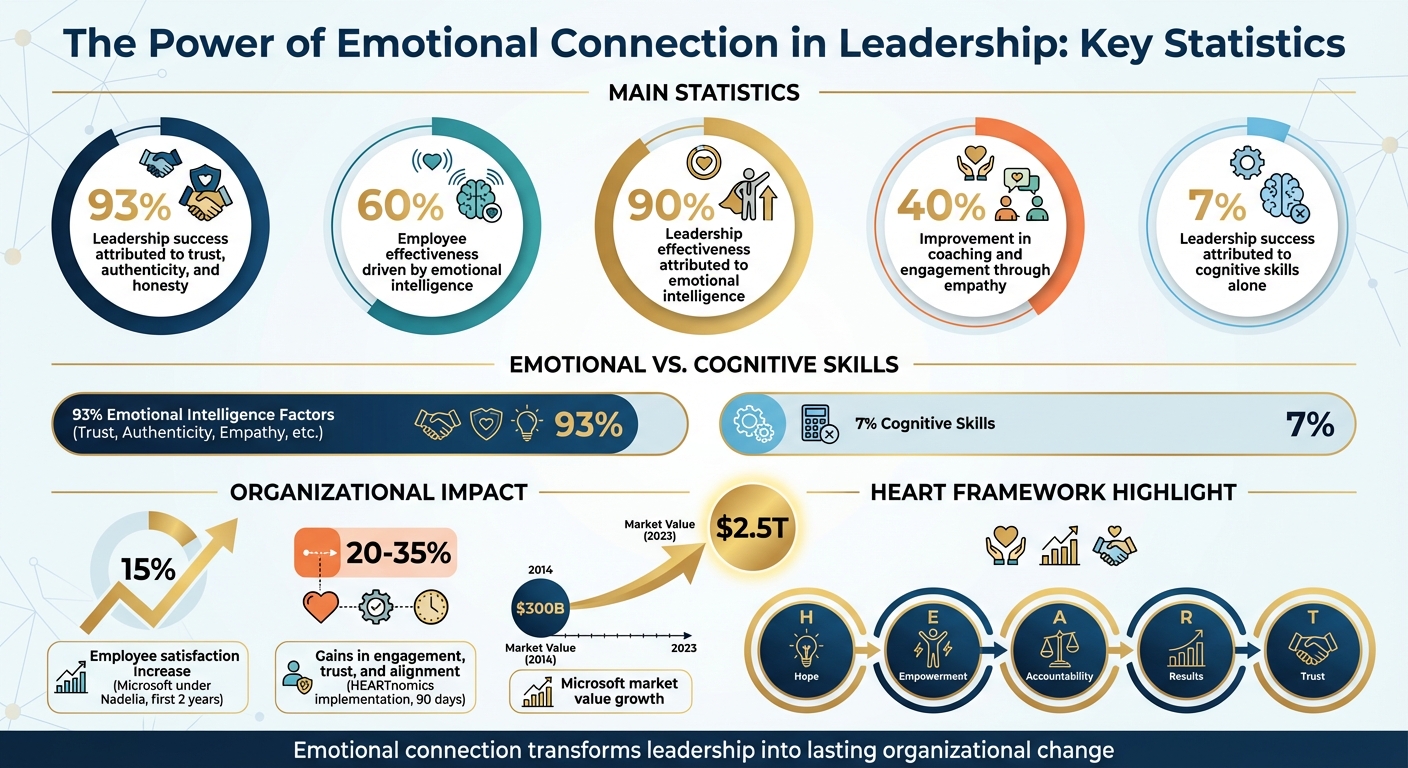
Emotional Intelligence Impact on Leadership Success: Key Statistics
1. Nelson Mandela
Empathy
Nelson Mandela understood that empathy wasn’t just about understanding others – it was a key strategy for uniting a fractured nation. He actively listened to people from all communities, paying close attention to both their words and non-verbal cues to truly understand their emotions and concerns [4]. By addressing the unique needs of different groups, Mandela showed he genuinely cared about their fears and aspirations. This approach wasn’t just kind – it was essential for fostering reconciliation and building trust across deeply divided communities [4].
Authenticity
Mandela’s honesty and integrity became the foundation of the trust he built across South Africa. Studies suggest that authenticity is a cornerstone of effective leadership, accounting for about 93% of its success [4]. Mandela himself said, “I had to leave my bitterness in prison to truly be free” [1]. By letting go of personal resentment and focusing on the greater good, he showed a deep commitment to his people. His willingness to prioritize others over his own grievances made his leadership relatable and trustworthy. This openness created a strong emotional connection with people from all walks of life [5].
Inspirational Motivation
Mandela’s vision of a "Rainbow Nation" gave South Africans a shared identity that transcended their differences [8]. By combining empathy and authenticity, he crafted a message of hope that resonated with everyone. For instance, he reassured white South Africans that democracy wouldn’t mean racial domination, inviting them to be part of the country’s transformation [8]. His leadership was about inspiring unity, not division. The Truth and Reconciliation Commission (TRC) was a clear example of this. Instead of seeking revenge for the injustices of apartheid, Mandela supported a process of truth-telling and healing, allowing both victims and perpetrators to contribute to a new South Africa [7]. This approach showed how forgiveness and accountability could coexist, proving that emotional connections and shared purpose can drive profound and lasting change.
sbb-itb-5c9cdaf
2. Oprah Winfrey
Empathy
Oprah Winfrey has built her media empire on a deep understanding of emotions – not just her own but those of millions who tune in to her work. Her approach to empathy goes beyond simply feeling for others; she actively listens and responds to the specific needs of her audience and team members [4]. This ability to connect emotionally has been a cornerstone of her leadership, enabling her to drive meaningful change. For Oprah, emotional connection isn’t just an added bonus; it’s the bedrock of her leadership style and a key driver of her transformative impact [6].
Authenticity
Oprah’s success is deeply rooted in her commitment to honesty and integrity. Studies show that these qualities are far more critical to leadership success than cognitive skills, which account for only 7% of a leader’s effectiveness [4]. Oprah embodies what researchers call "personalized care", consistently putting the needs of her audience and team above her own [4]. Her willingness to be open and vulnerable fosters what experts refer to as "emotional closeness" with her followers [4]. By leading with authenticity, she doesn’t just earn respect – she builds a foundation of unwavering loyalty.
Inspirational Motivation
Oprah’s ability to inspire lies in her talent for communicating a clear and compelling vision, a skill grounded in emotional intelligence. Emotional intelligence is responsible for at least 60% of an employee’s effectiveness, and in leadership roles, that figure jumps to an incredible 90% [4]. By helping others understand and navigate their emotions, Oprah opens doors to new possibilities and strengthens their commitment. Her ability to manage both her own emotions and those of others fosters an atmosphere of trust and collaboration [4]. Oprah’s leadership proves that emotional intelligence isn’t a soft skill – it’s a powerful driver of real, lasting transformation. Much like Mandela, her blend of empathy and authenticity serves as a model for analyzing transformational leadership at its best.
3. Satya Nadella
Empathy
In 2014, Satya Nadella’s life took a turn that profoundly influenced his leadership at Microsoft. His experience raising a son with cerebral palsy taught him the power of empathy, which he brought into the workplace. For Nadella, empathy isn’t just a personal value – it’s a tool for innovation. By understanding people’s unspoken needs, leaders can create solutions that truly make a difference.
Take the example of Seeing AI, an iOS app developed in 2017. Led by Saqib Shaikh, a blind Microsoft software engineer, this app uses artificial intelligence to narrate the world for visually impaired users. Shaikh credited the cultural shift under Nadella for giving him the confidence to turn his challenges into a source of creativity. Similarly, the Eye Control feature for Windows 10, launched the same year, enables users with ALS to control their computers using just their eyes. These breakthroughs emerged from Nadella’s push for cross-team collaboration and his belief in empathy as a cornerstone of innovation.
"Empathy makes you a better innovator" [9].
This focus on empathy helped establish a culture where trust and collaboration could thrive.
Building Trust
Nadella’s emphasis on empathy didn’t just spark innovation – it also redefined how Microsoft’s teams worked together. He shifted the company’s culture from one of internal competition to one of curiosity and collaboration. This wasn’t just a feel-good initiative; it delivered real results. Employee satisfaction improved by 15% within his first two years [9], and Microsoft’s market value skyrocketed from about $300 billion in 2014 to over $2.5 trillion by 2023 [10]. These numbers tell a story: emotional connection can fuel long-term success.
Nadella’s leadership style prioritizes listening over speaking. He creates an environment where employees feel safe to take risks and own up to mistakes. For example, Swetha Machanavajhala, a deaf engineer at Microsoft, developed the background-blurring feature for Teams to help her read lips during video calls. What started as a personal need became a feature used by millions worldwide. Nadella’s philosophy reinforces his belief:
"IQ has a place, but it’s not the only thing that’s needed in the world… if you just have IQ without EQ, it’s just a waste of IQ" [11].
4. Jacinda Ardern
Empathy
Jacinda Ardern’s leadership stood out for its focus on humanity. She once asked, "How do we remember the human experience in all of this?" [12]. This question shaped her decisions as New Zealand’s Prime Minister, especially during moments of crisis. After the Christchurch mosque shootings in March 2019, which tragically claimed 51 lives, Ardern wore a hijab to show solidarity with the Muslim community. She also refused to utter the attacker’s name, ensuring he would not gain further recognition. Her powerful statement, "They are us", struck a chord with a grieving nation [16].
Her compassion didn’t stop at words. Within just 27 days of the attack, her government passed legislation banning military-style semi-automatic weapons. The vote was nearly unanimous – 119 in favor, with only one dissenting voice [13]. Following this, a buyback program resulted in the destruction of over 50,000 prohibited firearms [15]. This swift action reflected her deeply empathetic approach to leadership.
Authenticity
Ardern’s authenticity shone through in her willingness to reject the "superwoman" image often associated with leaders. She spoke candidly about her struggles with imposter syndrome and the guilt she felt trying to balance her roles as a mother and a leader [17][18]. During the COVID-19 pandemic, she reached out to citizens through casual Facebook Live sessions, often dressed in a sweatshirt, creating a sense of shared experience with those in lockdown [13][16].
At just 37 years old, Ardern became the world’s youngest female head of government at the time [15]. She also broke barriers as the second elected leader to give birth while in office, famously bringing her baby to the UN General Assembly [14][15]. Her transparency during the pandemic, including admitting when she didn’t have all the answers, strengthened public trust [13]. Under her leadership, New Zealand reported fewer than 2,500 COVID-related deaths by early 2025, despite its population of 5 million [15]. As Ardern herself said:
"It takes courage and strength to be empathetic, and I’m very proudly an empathetic and compassionate leader" [15].
Inspirational Motivation
Ardern’s ability to inspire was rooted in her genuine connection with people and her unwavering optimism. She once stated:
"Optimism is true moral courage; it’s a state of mind that helps you to push through. It’s not naivety" [14].
Her message – "You can lead, just like me" [14] – was a direct call to others, encouraging them to see themselves as capable of leadership. Leadership experts have pointed out how her empathy fueled this transformative style of leadership [12]. By combining empathy, authenticity, and optimism, Ardern demonstrated how leaders can create meaningful emotional bonds to inspire change.
Leading with Heart: How Emotional Intelligence Transforms Leadership with Angela Payne
5. HEARTnomics | Hanna Bauer | Transformation Through Love and Excellence
HEARTnomics™ combines emotional awareness with clear strategies to build trust and achieve excellence, much like the other leadership models discussed earlier.
Empathy
HEARTnomics™ emphasizes the strategic use of empathy, helping employees feel valued and understood. This approach boosts loyalty, sparks creativity, and enhances productivity [19]. Rather than ignoring emotions, it encourages leaders to view them as critical information – paying attention to nonverbal signals to foster clarity and resilience [1].
By creating a "safe haven", leaders become emotionally available and responsive, which helps calm the team and instills a sense of security and belonging [23]. When leaders openly acknowledge emotions and shared challenges, trust and performance naturally improve [1][24]. This method, reminiscent of leaders like Mandela and Winfrey, highlights the transformative power of empathy in leadership.
Authenticity
Hanna Bauer, the creator of HEARTnomics™, built the system on two core principles: love and excellence. Love reflects passion and a heart-centered connection, while excellence ensures tasks are executed correctly to fulfill the mission [21]. Bauer sums it up perfectly:
"If both love and excellence come together, then we achieve our mission" [21].
The HEART framework embodies this philosophy through its dual meanings: Hope, Empowerment, Accountability, Results, and Trust as the pillars of transformation, and Honesty, Empathy, Accountability, Respect, and Transparency as guiding principles for daily actions [20][21]. By aligning values with actions, leaders can turn success into something more meaningful. This fusion of passion and precision underscores the importance of authentic emotional connections in leadership.
Building Trust
In the HEARTnomics™ model, trust is built through consistent and transparent behavior. Leaders are encouraged to practice relational transparency – sharing honest insights, admitting mistakes, and communicating openly [20][22]. As the framework highlights:
"Trust is the steady heartbeat that sustains leadership over time. It is built gradually, through consistent actions, honesty, and vulnerability" [20].
Organizations that adopt HEARTnomics™ have reported a 20–35% increase in alignment, engagement, and trust within just 90 days. This improvement comes from treating trust as a process, cultivated through deliberate actions, rather than as an inherent trait. While transparency might slow down tough decisions, it ultimately strengthens relationships and equips teams to handle challenges more effectively [20]. By blending emotional connection with operational discipline, HEARTnomics™ demonstrates how leadership can drive meaningful and lasting change.
Strengths and Limitations
Looking at the leadership examples discussed earlier, we can see how emotional connection strategies bring both opportunities and challenges to transformational leadership styles.
Empathy plays a huge role in successful leadership. Leaders who excel in empathy can improve coaching and engagement by 40% [4]. It allows them to understand unspoken needs and provide personalized support, which strengthens loyalty and emotional commitment [3]. However, constantly absorbing their team’s struggles and worries can lead to emotional exhaustion for the leader [2]. Striking a balance between empathy and compassion is key to staying effective without becoming overwhelmed.
Authenticity is another cornerstone of effective leadership. A staggering 93% of leadership success is tied to trust, honesty, and integrity [4]. But in more rigid workplaces, showing emotion might be seen as unprofessional, limiting a leader’s ability to fully embrace authenticity [24]. Leaders need to carefully navigate openness, building genuine connections without crossing boundaries. When done well, authenticity helps leaders inspire their teams to rally behind a shared vision.
Inspirational motivation connects personal values to the larger goals of the organization. This approach can spark innovation and encourage people to make sacrifices for collective success [3]. However, if team members lack emotional intelligence, even the most inspiring vision might not translate into stronger commitment [3]. Trust serves as the backbone for sustaining these motivational efforts.
Trust-building creates a secure and supportive environment where team members feel comfortable taking initiative and adapting to change [1]. A foundation of trust can reduce stress and increase engagement [23]. But trust is fragile – it requires ongoing reinforcement through consistent actions, honesty, and vulnerability. Even small inconsistencies or transactional behaviors can erode it quickly [20].
Conclusion
Mandela, Winfrey, Nadella, and Ardern remind us that emotional connection is at the heart of meaningful and lasting change. Their leadership highlights how empathy, trust, and honesty can drive commitment and improve performance within organizations. These qualities offer a roadmap for leaders aiming to create impactful transformations.
Studies reveal that 93% of leadership success relies on trust, authenticity, and honesty [4]. Modern leaders embrace this by treating emotions as valuable data [1]. By paying attention to physical cues, accurately naming emotions, and understanding the needs behind them, leaders can enhance performance and strengthen relationships [1].
The HEARTnomics frameworks provide practical tools for building these emotional connections. Just as Mandela and Winfrey exemplified transformational practices, HEARTnomics™ shows how emotional intelligence fuels operational success. The HEART framework (Hope, Empowerment, Accountability, Results, Trust) helps leaders address individual emotional needs [20]. The BEAT method (Believe, Engage, Act, Transform) connects emotional intelligence to measurable business outcomes [25]. Meanwhile, the CORE philosophy (Cultivate, Optimize, Reach, Elevate) emphasizes shared values, moving leadership beyond simple transactional interactions [20].
Leaders who adopt these frameworks create environments where emotional intelligence drives 60% of an employee’s overall effectiveness [4]. Organizations that implement these approaches report 20–35% gains in engagement, trust, and alignment within just 90 days. This demonstrates how blending emotional connection with strategic action can boost performance, spark innovation, and build loyalty.
When leaders align their values with measurable actions, they go beyond managing people – they transform organizations. By seeing emotions as critical information, they create workplaces where strategy and connection work hand in hand to foster growth and success [20].
FAQs
How can I build trust fast without oversharing?
Building trust quickly without sharing too much personal information requires a focus on emotional awareness. Pay attention to both physical and emotional cues, practice active listening, and ensure your behavior stays consistent over time. At work, normalizing emotions involves showing empathy and fostering a safe space where others feel understood – without diving into overly personal details. This approach reflects the HEARTnomics™ framework, which emphasizes trust, clarity, and genuine connections. These elements pave the way for stronger emotional bonds, supporting leadership and long-term growth.
How do I show empathy without burning out?
To express empathy without overwhelming yourself, it’s essential to strike a balance between emotional involvement and self-care. Center your approach on compassion – respond with kindness and understanding, but also set clear boundaries to protect your emotional well-being. Be attentive to emotional signals from others, and incorporate mindfulness techniques to help regulate and conserve your energy. These strategies enable leaders to foster trust and meaningful emotional connections while staying resilient and genuine.
How can I measure emotional intelligence results at work?
Measuring emotional intelligence (EI) in the workplace focuses on tracking behavioral shifts and their impact on organizational results. Some key signs include stronger team trust, higher levels of employee engagement, and enhanced resilience over time. Tools like 360-degree surveys are particularly useful for assessing a leader’s empathy, emotional awareness, and ability to manage relationships effectively. HEARTnomics™ takes these insights a step further by connecting them to measurable outcomes like employee retention and performance during high-pressure situations, fostering growth through principles of Love and Excellence.