Creating a feedback culture isn’t just about occasional performance reviews – it’s about integrating feedback into daily work. Why? Because regular feedback improves engagement, lowers turnover, and boosts team performance. For example, teams with weekly feedback see 3.5x higher engagement and are 85% more likely to take initiative. Yet, there’s often a gap: 50% of managers think they give weekly feedback, but only 20% of employees agree.
To close this gap, focus on these steps:
- Build trust and psychological safety: Employees share more when they feel safe.
- Encourage multi-directional feedback: Feedback should flow between all levels – managers, peers, and team members.
- Use structured systems: Tools like 360-degree feedback and models like SBI (Situation-Behavior-Impact) ensure feedback is clear and actionable.
- Act on feedback: Show employees their input matters by making visible changes and closing the loop.
When feedback becomes routine, teams are more aligned, motivated, and productive. Let’s dive into how to make this a reality.
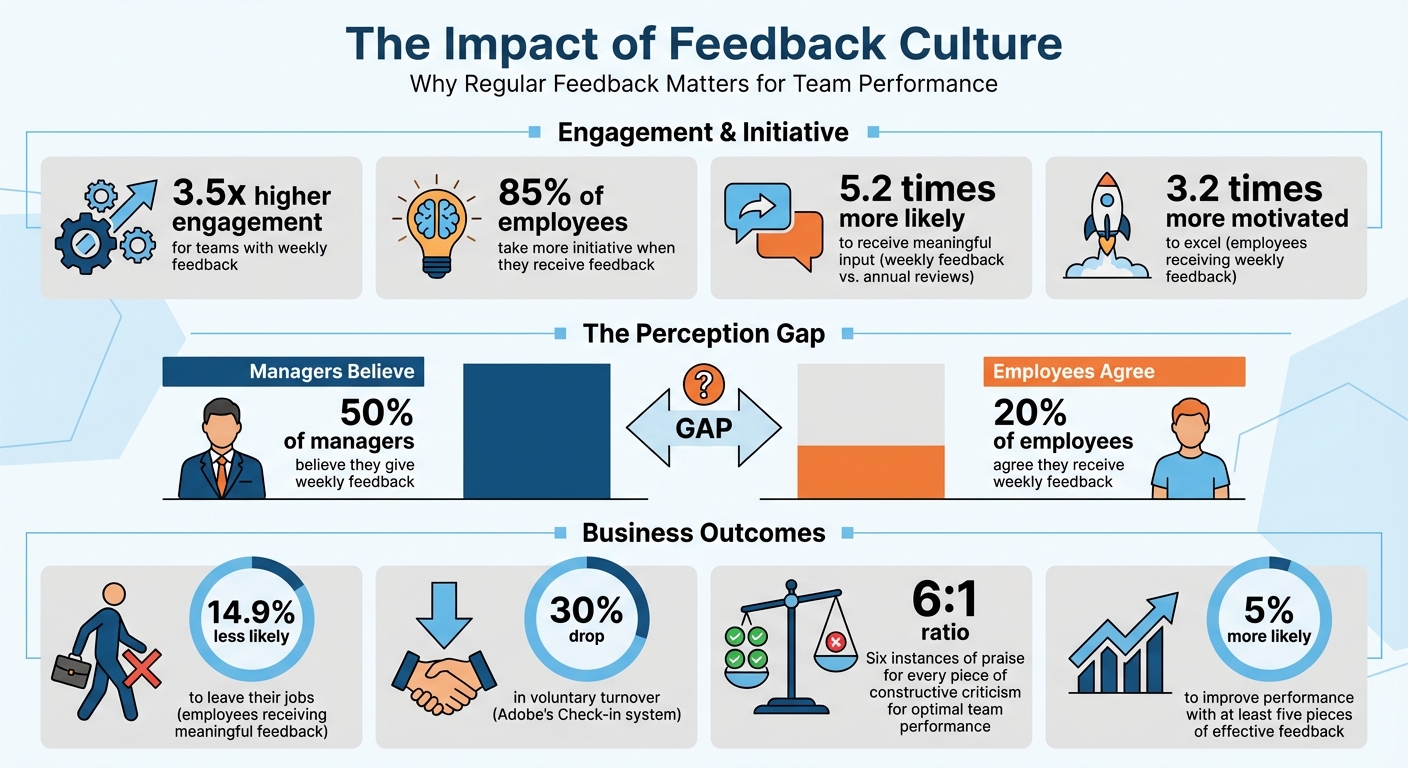
Feedback Culture Statistics: Impact on Employee Engagement and Performance
The 5 Tenets of a Culture of Feedback | #culturedrop | Galen Emanuele
sbb-itb-5c9cdaf
Step 1: Understanding the Basics of Feedback Culture
At its core, feedback culture is built on a few key principles that shape daily interactions. One of the most important is psychological safety. Dr. Amy Edmondson of Harvard Business School defines this as:
"a belief that one will not be punished or humiliated for speaking up with ideas, questions, concerns, or mistakes" [5].
When this safety is absent, the brain’s amygdala kicks into fight-or-flight mode, shutting down open communication [5][4]. Without open dialogue, innovation grinds to a halt. This is why fostering psychological and emotional safety is so crucial. Adding to this foundation is the importance of a growth mindset.
The second pillar is a growth mindset, a concept popularized by Carol Dweck in her book Mindset. She explains:
"With a growth mindset, individuals trust that their fundamental abilities can be enhanced through dedication and persistence – intelligence and talent are merely the beginning" [2].
This perspective transforms feedback from being perceived as criticism to being seen as a chance to grow. High-performing organizations embrace this by making feedback part of daily routines rather than limiting it to annual reviews. In fact, employees who receive weekly feedback are 5.2 times more likely to say they receive meaningful input and 3.2 times more motivated to excel [4].
Effective feedback also thrives on multi-directional communication – it’s not just about managers giving directives. Feedback should flow in all directions: upward from employees to managers, sideways among peers, and downward from leadership [5][1]. McKinsey & Company has formalized this with an "obligation to dissent" policy, encouraging team members to challenge ideas regardless of hierarchy [5]. This ensures that valuable insights aren’t lost due to organizational structure.
How Leaders Shape Feedback Culture
Leaders play a pivotal role in creating a feedback-friendly environment. When leaders actively seek input and demonstrate changes based on it, they send a clear message: feedback is a strength, not a weakness [5]. This involves modeling vulnerability. For example, instead of asking a vague "Do you have feedback?", leaders might ask something more specific, like, "What could I have done differently to support you on this project?" [2][3].
Practicing Radical Candor – a balance of personal care and direct challenge – can also help leaders cultivate honest conversations [4]. Separating developmental feedback from compensation discussions further encourages employees to drop their defenses and engage in meaningful dialogue [5][3].
How Feedback Drives Business Results
The impact of feedback on business outcomes is clear. Regular feedback functions like a performance GPS, helping teams adjust in real time to avoid bigger problems down the road. Research shows that teams perform best when they receive about six instances of praise for every piece of constructive criticism [2]. Moreover, 85% of employees take more initiative when they receive feedback [2], giving organizations a competitive edge through greater agility and responsiveness.
However, a disconnect exists: while 50% of managers believe they provide weekly feedback, only 20% of employees agree [3]. Bridging this gap requires more than better communication – it demands systems that make feedback as natural and consistent as breathing. With this foundation in place, leaders can build trust and establish processes that make feedback an integral part of their organization’s culture.
Step 2: Building Trust and Psychological Safety
Trust doesn’t happen overnight – it’s earned through consistent actions and meaningful feedback. Adobe made waves when it replaced annual performance reviews with ongoing "Check-ins." This shift created room for conversations focused on growth, detached from compensation discussions, and led to a 30% drop in voluntary turnover [5]. When employees know their input won’t directly impact their paycheck, they feel safer sharing honest thoughts. This trust sets the stage for leaders to lead by example.
Leaders play a crucial role here. By actively seeking feedback and responding with grace – even when the feedback stings – they show that input is valued. Adjusting their behavior based on this feedback sends a strong message: listening and acting on feedback matters.
Creating Open Communication Channels
Once trust is established, open communication channels can empower teams even further. The key is tailoring these channels to fit the situation. For example, anonymous surveys are great when trust is still building or when tackling sensitive issues like leadership performance or workplace dynamics [5]. On the other hand, structured sessions like Reverse 1-on-1s – monthly 30-minute meetings where employees give feedback to their managers – help shift the traditional power dynamic and normalize upward feedback [1].
Another approach is fostering an "obligation to dissent", where team members are encouraged – and expected – to voice disagreements, regardless of hierarchy [5]. Regular practices like "Feedback Fridays" can also make reflection and peer input a natural part of the team’s rhythm [5].
Handling Resistance to Feedback
Resistance to feedback isn’t just a personality trait; it’s often a biological response. Corrective feedback can trigger the brain’s amygdala, leading to a fight-or-flight reaction – think sweating, a racing heart, or defensive thoughts [4]. This is why creating psychological safety is so important. Without it, the brain focuses on self-preservation instead of growth. Leaders who understand this can approach feedback with greater empathy.
One way to ease resistance is by rebranding how feedback is framed. Swap terms like "criticism" or "corrective action" for words like "insights" or "opportunities" [2]. Using objective tools like the SBI (Situation-Behavior-Impact) model helps keep feedback fact-based and avoids personal judgments [5]. Training teams to see feedback as a gift – a single perspective offering valuable insights rather than a definitive judgment – can gradually reduce defensiveness. Over time, this mindset fosters a culture where continuous improvement becomes second nature [4].
Step 3: Setting Up Clear Feedback Processes
Creating structured feedback systems ensures that feedback is consistent, meaningful, and actionable. This builds on the feedback culture established earlier, preventing it from feeling arbitrary or sporadic. The aim is to shift from occasional conversations to a reliable rhythm that everyone understands and values. The next step is choosing methods that align with your feedback objectives.
Selecting Effective Feedback Methods
Different situations call for different feedback approaches. For example, the SBI model (Situation-Behavior-Impact) is ideal for addressing specific actions in an objective way. You describe the situation, highlight the visible behavior, and explain its impact on the team or project [7][5].
For simpler adjustments, the Stop-Keep-Start method works well. It focuses on identifying one behavior to stop, one to continue, and one to start. This approach delivers clear, actionable suggestions [7][1].
The BEAT framework (Believe, Engage, Act, Transform) is particularly useful for long-term growth. Leaders inspire team members to believe in their potential, engage them in open discussions about strengths and areas for improvement, and guide them toward specific actions that lead to meaningful change.
Using Feedback Tools and Systems
Feedback tools and systems help turn good intentions into consistent practices. One effective method is 360-degree feedback, where input comes from managers, peers, and direct reports. This multi-directional feedback provides a broader perspective, reduces blind spots, and encourages accountability [8][5].
Technology also plays a key role in streamlining feedback processes. Platforms like Synergita and Teamflect automate reminders, track action plans, and integrate feedback into everyday tools like Microsoft Teams or Slack [8][3]. These tools make it easier to embed feedback into daily workflows.
Regular 1-on-1 check-ins – short meetings held weekly or bi-weekly – help keep feedback timely and relevant. These 15–30 minute conversations prevent small issues from escalating and ensure continuous improvement [8][6]. Research shows that employees who receive weekly feedback are 5.2 times more likely to find it meaningful compared to those who only get annual reviews [4]. Companies like Google have successfully integrated performance feedback into regular team meetings, making it feel natural and effective rather than forced.
Step 4: Taking Action on Feedback
Once you’ve set up a structured feedback process, the real challenge begins – turning that feedback into meaningful actions. It’s not enough to just listen; the key is to create visible, measurable changes that show your team their input matters.
Converting Feedback Into Action Plans
The first step? Take a moment to reflect before diving into solutions. Leaders who thoughtfully process feedback instead of reacting on impulse are more likely to implement changes that feel sincere and impactful [9]. While quick fixes might address surface-level issues, deeper challenges often need gradual, well-communicated adjustments.
To get to the heart of the matter, use tools like the "5 Whys" technique to uncover the root cause [10]. For example, if your team complains about unproductive meetings, ask why. Maybe agendas aren’t clear. Why? Perhaps priorities aren’t communicated in advance. Keep digging until you identify the core issue that needs attention.
Once you’ve pinpointed the problem, involve your team in crafting solutions. This builds accountability and trust – key components of the HEART framework (Hope, Empowerment, Accountability, Results, Trust). Use open-ended questions like, “What changes would make the biggest impact?” to ensure everyone feels heard.
Effective action plans should highlight what’s working, identify areas for improvement, and set clear, measurable goals [6]. Tie these plans to team or business objectives so they feel purposeful, not just performative [6][8]. And don’t forget to explain your reasoning when rolling out changes. Sharing the "why" and "how" behind your decisions helps align expectations and demonstrates authenticity [9]. Studies even show that employees are 5% more likely to improve performance when they receive at least five pieces of effective feedback compared to none [11].
Finally, once your action plan is in motion, recognize the contributions that made it possible. This reinforces a culture of continuous improvement.
Acknowledging Feedback Contributions
Acknowledging your team’s input is just as important as acting on it. When people see their feedback driving real change, they’re more likely to share ideas in the future. Even a simple public acknowledgment – like mentioning in a meeting how a suggestion improved project workflows – can encourage ongoing participation.
You might also consider creating a "Feedback Champions" program to spotlight team members who provide actionable insights. This makes feedback feel like a valued contribution rather than a risky criticism.
Another critical step is to close the loop. Follow a four-step process: acknowledge the feedback, evaluate how it aligns with goals, take action, and communicate the outcomes [8]. For instance, you could send a message like, “Thanks to your feedback about unclear timelines, we’ve updated our project tracker so all deadlines are now visible in one place.” Transparency like this builds trust and shows your team you’re serious about improvement.
"Taking the time to express gratitude can go a long way toward convincing their employees that the request for change will be acted on with earnestness." – Danbee Chon and Francis J. Flynn [9]
To keep the momentum going, try scheduling monthly retrospectives or designating “Feedback Fridays” for the team to reflect on progress and celebrate wins. Recognizing even small improvements and being open about ongoing efforts helps sustain a feedback-driven culture built on trust.
Conclusion: Maintaining a Feedback-Driven Culture
Creating a culture of feedback takes dedication and consistency. When leaders openly seek input on their own decisions and share their development goals, they set an example that feedback is a strength, not a vulnerability. This transparency helps build the psychological safety necessary for open, honest conversations.
Research shows that employees who receive meaningful feedback are 14.9% less likely to leave their jobs, and 85% of employees show greater initiative when they receive regular feedback [2]. Yet, there’s often a disconnect: while half of managers believe they provide weekly feedback, only 20% of employees agree [3]. To address this gap, it’s crucial to move beyond annual reviews and implement regular feedback opportunities – such as weekly one-on-one meetings, monthly reverse one-on-ones (where employees share their needs with leaders), and project-specific retrospectives. These consistent touchpoints ensure feedback becomes a natural part of the workplace routine.
The HEARTnomics™ framework emphasizes two key principles: Love, which prioritizes care and psychological safety, and Excellence, which focuses on continuous improvement and closing the loop. By balancing praise with constructive feedback, leaders can build trust and set the stage for sustainable growth [2].
Refining feedback practices is an ongoing process. Equip teams with tools like the OIO or GROW models to improve empathy, active listening, and non-defensive communication. Recognize individuals who consistently provide thoughtful input or handle challenging feedback with a growth mindset. Making feedback a daily habit fosters a culture where improvement is constant and everyone feels empowered to contribute.
When feedback becomes second nature, trust grows, people feel safe to share their thoughts, and performance flourishes. By embedding structured feedback into daily interactions, leaders can cultivate a high-performing environment grounded in both care and excellence. This balance is the cornerstone of a thriving, feedback-driven culture.
FAQs
How can I tell if my team feels psychologically safe giving feedback?
Psychological safety exists when team members feel comfortable sharing ideas, concerns, and suggestions without worrying about backlash or negative outcomes. You’ll notice it in teams where people actively exchange feedback, voice their opinions freely, and engage constructively when receiving input.
To create this kind of environment, make feedback a regular part of everyday work. Encourage open communication and trust by providing consistent training. Focus on principles like trust, empowerment, and accountability to build a feedback culture that lasts.
What’s the best way to ask for upward feedback without making it awkward?
To seek upward feedback without creating unease, it’s important to approach the conversation with openness and an emphasis on self-improvement. Present your request as an opportunity to enhance team collaboration and refine your own contributions. Use considerate, open-ended questions that encourage honest input, maintain a respectful and approachable tone, and aim for a balance between honesty and professionalism. This approach helps build trust and fosters a productive exchange, making upward feedback feel like a natural step in strengthening the team and organization.
How do we turn feedback into visible changes and close the loop?
To make feedback result in tangible improvements, it’s essential to connect it to specific actions. Start by setting clear, actionable goals, assigning responsibilities to the right people, and keeping track of progress over time. Regularly revisit feedback, share updates on what has been done, and acknowledge any positive changes or advancements. Incorporating these steps into everyday workflows helps build trust, encourages accountability, and promotes ongoing growth.