Want to develop leadership strengths effectively? Here’s a quick guide to seven tools that help leaders focus on their natural talents instead of trying to fix every weakness. These tools provide actionable insights into behaviors, communication styles, and team dynamics, driving better leadership outcomes. Many organizations pair these assessments with leadership development strategies to ensure insights translate into lasting behavioral change.
Key Takeaways:
- CliftonStrengths: Identifies 34 talent themes; great for team collaboration and individual growth.
- Leadership Practices Inventory (LPI): Focuses on observable leadership behaviors across five practices.
- Leadership Circle Profile (LCP): Explores motivations and behaviors through 360-degree feedback.
- Hogan Leadership Forecast Series: Examines personality traits, stress responses, and motivations.
- StandOut Assessment: Highlights two primary "Strength Roles" for workplace impact.
- VIA Character Strengths Survey: Pinpoints character-based strengths tied to six core virtues.
- Zenger Folkman 360-Degree Strength Assessment: Compares leaders to top performers globally, focusing on strengths.
Quick Comparison:
| Tool | Focus | 360-Degree Feedback | Time to Complete | Cost |
|---|---|---|---|---|
| CliftonStrengths | Personal talents and leadership | No | ~60 minutes | $24.99–$89.99 |
| Leadership Practices Inventory | Leadership behaviors | Yes | 10–20 minutes | Contact vendor |
| Leadership Circle Profile | Leadership styles and motivations | Yes | Not specified | Contact vendor |
| Hogan Leadership Forecast | Personality and stress behaviors | Yes | Not specified | Contact vendor |
| StandOut Assessment | Two main "Strength Roles" | No | Not specified | Contact vendor |
| VIA Character Strengths Survey | Character-based strengths | No | 12 minutes | Free (basic version) |
| Zenger Folkman Assessment | Leadership strengths | Yes | ~8 minutes (short) | Contact vendor |
Each tool offers unique benefits depending on your goals, whether you’re looking for quick self-assessments or in-depth 360-degree feedback. The right tool depends on your specific needs and priorities, such as using the HEART Leadership Code™ to align values with performance.
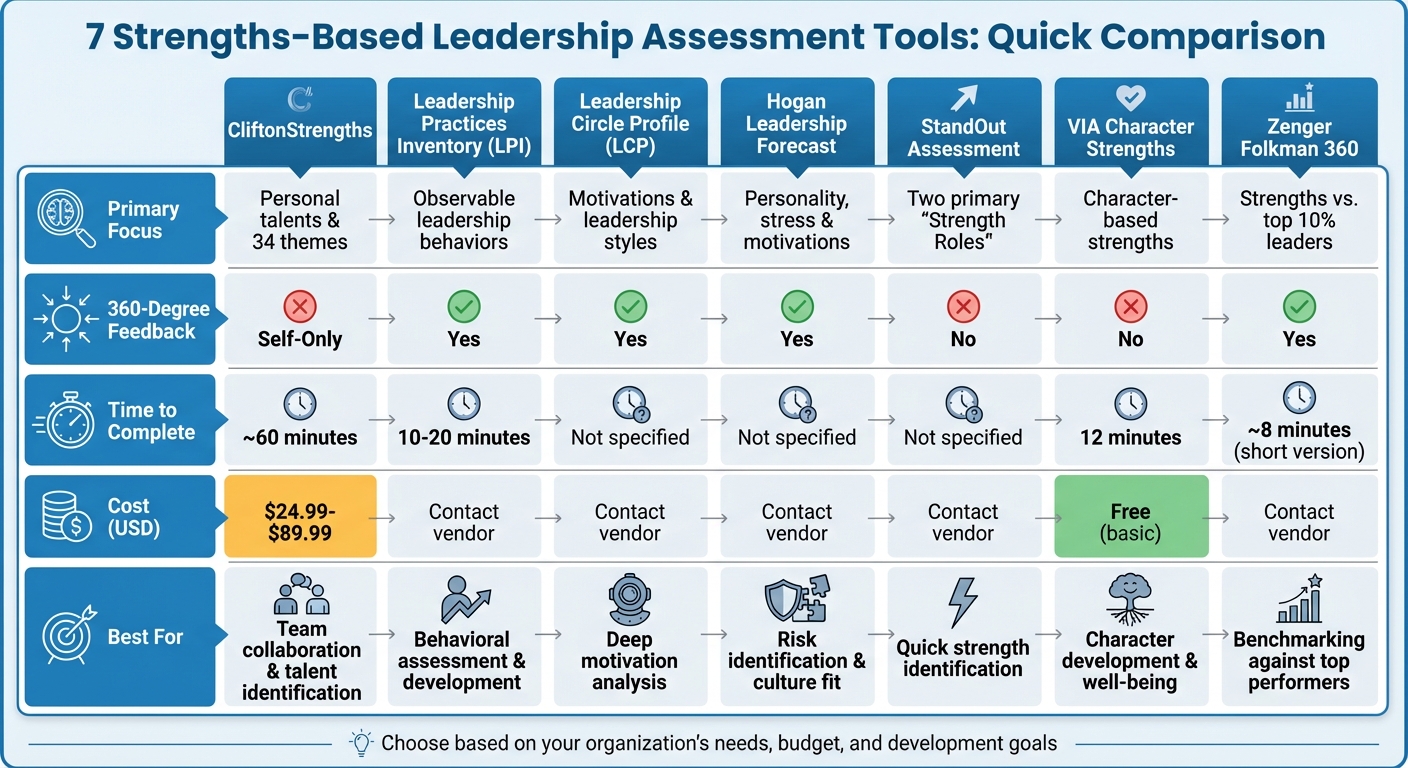
Strengths-Based Leadership Assessment Tools Comparison Chart
Using STRENGTHS-BASED leadership to be the best YOU w/ Mike Vincent
1. CliftonStrengths (StrengthsFinder)
CliftonStrengths is one of the most widely used tools for identifying personal and leadership strengths [7]. Developed by Gallup after decades of research, this assessment categorizes strengths into 34 talent themes, grouped into four leadership domains: Strategic Thinking, Relationship Building, Influencing, and Executing [4].
The assessment works by asking participants to choose between paired statements that reflect their natural tendencies. The "CliftonStrengths for Leaders" report goes beyond identifying strengths – it also explains how your top themes influence your leadership style and effectiveness [4].
"I appreciate the directness of this report … for me, it’s the appropriate tone to set when talking to a leader" [4].
Emphasis on Leadership Strengths
Gallup’s approach challenges the idea of a universal set of strengths by focusing on what makes each individual unique. The assessment highlights your dominant themes and offers practical guidance on applying them effectively [4]. Interestingly, the odds of two people having the same top five themes in the same order are extremely rare [9]. Leadership-specific reports include actionable strategies and reflection prompts, helping leaders maximize their impact. Additional tools also support understanding team dynamics, making it a resource not just for individuals but for entire teams. For organizations seeking tailored implementation, Heartnomics Consulting provides expert guidance on integrating these insights into leadership development programs.
360-Degree Feedback Options
While CliftonStrengths is primarily a self-assessment tool [6], managers can use Gallup Access to review individual reports and explore team dynamics through features like "Team Grids" [8].
Time Commitment
The assessment typically takes between 30 and 60 minutes to complete [6].
Pricing (USD)
| Package | Price | What’s Included |
|---|---|---|
| CliftonStrengths Top 5 | $24.99 | A basic overview of your top five themes [9] |
| CliftonStrengths for Leaders | $49.99 | Assessment plus leader-specific insights [4] |
| CliftonStrengths 34 | $59.99 | Full ranking of all 34 themes [9] |
| Leaders + Full 34 Bundle | $89.99 | Complete leadership profile with all features included [4] |
2. Leadership Practices Inventory (LPI)
The Leadership Practices Inventory (LPI), developed by James Kouzes and Barry Posner in 1988, evaluates leadership through the lens of the Five Practices of Exemplary Leadership®: Model the Way, Inspire a Shared Vision, Challenge the Process, Enable Others to Act, and Encourage the Heart [1][10]. Unlike personality-focused tools, the LPI zeroes in on observable behaviors, offering a practical approach to understanding leadership [1].
The assessment measures 30 specific behaviors – six for each practice – on a 10-point frequency scale. Its credibility is backed by four decades of research, over 750 studies, and input from 8 million users [10][11]. Studies show that leaders who consistently apply these practices see team engagement levels that are 25% to 50% higher than those who don’t [10].
360-Degree Feedback Option
The LPI is available as a 360-degree tool (LPI 360), which compares a leader’s self-assessment with feedback from 8–10 observers. For those seeking a simpler option, a self-assessment (LPI Self) is also offered [10][12][13]. To track progress effectively, organizations are encouraged to conduct a follow-up LPI 360 within 18 months of the initial assessment [10].
Time Commitment
Completing the LPI questionnaire typically takes just 10–20 minutes, making it a quick yet impactful tool for leadership evaluation [11].
Pricing Details (USD)
Pricing varies depending on the distributor. For current rates, you can reach out to authorized providers like Wiley & Sons or The Leadership Challenge [11]. With its focus on actionable leadership behaviors, the LPI serves as a vital tool in any comprehensive strengths-based evaluation strategy.
3. Leadership Circle Profile (LCP)
The Leadership Circle Profile (LCP) is a 360-degree assessment tool designed to delve into both a leader’s internal motivations and external behaviors. It doesn’t just show what leaders do – it uncovers why they do it.
Understanding Leadership Strengths
At the heart of the LCP is the Universal Model of Leadership, which categorizes leadership styles into two key areas: reactive and creative. This framework helps leaders understand how their approach aligns with their goals and offers actionable insights for improvement. By pinpointing both strengths and areas for growth, leaders can create personalized, data-informed development plans. Combined with multi-rater feedback, this offers a well-rounded view of their leadership effectiveness.
Comprehensive 360-Degree Feedback
The LCP uses a multi-rater feedback system to collect input from peers, managers, and direct reports, offering a balanced perspective on a leader’s performance and reputation. This feedback not only highlights current strengths but also identifies specific areas for improvement. Beyond individual assessments, the tool is part of a larger Leadership System that evaluates team effectiveness and leadership dynamics across entire organizations.
Pricing (USD)
For pricing details and volume discounts, reach out to authorized Leadership Circle distributors directly.
4. Hogan Leadership Forecast Series
The Hogan Leadership Forecast Series (LFS) dives into leadership potential by examining everyday strengths, stress-induced behaviors, and core motivations. This comprehensive suite includes three key tools: the Hogan Personality Inventory (HPI), Hogan Development Survey (HDS), and Motives, Values, Preferences Inventory (MVPI). Together, they help build what Hogan refers to as "strategic self-awareness", a concept that resonates with the latest approaches to leadership evaluation.
Focus on Leadership Strengths
The LFS takes a balanced look at leadership by identifying both strengths and potential challenges. The HPI focuses on the strengths and behaviors leaders demonstrate in typical situations. The HDS, on the other hand, uncovers potential "derailers" – those unproductive behaviors that may emerge under stress, pressure, or even boredom. Finally, the MVPI provides insights into what drives a leader and the type of organizational culture they are likely to foster. Hogan Assessments proudly notes that these tools were "the first to scientifically measure personality for business", with over three decades of validated research backing their effectiveness [14].
360-Degree Feedback Availability
Although the Leadership Forecast Series itself centers on personality assessments, Hogan also offers the Hogan 360, a separate multirater feedback tool. This tool captures a leader’s reputation through the eyes of colleagues, direct reports, and managers, providing a bridge between internal self-assessments and external perceptions [14]. To ensure meaningful insights, organizations often work with certified consultants who interpret the results and design personalized development plans [15].
Time Required for Completion
Completing the series involves taking three separate assessments, which can demand a significant time commitment [15][16]. To make the process more manageable, many organizations split the assessments across multiple sessions. This thorough approach sets the Hogan suite apart in the realm of leadership evaluation tools, offering a more in-depth perspective than simpler personality tests.
Pricing (USD)
Pricing details for the Hogan Leadership Forecast Series aren’t publicly available. Interested organizations need to consult directly with Hogan Assessments or an authorized partner to discuss costs. It’s worth noting that this suite is described as a "significant investment", reflecting the depth of insights it provides compared to less comprehensive tools [15].
sbb-itb-5c9cdaf
5. StandOut Assessment
The StandOut Assessment, created by Marcus Buckingham and ADP, takes a unique approach to evaluating leadership. Instead of focusing on broad personality traits, it zeroes in on "Strength Roles" – distinct behavioral patterns that highlight how leaders create value in their roles.
Emphasis on Leadership Strengths
This assessment identifies two primary Strength Roles – out of a total of nine – that define a leader’s unique approach and provide actionable strategies for improving their professional impact. These roles highlight the consistent ways in which leaders contribute most effectively in the workplace. By focusing on these specific strengths, the StandOut Assessment offers leaders practical insights to enhance their influence and performance.
Pricing (USD)
The exact cost of the StandOut Assessment isn’t publicly available. Organizations interested in using the tool should reach out directly to the provider for a customized quote. Pricing typically varies based on factors such as the number of participants, organizational needs, and any additional services bundled with the assessment.
6. VIA Character Strengths Survey
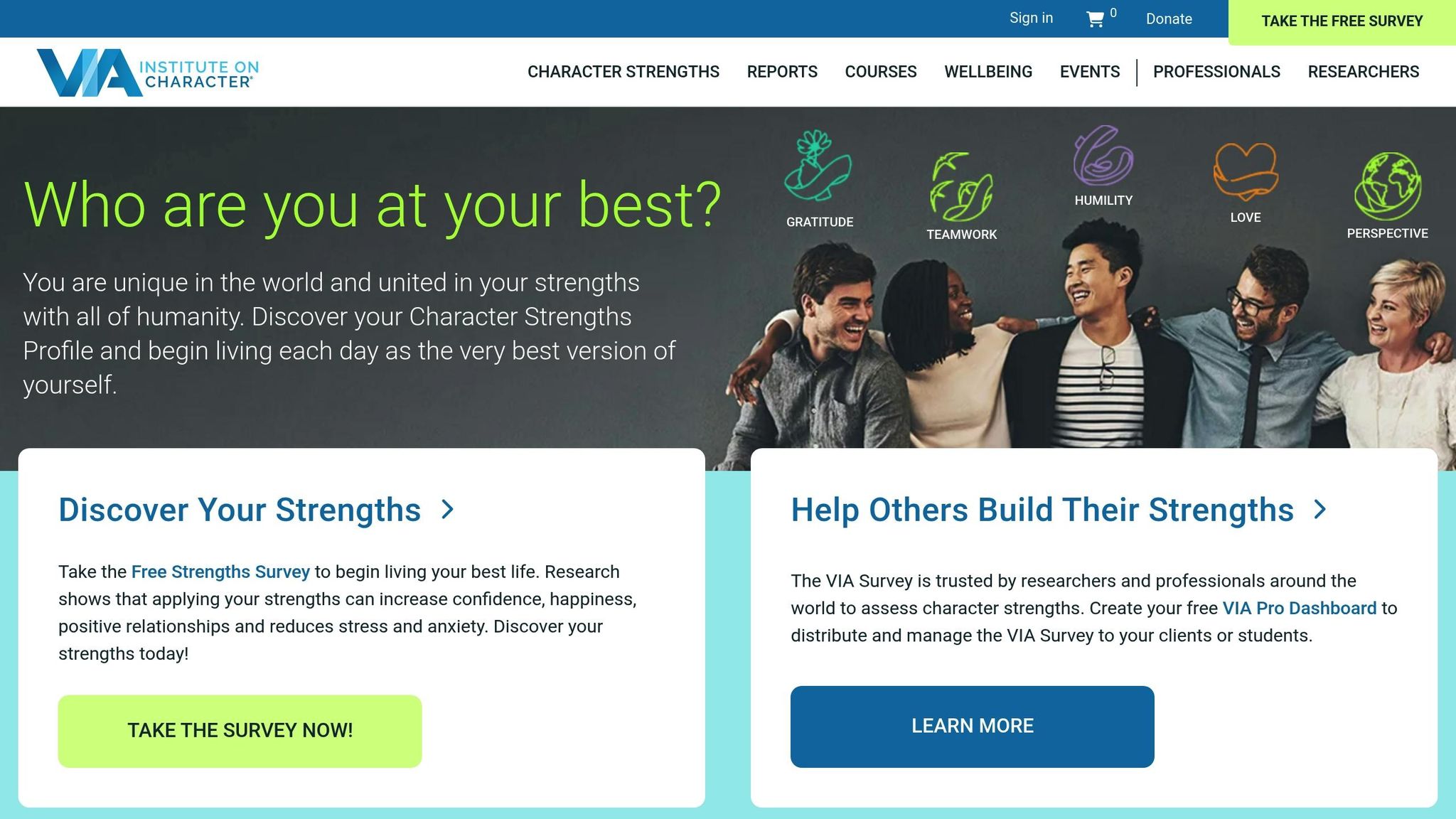
The VIA Character Strengths Survey takes a unique approach by focusing on personal character and virtues rather than leadership development programs. Created by the VIA Institute on Character, it highlights 24 universal character strengths grouped into six core virtues: Wisdom, Courage, Humanity, Justice, Temperance, and Transcendence [17].
Leadership and Signature Strengths
This survey pinpoints "signature strengths", which are key qualities that define a leader’s identity. It also uses the "golden mean" framework to assess how effectively these strengths are being used – whether they are underutilized or overextended [17][1]. This helps leaders better understand their natural talents and focus on strengths that enhance well-being, rather than fixating on areas where they might not excel [18]. By emphasizing core virtues, the VIA Survey sets itself apart from more conventional business assessments.
External Feedback Options
While the main VIA Survey is a self-assessment, the VIA Institute also offers the Partners Strengths Questionnaire, which provides 360-degree feedback from others [17].
Quick and Accessible
The survey takes just 12 minutes to complete [18], making it a practical option for busy professionals and teams. Interestingly, 90% of participants report feeling eager to apply what they’ve learned from their results [18].
Cost and Availability
The VIA Character Strengths Survey is available for free. Individuals can access the basic survey at no cost, and organizations can set up a free VIA Pro Dashboard to distribute and manage the assessment for employees, clients, or students [17][18]. For those looking for more in-depth insights, the VIA Institute offers optional personalized reports and courses for an additional fee [18].
7. Zenger Folkman 360-Degree Strength Assessment
The Zenger Folkman Strength Assessment takes a unique approach to 360-degree evaluations by emphasizing leadership strengths rather than solely addressing weaknesses. Their research highlights that exceptional leaders achieve success by capitalizing on a few core strengths. As Zenger Folkman puts it:
"Our ground‐breaking leadership research has proven that great leaders are defined by having a few profound strengths rather than an absence of weaknesses" [2].
This mindset shifts the focus from trying to fix every flaw to honing the abilities that set top leaders apart [2].
Emphasizing Leadership Strengths
This assessment evaluates 19 specific leadership skills that statistically separate the top 10% of leaders from the rest. With a database of over 1.5 million assessments worldwide, the results provide a clear picture of a leader’s standout qualities and highlight areas that may need attention [2]. This aligns with the broader goal of leveraging individual strengths to achieve organizational success. This is a core focus of Heartnomics training programs.
Comprehensive 360-Degree Feedback
Leaders receive feedback from managers, peers, and direct reports through a secure platform. Additionally, the tool includes an Employee Engagement and Commitment Index, which directly connects a leader’s effectiveness to their team’s motivation and satisfaction. Organizations can also collaborate with Zenger Folkman to design custom 360-degree assessments tailored to their unique values and strategies, using rigorously validated questions [2].
Efficiency for Busy Leaders
For leaders short on time, there’s an 8-minute version of the assessment that still delivers actionable insights. This makes it one of the quickest and most efficient 360-degree tools on the market [2].
Pricing (USD)
The 8-minute version serves as a streamlined entry point, but pricing for the full 360-degree assessment requires consultation with Zenger Folkman’s team. Recognized as one of the "Top HR Assessment Services Providers" in 2023 by Manage HR, the tool has also earned awards from organizations like TrainingIndustry.com, the Association for Talent Development (ATD), Leadership Excellence, CLO, and ISA [2].
Tool Comparison Table
Choosing the right leadership tool depends on your organization’s specific needs, budget, and timeline. Here’s a breakdown of some popular tools, highlighting their best use cases, costs, estimated completion times, and whether they offer 360-degree feedback.
| Tool | Best Use Case | Pricing (USD) | Completion Time | 360-Degree Feedback |
|---|---|---|---|---|
| CliftonStrengths (StrengthsFinder) | Uncovering natural talents, enhancing team collaboration, and promoting a strengths-focused culture [1][5][3] | Coaching Starter Kit: $495.00; Team Activities Guide: $99.99; Manager Resource Guide: $20.00 [5] | ~60 minutes [3] | No (self-report only) |
| Leadership Practices Inventory (LPI) | Evaluating leadership behaviors against "The Five Practices of Exemplary Leadership" to address behavioral gaps [1] | Contact vendor for pricing | 10–20 minutes [11] | Yes |
| Leadership Circle Profile (LCP) | Exploring "Creative Competencies" and "Reactive Tendencies" for a deeper understanding of leadership styles [15][19] | Contact vendor for pricing | Not specified | Yes |
| Hogan Leadership Forecast Series | Gaining strategic self-awareness, identifying personality-based risks, and aligning with organizational culture [14] | Contact vendor for pricing | Not specified | Yes (via Hogan 360) [14] |
| StandOut Assessment | Quickly identifying key strengths and optimizing team roles | Contact vendor for pricing | Not specified | No (self-report only) |
| VIA Character Strengths Survey | Recognizing character-based strengths and understanding potential overuse of certain traits [1] | Free online version available | 12 minutes [18] | No (self-report only) |
| Zenger Folkman 360-Degree Strength Assessment | Comparing leaders to the top 90th percentile globally and focusing on developing a few core strengths [2] | Contact vendor for pricing | 8 minutes (abbreviated version) [2] | Yes [2] |
This table offers a clear snapshot of each tool, helping you make an informed choice tailored to your leadership development goals.
Conclusion
When it comes to leadership assessments, the key is to select tools that align with your leadership goals and the specific features you need. Self-assessments are great for uncovering personal strengths, while 360-degree feedback offers a broader perspective by capturing how others perceive you – something self-evaluation alone can’t achieve.
After narrowing down your options, it’s crucial to ensure the tools you choose are scientifically validated. Look for assessments supported by solid psychometric research. As Kirsty Gardiner, Ph.D., Research Director at Ardent, emphasizes:
"Leadership assessment outcomes are useless unless they are meaningfully integrated into existing frameworks of leadership best practice" [1].
But don’t stop at the assessment results. Use them as a springboard to create actionable development plans. Set clear goals, establish timelines, and track progress regularly. For a more comprehensive understanding, consider blending multiple assessments – pairing tools like personality inventories with 360-degree feedback often reveals deeper insights than relying on just one [1].
Whether your goal is to identify emerging leaders, enhance team collaboration, or align leadership styles with organizational objectives, the best tool will depend on your unique context and challenges. Take time to weigh your priorities, budget, and desired outcomes. And remember, assessments work best when integrated into ongoing leadership development initiatives, driving long-term impact for your organization. For tailored support, explore leadership consulting services to implement these tools effectively.
FAQs
How can I select the best strengths-based leadership tool for my goals?
Selecting a strengths-based leadership tool begins with understanding what you want to achieve. Are you aiming to uncover individual strengths quickly, dive deep into leadership themes, or get a full 360-degree view of how a leader’s strengths influence their team? Self-assessment tools work well for personal insight, while 360-degree feedback offers a broader perspective by including input from peers, managers, and direct reports.
Next, think about the tool’s reliability and depth. Opt for assessments that are backed by solid research and provide results you can act on. Some tools offer simple summaries, while others deliver detailed analytics and insights tailored for teams. It’s also important to weigh the cost and scalability – whether a one-time purchase or a subscription model fits better with your budget and organizational goals.
Lastly, align the tool with your organization’s culture and long-term vision. For example, HEARTnomics™ provides a system that combines emotional intelligence with leadership excellence, helping to weave strengths into everyday practices. Matching your goals with the right tool can lead to stronger teams, better leadership dynamics, and lasting growth.
What are the advantages of using 360-degree feedback for leadership evaluations?
360-degree feedback offers a well-rounded perspective on a leader’s performance by gathering input from various sources – managers, peers, direct reports, and sometimes even customers. By relying on multiple viewpoints, this approach provides a broader and more reliable assessment compared to feedback from a single source. It helps leaders identify blind spots they might not notice on their own.
The feedback is designed to be practical, giving leaders a clear picture of their strengths and areas they need to work on. Detailed, personalized reports highlight specific opportunities for growth, making it easier to set measurable goals and track progress over time. Comparing these results to industry benchmarks or internal standards adds valuable context, helping leaders focus on meaningful improvement.
On a larger scale, 360-degree feedback contributes to building a team environment rooted in trust and accountability. By showing leaders how their behavior affects others, it encourages stronger collaboration and more thoughtful decision-making. This ripple effect can significantly enhance overall organizational performance.
How can strengths-based assessments enhance team collaboration and dynamics?
Strengths-based assessments can play a big role in improving how teams work together. By helping both individuals and leaders pinpoint their unique talents, these assessments pave the way for better collaboration. When team members recognize their own strengths and see how they complement one another, it builds trust, cuts down on conflicts, and boosts overall productivity.
Tools like 360-degree feedback and team strength grids offer valuable insights into both individual and group abilities. When leaders align tasks with each team member’s strengths, they can create a more engaged and efficient team. HEARTnomics™ takes this idea further by turning strengths data into practical strategies. Using its proprietary HEART framework, it helps teams strengthen trust, accountability, and long-term collaboration.